
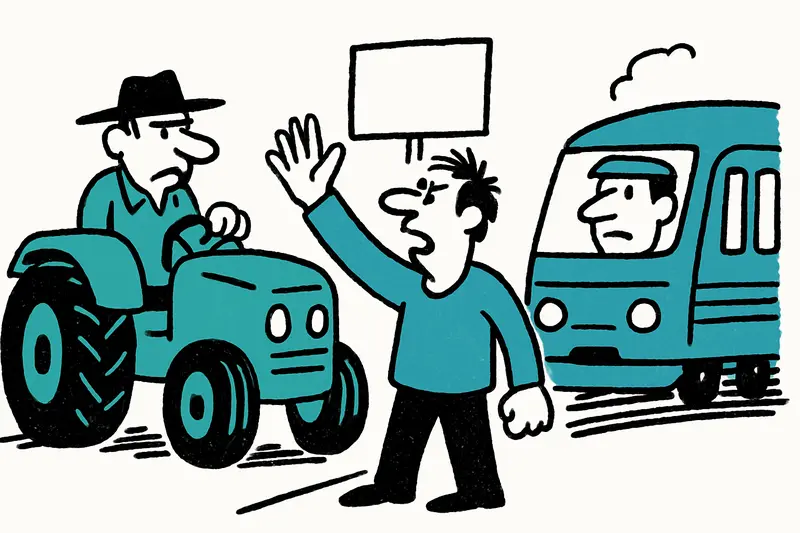
Tractors on the Plaza Major, concerned farmers and conservationists — the planned extension of the rail line to Port d'Alcúdia has sparked a fundamental debate in Sa Pobla: how much space should transport really take on Mallorca?
Tractors in formation: Sa Pobla asks questions before the diggers arrive
In the early morning there was the smell of diesel and freshly brewed café con leche, and a wind swept across the Plaza Major, making the edges of the information leaflets flutter. Several tractors stood shoulder to shoulder, the drivers with dusty boots and weathered hands — an image that says more than many protest signs. The key question hanging over Sa Pobla yesterday: does mobility really have to take the island's last good soils?
What's at stake
The idea of extending the rail line from Sa Pobla to Port d'Alcúdia and linking Palma in the south to Llucmajor sounds reasonable on paper: better connections, fewer cars, more progress towards climate goals. But conversations on the plaza revealed many details rarely mentioned in official presentations: new tracks cutting across centuries-old plots; soil sealing on fertile clay soils; possible impacts on groundwater from altered drainage. And not to forget: the proximity to s'Albufera and the Alcúdia wetlands, the region's sensitive, living filters.
An alliance of farmers, residents and conservationists
At first glance an unusual trio. On closer inspection: logical. The farmer in an apron points to divided fields that would become impractical after a route is built. The older resident speaks of altered wind paths from a raised gravel embankment that in summer would carry more dust into the streets. Conservationists, meanwhile, see risks to migratory birds, amphibians and the delicate water regime. Together they demand more transparency and fewer pre-commitments. It was not about a radical no to public transport — many said: "We want a train, but not at the price of our soils."
What is often overlooked
The same buzzwords often appear in debates: land sealing, noise, compensation. Less frequently discussed are the smaller but lasting effects: the fragmentation of plots that disrupts the mechanics of traditional irrigation systems; the loss of hollow ways and stone walls that harbor biodiversity; changed microclimates that can affect harvest times. Nor is there much attention to how construction phases — months of heavy traffic — can ruin sowing years. These everyday consequences rarely make it into feasibility studies, but they are existential for the people here.
How planners respond — and where gaps remain
Officials point to studies, climate targets and cost-benefit calculations. But in the fields that often sounds too technical. Suggestions from the municipality are concrete: make better use of existing tracks, rethink the concept of the so-called "last mile", direct freight traffic at night. Some call for elevated sections (steel bridges) instead of new routes through farmland, others see tunnels as the solution — but costs then explode. A binding compensation scheme for lost arable land is still missing from the public debate.
Concrete steps that could help
The protests in Sa Pobla suggest it is not only about a yes or no, but about design: First: a comprehensive soil assessment before any surveying — not only economic, but ecological and cultural. Second: priority for using existing rail and a mandate to examine whether transport flows can be organized differently. Third: development zones and corridors that do not pitch agriculture, conservation and transport against each other. Fourth: genuine compensation measures that do not only provide money but finance reforestation, joint infrastructure or new irrigation possibilities. And fifth: binding construction phases that respect harvest times.
Why this is a Mallorca issue
On an island, space is a scarce resource — that is not an abstract slogan, that is everyday life here. When the church bell rings in Sa Pobla and a tractor leaves the square, the question remains: what do we give this space up for? For faster arrival at the beach? For more tourist buses? Or do we secure the basis of food production and the landscape that attracts so many people? Town council meetings at the Ayuntamiento and the upcoming public forums will show whether planners learn to read not only maps but also the voices at the street corners.
Until then the Plaza Major remains a good place to listen, with wind and the smell of coffee. And who knows: perhaps a solution will be found here that not only lays rails on the ground but also preserves values — olive trees, bird migrations and the right of people to have a say in their fields.
Similar News

Arrest after Jewelry Heist in Palma: Questions Remain
A 38-year-old man was apprehended in Barcelona. The theft on the Paseo del Born targeted a shipment of Bulgari jewelry w...

Island council wants to contain the blue crab — is the new package of measures enough?
The Consell will now allow the catching of the invasive blue crab in almost all waters of Mallorca and deploy more fishi...

Ja Era Hora: Gastrofest fills Binissalem parking lot with flavors and music
Instead of a classic Christmas market: In Binissalem the municipality celebrates a gastrofest with local cuisine, dance ...

Nadal's Gift to Juan Carlos: A Photo That Connects Majorca
In his memoir 'Reconciliation', former King Juan Carlos shows a personal gift from Rafa Nadal: a wedding photo with a de...
Two holidays, a long weekend: How Mallorca celebrates on December 6 and 8
Mallorca gets a long weekend: December 6 is Constitution Day and December 8 is the Feast of the Immaculate Conception. W...
More to explore
Discover more interesting content

Experience Mallorca's Best Beaches and Coves with SUP and Snorkeling

Spanish Cooking Workshop in Mallorca
