
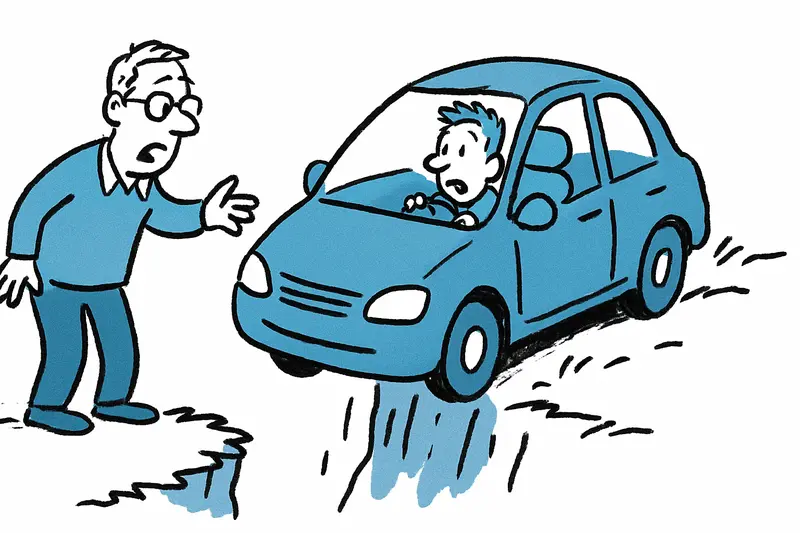
Sant Elm: Family car rolls down embankment – 18-year-old without a driving license at the wheel
A Toyota with German plates slid three meters down an embankment in Sant Elm. The driver, just under 19, had no driving licence. Beyond the shock, questions arise about checks, insurance and responsibility for foreign-registered cars on Mallorca.
Sant Elm: Family car rolls down embankment – young driver, many questions
In the early afternoon, some residents and curious tourists gathered on Carrer de Mossèn Joan Ensenyat in Sant Elm. A Toyota lay half in the bushes, about three metres below the roadway, after it apparently rolled down the embankment uncontrolled, as reported in Sant Elm: Car slides down the embankment — Driving without a license and insurance raises questions. Witnesses alerted the emergency services at around 14:50; the smell of the sea is almost always in the air here, today a cool breeze blew in from the sea, and the scene seemed oddly calm.
Rescue quickly on scene, driver appears uninjured
Local police from Andratx and an ambulance were on site within minutes. Emergency personnel attended to the young driver, who will turn 19 in a few weeks, details that appear in Sant Elm: Car slides three meters down slope – many questions, few answers. He showed no obvious serious injuries; more detailed examinations are still pending. Passersby whispered, dogs strained on their leads, and the church bells of Sant Elm rang in the background – an ordinary island afternoon, only with an extraordinary accident.
Particularly sensitive: The young man stated that he had been driving without a licence. The vehicle bears German plates, appears to be deregistered, and officers could not confirm valid insurance coverage or a current technical inspection sticker at the scene, as noted in Coche familiar cae por un talud en Sant Elm: joven de 18 años conducía sin licencia ni seguro. According to statements, the driver said he had used a relative's car; the police are currently examining ownership and possible responsibilities.
The key question: How can an uninsured car with an unclear registration status travel so freely on Mallorca's roads?
The incident raises more questions than answers. Was it a mistake while reversing at the steep edge, a technical failure, or simply carelessness? Even more open is the structural question: How often do foreign-registered vehicles park and drive in risky situations without complete documentation? On a holiday island like Mallorca, cars with foreign registration are common – and that complicates checks.
Checking technical inspection (TÜV) or insurance data often takes time because authorities must coordinate between different national registries. There are also grey areas: families bring vehicles from the mainland to the island, seasonal workers use brought-in cars, and some short-term visitors rely on informal permission from the owners. The result is uncertainty at places where every road can have a steep drop and every parking space can be a hazard.
What is often missing in the public debate
Public discussions usually focus on noisy parties or traffic jams, and less on the administrative and preventive side: Who is liable if a foreign-registered car without insurance causes an accident? What reporting obligations exist for owners who leave their vehicle on Mallorca for an extended period? And how can local authorities quickly obtain relevant documents from abroad when a criminal investigation is a possibility?
Another blind spot: the responsibility of parents and vehicle owners. When young drivers have access to other people's cars, a pedagogical warning is often not enough. Serious legal consequences can follow – not only for the unlicensed driver but also for the person who made the vehicle available.
Concrete steps and solutions – what would help now
In the short term, the police and traffic authorities can increase controls at particularly sensitive points, such as parking areas near cliffs or narrow village streets. Technically useful would be mobile readers for licence plate checks that quickly provide information about registration and insurance. On a municipal level, simple structural measures like additional bollards, clearer markings or barriers at steep edges could reduce immediate risks.
In the long term, better information work is needed: landlords, families and companies should be more strongly informed about liability risks. Cooperation between Policía Local, Guardia Civil and foreign authorities should be standardized so that inspection or insurance data can be retrieved quickly. Digital solutions at EU level could also help reduce bureaucratic hurdles.
In general: sanctions are necessary, but prevention is cheaper. Multilingual information campaigns, prominent notices at ferry terminals and car parks, and regular traffic training for seasonal staff and young people could lower the risk — and help preserve calmer summer evenings on the coast for all of us.
What happens next
The Guardia Civil and the traffic authority are continuing to investigate the case. Possible charges for driving without a licence, enforcement of driving bans and questions about the liability of the vehicle owner are under consideration; local outlets have published related coverage such as Joven de 19 años hace caer el coche de su madrastra por un precipicio de tres metros en Sant Elm. For neighbours, the memory remains of an unusual afternoon: the sound of the sea, half a car in the bushes, and the question of how we can better prevent such situations in the future.
We will continue to follow the story and report as soon as the authorities provide further details on injuries, claims for damages or possible charges.
Frequently asked questions
What should I do if I see a car accident in Sant Elm, Mallorca?
Can you drive a car in Mallorca without a valid driving licence?
What happens if a car in Mallorca has no valid insurance or inspection papers?
Are foreign-registered cars common on Mallorca roads?
Why are steep roads in Sant Elm, Mallorca, a traffic risk?
What should vehicle owners in Mallorca know about lending a car to someone else?
Can a car roll down an embankment while parking in Sant Elm?
What safety checks help prevent roadside accidents in Mallorca villages?
Similar News

When Palma Becomes a Zombie Zone: 'Mallorca Z', AI and the Thought Experiment with Side Effects
A Mallorcan lawyer built a strategy game over a weekend using AI that treats the island as the scene of a zombie crisis....
Learning to Wait: How Leisure Is Making Space Again on Mallorca
Waiting doesn't have to be lost time. A mild October day in Palma shows how small pauses slow down our lives — and what ...
Cala en Brut: Body in the Sea — a Fatal Autumn Day and What’s Missing
In Cala en Brut (Ciutadella) a man's body was recovered during storm Dana "Adam". Why do autumn storms in the Balearics ...
When the road is gone: Port de Valldemossa cut off after storm 'Adam'
After heavy rains a retaining wall gave way and two sections of mountain road MA-1131 became impassable. Why are rural p...

Crypto Promises, Ferry, Arrest: How Investors in Mallorca and the Neighboring Islands Fall into the Trap
A Swiss man wanted under a German arrest warrant was captured in Ciutadella. The case raises questions about cross-borde...
More to explore
Discover more interesting content

Can Cap de Bou

Townhouse Lleo 72
