
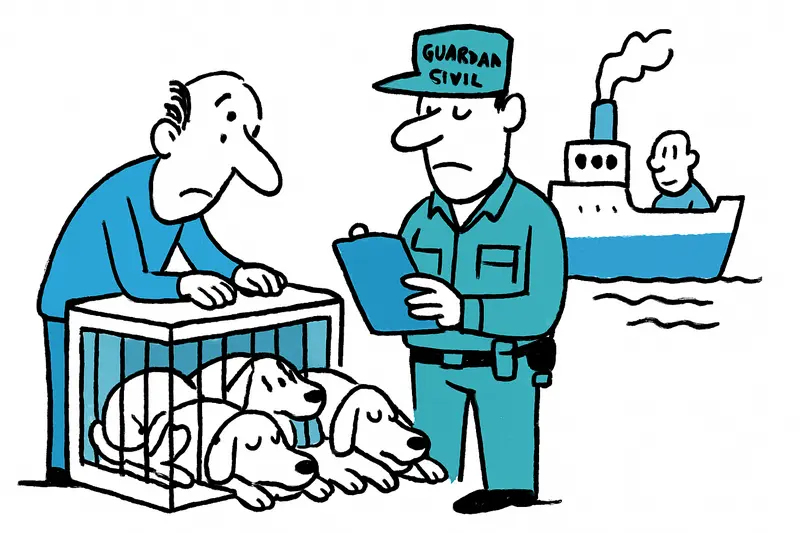
A truck unloaded 27 lifeless animals from the car deck of a ferry — the Guardia Civil is investigating. Why animals could die on the car deck and what must change now.
27 dead hunting dogs in Palma: A port morning crying out for answers
It was still dawn, seagulls screamed, and the regular thudding of the ferry had barely faded when helpers and dock workers in the port of Palma saw a sight during unloading that no one had expected: 27 hunting dogs lay motionless in their crates on the car deck of a truck. A sharp diesel smell mixed with the salty wind — and with a wave of dismay that quickly spread.
The key question: heatstroke, negligence or systemic failure?
The Guardia Civil has opened investigations. At the center is a simple but bitter question: could these dogs have survived if ventilation, checks or actions had been different during the crossing? First witness statements and information from authorities indicate that the temperature in the cargo area was critical for hours. The driver says he followed the prescribed procedures; the transport company denies any negligence. That is not enough to clarify the moral and legal questions of the incident.
What has been lacking so far in public debate
Reports focus on assigning blame and on autopsies — correct and important. But it is often overlooked how structurally vulnerable animals are during ferry and truck transports. Who checks whether the ventilation openings on the car deck work even in still air and summer heat? How are checks documented and by whom? And how do crew, shipping company and port staff really react in an emergency?
Another blind spot: the increase in extreme temperatures in the Mediterranean region. What years ago might have been considered an acceptable risk is now judged by a different standard. Transport regulations, which were mostly designed for average climates, reach their limits when outside temperatures and solar radiation heat up cargo spaces.
Concrete points that the investigations must clarify
Officers are currently examining protocols, inspection reports and camera data. Specific questions include: were ventilation slots or a mechanical ventilation system present and functional? Did the crates allow sufficient spacing for air circulation? Was water provided at regular intervals? Were the number and size of the crates chosen in accordance with applicable EU transport regulations? And not least: were alarm situations on board the ferry or during transport reported on land?
The autopsies — a painful but necessary step
Veterinarians from Palma are on site to accompany the announced autopsies. They should clarify whether the cause of death was heatstroke, poisoning, heart failure or another acute problem. The result can have not only legal consequences but must also serve as a basis to make future transports safer.
What Mallorca should do now — concrete solutions
The incident must go beyond a single question of blame and lead to structural improvements. Practical proposals could include:
- Mandatory climate-controlled transport containers on ferries when animals are transported overnight or for several hours. Mobile ventilation and temperature sensors with mandatory recording would create accountability.
- Cameras and temperature logging on car decks, with data that can be evaluated during inspections. This would reduce gaps in documentation.
- Stronger checks in the port by port police and veterinary authorities, especially on arrivals in hot months. Spot checks should be regular and unannounced.
- Training and clear emergency protocols for drivers, ferry staff and port workers: who is responsible when animals show signs of stress? How is quick action taken?
The island community and the moral dimension
For residents, helpers and animal rights activists, this image is hard to process. In cafés along the waterfront, among the cranes in the port and in the alleys between olive trees, this news will resonate for a long time. Legally, the autopsy results can pave the way for investigations against companies or individuals — and hopefully also spark a debate about standards adapted to the reality of climate change.
Anyone who saw anything or can provide information is asked to contact the Guardia Civil in Palma. The results of the autopsies are expected in the coming days — they should not only provide clarity but also a message that the island learns from such a tragedy.
Similar News

Palma Invests More in El Terreno: What the Renovation Will Actually Deliver
Palma has kicked off the upgrade of El Terreno: new sidewalks, more greenery and utilities moved underground — the city ...

Sóller: Fàbrica Nova to be comprehensively restored – Island Council takes over and invests millions
The decaying textile factory Fàbrica Nova in Sóller gets a new chance: the Island Council has purchased the building and...

Late-night racing on Avinguda Mèxic: residents demand quiet
In the Nou Llevant neighborhood, daily illegal car races on Avinguda Mèxic are causing fear and sleeplessness. Around 50...

Actions for the International Day Against Violence Against Women in Palma
Palma takes to the streets: Two rallies start in the evening, municipalities offer additional activities — and the bus c...

Many conferences pull out: Hotel prices make Mallorca unattractive for business travel
Several larger companies have moved events off the island. Too-high room prices and the lack of availability for short s...
More to explore
Discover more interesting content

Experience Mallorca's Best Beaches and Coves with SUP and Snorkeling

Spanish Cooking Workshop in Mallorca
