
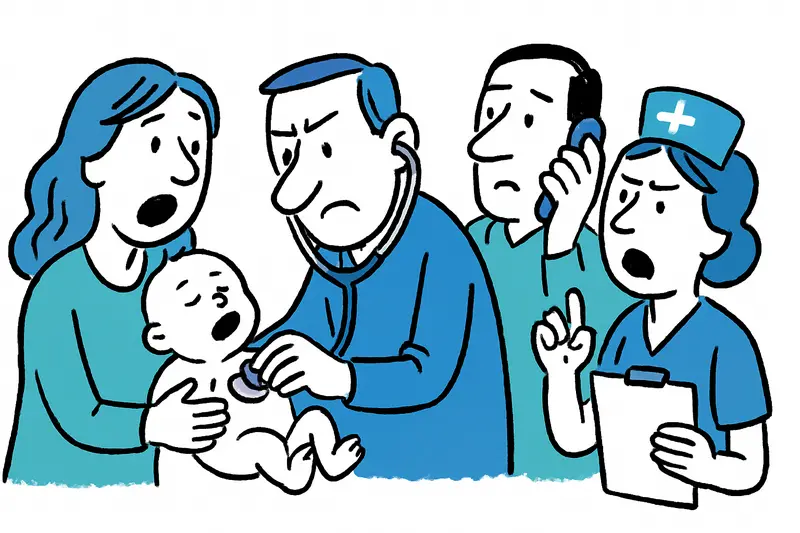
When a Baby Suddenly Stops Breathing: Palma’s Emergency Response Put to the Test
Every minute counts in a medical emergency involving an infant. What matters is not only who arrives first, but also whether help is called, access is made possible, and the handover is handled correctly.
An emergency at home is not an abstract issue
A child suddenly stops breathing normally, someone calls for help, and footsteps echo in the stairwell. In moments like these, everyday life in Palma can quickly turn into an emergency. The key question is not who will later be celebrated as a hero. It is: How can a child get effective medical help without delay?
Adults are often especially unsettled when infants and young children are involved. They want to do something immediately, but are also afraid of doing the wrong thing. That is understandable. But hesitation, several calls made at once, or an unclear address can all cost valuable time. An effective emergency response chain must therefore be simple enough to work even under stress.
The first step: Call for help clearly
In Spain, 112 is the general emergency number. When calling, give the exact location first if possible: street, building number, floor, and directions to the entrance. In Palma, an address alone may not be enough if there are several entrances, courtyards, or restricted access points. If another adult is available, they can wait downstairs and guide the emergency responders in.
It is important to answer the dispatcher’s questions and follow their instructions. Do not hang up just because someone else is already on the phone. And do not call several numbers one after another if that could lead to confusion. If you are alone, say so. The dispatcher can then give you guidance while help is on the way.
If a child appears unconscious or is not breathing normally, it is a medical emergency. Bystanders should not attempt improvised treatments or give the child anything to eat or drink. What to do depends on the situation; the dispatcher’s instructions and the assessment of medical professionals should guide the response. Reading a general newspaper article is no substitute for a first-aid course or calling emergency services.
What often gets overlooked in public discussion
When an emergency is dramatic, attention quickly turns to one person and their courageous actions. That is human nature. But a successful rescue does not automatically mean that procedures are working well everywhere. Nor can one conclude from a single case that mistakes were made. Answering those questions requires clear information: How is an emergency coordinated? Which first responders are on site? How is the handover to the ambulance service organised?
The time before professional help arrives also deserves more attention. Do parents and caregivers know about first-aid courses for children? Are the materials available in several languages? Do people know how to give an exact address and keep access to a building clear? These questions may be less dramatic than a single rescue story, but in an emergency they can make all the difference.
It would be helpful for the city and the relevant authorities to provide easy-to-find information about emergency calls and first-aid courses, including for people who have only recently moved to the island. Courses should be offered regularly and in different locations, such as neighbourhoods, schools, and childcare facilities. This cannot prevent every tragedy, but it can make it less likely that people will be completely unprepared when it matters most.
Everyday life in Palma: narrow entrances, many languages
In the city’s residential neighbourhoods, everyday life and an emergency can be separated by nothing more than an open front door. A delivery van passes outside, a stroller is parked in the stairwell, and a phone rings somewhere. Anyone who wants to help in such a situation does not need to make a grand gesture. One person calls, another opens the entrance, and a third keeps the way clear. When no one is left alone and information is passed on in an orderly way, frantic confusion can become useful support.
It sounds simple. That is precisely why it belongs in any preparation: Is the building number easy to see? How do you get into the courtyard? Is there someone who speaks Spanish or Catalan if the caller does not? In an emergency call, the most important thing is to describe the situation clearly. No one needs perfect words; short, clear details are more helpful than long explanations.
Being prepared is not scaremongering
Families, babysitters, and caregivers can spend a few minutes preparing before anything happens: save the address in a phone, explain how to access the home, and take a recognised first-aid course for infants and children. Adults who live together or care for a child should also agree on who will call in an emergency and who will meet the responders. This will not eliminate all fear, but it can prevent everyone from doing the same thing at once—or no one from taking the first step.
The fair lesson from every emergency involving a child is not to treat one helper as the solution to the whole system. What matters is an effective chain of response, from the first call through to medical care. Everyday life in Palma is noisy, crowded, and sometimes a little confusing. In an emergency, at least one thing should be clear: whom to contact, where help is needed, and how to clear the way for it to arrive.
Frequently asked questions
What number should I call for an emergency in Mallorca?
What details should I give 112 when calling from Palma?
What should I do if a baby in Mallorca is not breathing normally?
Should I hang up if someone else has already called 112 in Mallorca?
How can I prepare a babysitter for an emergency at home in Palma?
Why should parents in Mallorca take a first-aid course for children?
How can bystanders help while emergency responders are on their way in Palma?
What if I do not speak Spanish or Catalan during an emergency in Palma?
Similar News
Bus Strike Before Christmas in Mallorca: What Is Confirmed—and What Isn’t
A strike in passenger and freight transport has been announced for December 23 and 24. How severely Mallorca would be af...
Car Transporter Fire Temporarily Disrupts Access to Palma
A car on a transporter caught fire on Monday morning on the Ma-1 near Portopí. The closure affected rush-hour traffic; t...
Celebrity on Mallorca: Who Benefits from the Big Event?
When familiar faces draw a crowd on the island, a simple question arises: what remains besides photos and talking points...
Carolina Noeding and the “Island Kid” Label: Who Owns Mallorca’s Party Image?
Carolina Noeding represents a Mallorca stage that promises island spirit. But between stage persona and everyday life ar...
The Bridge to Mallorca Exists Only in the Song—and That’s Exactly Why It Endures
The pop song “El puente” turned an impossible bridge between mainland Spain and Mallorca into a catchy holiday idea. To ...
More to explore
Discover more interesting content

Can Cap de Bou

Townhouse Lleo 72
