
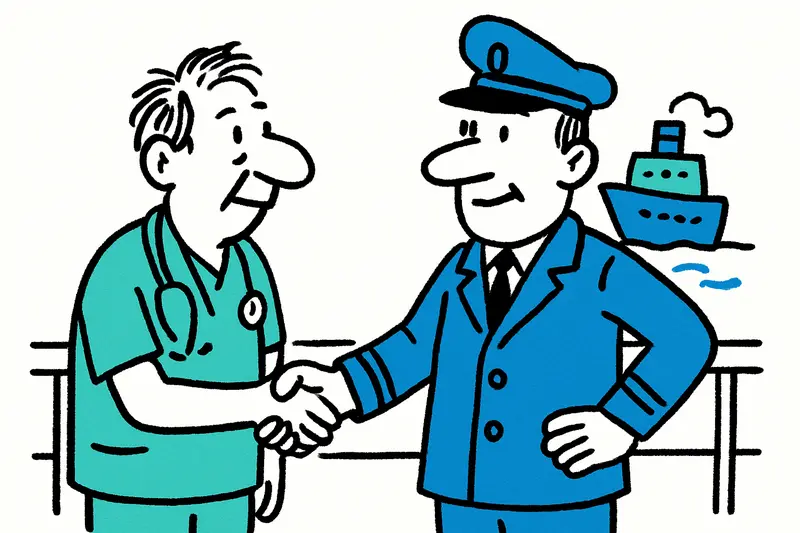
From Operating Room to Deck: How a Bavarian Heart Surgeon Found a New Life in Palma
He was a heart surgeon, now he is a ship's doctor: A 61-year-old Bavarian shares his year between the OR and the sea. In Palma and on deck he gathers stories, small miracles and reminders of medicine's limits.
From the Scalpel to the Sea: an Unusual Career Change
Sometimes a glance over Palma Bay is enough: early mornings when the sun paints the water pink and the seagulls cry above the Passeig Marítim. There, on the deck of a cruise ship, you can now meet a 61-year-old Bavarian who used to be a heart surgeon and intensive care physician at several university hospitals. Not a loud exit in a wool cap and fisherman's shirt – more a planned exhale: half the year on board, half the year in his practice at home (see New Medical Center on the Paseo Marítimo). And in between: harbor coffee, shore leaves and the sounds of Mallorca that reach all the way into the ship's clinic.
Medicine Like a Small Island Hospital
Since 2017 he has worked as chief ship's doctor for a large German cruise company. On board: a medical department that resembles a small hospital – beds, an operating theatre, X-ray, laboratory. But the everyday cases are mostly trivial and deeply human: colds after changeable weather, circulatory collapses after extensive buffets, twisted ankles after steep cobblestone excursions in historic villages; incidents like these echo local reports, for example the Port d'Andratx resuscitation of a tourist. "It never gets boring," he says, laughing with the dry tone of a doctor who has seen many hours and weather conditions.
Work on board is more practical than academic, as becomes clear quickly. The challenge is to make decisions in a short time, use resources wisely and calm people who are usually on vacation and suddenly afraid; concerns about medical practice standards on Mallorca have been discussed in When the bargain leads to the hospital: Medical fraud in Palma and what now needs to change. A sound he often hears: the muffled thud of ropes at the pier, the calls of dock workers, the clinking of espresso spoons on the jetty — and in the middle of it all the consultation hour in the ship's clinic.
When an Ultrasound Becomes a Small Miracle
One experience has left a deep impression: a woman arrived with severe pain — the examination showed something unexpected on the monitor: a beating heart that no one had been able to find for a long time. Tears, disbelief, relief. Moments like that explain why he dared to make the change: medicine meets people, and that in the middle of the ocean while the horizon drifts by. Such cases, as precise as the small ultrasound, are for him less technical triumphs than human encounters.
And yet there is room for serious lessons. He thinks of a young sailor with a brain hemorrhage for whom every measure — despite modern equipment and courageous teamwork — no longer helped. Such losses pull you quickly out of the sunshine back down to earth. "We can do a lot, but not everything," he says calmly. This experience has changed his view of life and work; it is not sentimentality but a sober insight he repeatedly shares in conversations with colleagues and passengers.
More Than a Doctor: Listener, Mediator, Collector of Stories
On a ship the doctor is not only a diagnostician. He is a comforter for homesickness, a conflict mediator between arguing couples, a first-aid teacher for travel-hungry seniors and sometimes a comedy expert when a monkey in Gibraltar steals a traveller's breakfast. The anecdotes, he says, are part of everyday life: a monkey steals a roll, an elderly lady trips — in the end there are scratches, frowns and stories that are better than any medical record.
He has now turned his life on board into a book. 'A Doctor for Every Wave' is not a medical textbook but a personal account full of small observations, sober truths and warm encounters. It reads like a conversation over an espresso in the Portixol harbor: direct, sometimes thoughtful and always concrete.
Book tip: 'A Doctor for Every Wave' – published July 2025 (Goldmann). ISBN: 978-3-442-14316-0.
Advice from the Man Between Land and Sea
He does not advise everyone to drop everything and go on a cruise. But his message is simple: those who listen to their feelings, stay open and are willing to pitch in can combine work and life meaningfully. Whether in Palma over a late cappuccino while the fishermen mend their nets, or on deck when the sea is calm and the captain adjusts course — there is room for change. For him, the decision not to trade the scalpel for binoculars but to combine both sensibly has created a new rhythm. And the island alleys, the call of the seagulls and the smell of salt are reminders that medicine is always work with people — whether in the operating room or on the waves off Mallorca.
Frequently asked questions
What is it like to work as a ship doctor in Mallorca-linked cruise routes?
Can you visit Palma year-round if you want to combine work and life by the sea?
What medical facilities are usually available on a cruise ship in Mallorca?
Why do people get sick or injured on cruises from Palma?
Is Palma a good place to look for medical stories or books about cruise life?
What should you do if you feel unwell on a cruise leaving Mallorca?
How does a doctor in Mallorca deal with emergencies at sea?
What can visitors to Palma learn from a doctor who works between land and sea?
Similar News
Thief takes salon security — and even steals the camera
In Palma a man stole the tip jar and the surveillance camera from a massage salon. A neighbor filmed the act and handed ...
From Workshop to Luxury Villa: What a €19.5 Million House Reveals About Palma's Market
A historic town house on Carrer de la Pelleteria was converted into a 1,000-sq m residence and is on the market for €19....
FC Germania Mallorca: Why does the lead always slip away in stoppage time?
After the 1-2 at C.A. Pal ne da Tesa questions arise: are these coincidences, a shortage of personnel, or a deeper probl...
Hidden War Bunkers in Palma: Remember, Preserve, Reveal?
Beneath Palma's paving lie remnants of a forgotten shelter system from the Civil War. Consolidation, ethics and tourism ...
Death in the Gorge: Key Questions on the Safety of Rallies on the Ma-10
A Porsche plunged into a ravine during the 550 Challenge near Mortitx. Who bears responsibility, what safety gaps were r...
More to explore
Discover more interesting content

Can Cap de Bou

Townhouse Lleo 72
