
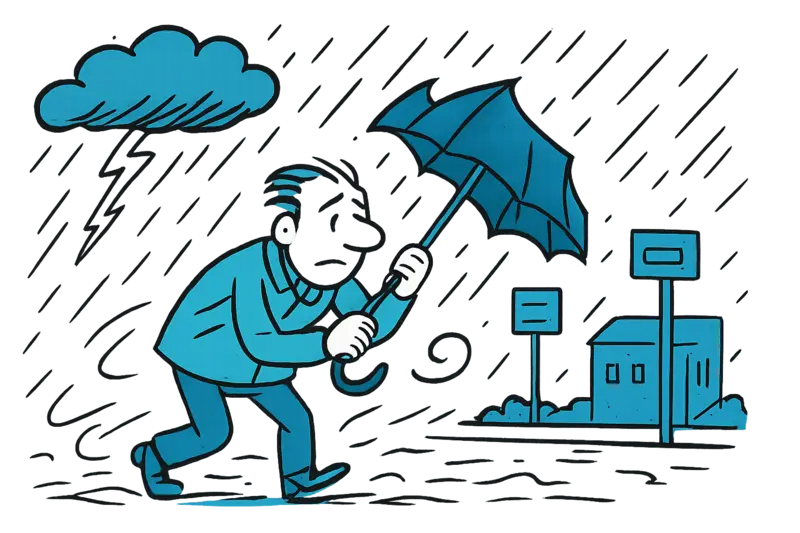
Key question: Are Mallorca's cities and infrastructure prepared for such cold fronts?
Key question: Are Mallorca's cities and infrastructure prepared for such cold fronts?
On the night to Wednesday a sharp cold front brought lightning, thunder and heavy rain to the island. AEMET keeps the severe weather warning (yellow) in place. A reality check: what went well, what remains unaddressed — and what can quickly help so Mallorca doesn't stall at every autumn storm?
Key question: Are Mallorca's cities and infrastructure prepared for such cold fronts?
Thunderstorms, rain and wind — the figures and the scene
On the night to Wednesday a strong cold front crossed the island and brought lightning and thunder as well as persistent rainfall. The national weather service AEMET kept the yellow severe weather warning for the entire island in place at least until the afternoon, as noted in New Storm Front on Mallorca: How Prepared Are the Island and Its People?. Meteorologically this is not an extraordinary event in the transition to autumn — for many people and for daily operations on Mallorca it nevertheless felt like a sharp break: after almost 30 degrees in the days before, expected daytime highs initially fell to around 26 degrees, and in the following days even to about 22 degrees. Night temperatures will only reach 13 to 15 degrees, and the risk of precipitation remains elevated until Friday.
Concrete measurements from recent days show how suddenly the change came: in Porreres and Llucmajor about 28.8 °C were recorded, closely followed by the University of Palma and Binissalem with 28.7 °C, the airport and Cap Blanc were at roughly 28.3 °C. In some places the streets later turned into a rain mist that transformed the light of street lamps into a milky disc.
Main question and analysis
Main question: Are our cities, roads and air traffic organized so that they remain operational during repeated cold fronts — or do we continue to react mainly in a piecemeal and improvised way?
Short answer: the reaction is mixed. On the one hand the warning chain worked: AEMET reported the front, airports and airlines reacted with changes. There were delays on some departures (including flights to Munich and Dortmund) and at least one domestic flight from Barcelona was cancelled. This shows that providers adapt procedures, though gaps remain as discussed in Severe weather on Mallorca: When it really becomes critical — and what's still missing. On the other hand, traffic disruptions were again observed on secondary roads, storm drains overflowed after heavy showers and annoyed passengers at bus stops — for example on Avinguda Antoni Maura in Palma — had to struggle through standing water.
What is still missing in the public discourse
The debate often remains at weather reports and missed flights. Far less visible is: how robust are drainage systems in old districts? What priority do repairs to dilapidated access roads in rural areas have? Are emergency plans in place for farmers if harvests are threatened by intense periods of rain? And how are temporary traffic measures communicated so that commuters and tourists can replan early, as explored in Short break before the rain: Is Mallorca ready for the fast cold front?
A daily scene from the island
Anyone who was out in Palma on the night to Wednesday knows the picture: drops pelted down on the Passeig Marítim, fishermen at the Moll de la Fusta tightened hoses, a taxi at Son Sant Joan Airport got out with wet shoes, taxi drivers pulled hoods over their ears. In Sineu and Pla de Mallorca women farmers exchanged worries by phone — the olive trees were already standing in wet soil in places, and those who plan to harvest in the coming days expect delays. Local reports on cold snaps and agricultural impacts appear in Cold snap in Mallorca: Is the island really prepared?. In Cala Major gusts rolled over the promenade, kiosks briefly locked their awnings, and the smell of wet asphalt hung over the city.
Concrete approaches — pragmatic and local
Some measures can be implemented relatively quickly, others require planning and money. Suggestions that can help now:
For municipalities and the island administration: introduce priority scheduling for clearing drains after heavy rain events; keep mobile pumps ready for lower-lying streets; use transparent information channels (SMS, app notifications) to communicate road closures and bus detours early.
For airports and airlines: standardized communication in case of delays, early rebooking offers and clear notices about ground traffic problems for passengers so that connections are less endangered.
For farmers and businesses: temporary catchment systems, flexible harvesting schedules and coordination with local cooperatives to organize labor at short notice when weather conditions shift work plans.
For residents and tourists: take AEMET updates seriously, secure balcony furniture, check private gutters, do not park vehicles in low-lying streets, and consider covered alternatives for bicycle parking.
What would bring quick results
Cleaning main storm drains before the rainy season, fixed maintenance intervals for municipal pump facilities and a simple digital platform where citizens can report damage (with location) would significantly reduce response times. Such measures do not cost the earth but prevent expensive repairs and outages.
Pointed conclusion
The storm was not a meteorological blockbuster, but it was a wake-up call: Mallorca is not an isolated weather zone — coastal weather, urban infrastructure and rural economy meet directly here. The island responds, but too often in a piecemeal way. A combination of clear warning communication, targeted maintenance measures and practical support for airport and land transport would greatly reduce the impact of such cold fronts. In the short term: pay attention to AEMET notifications, secure balconies, and avoid travel where possible. In the medium term better drain maintenance and fast information channels are needed — so that thunderstorms do not automatically mean chaos.
Frequently asked questions
When is the best time to visit Mallorca for good weather?
What are the must-visit beaches in Mallorca?
How should I pack for a trip to Mallorca?
Is Mallorca suitable for a family holiday?
What’s the best way to get around Mallorca without a car?
What languages are spoken in Mallorca, and will English help?
What water activities are popular in Mallorca?
Are day trips from Mallorca easy to arrange?
Similar News

Oysters, 800 HP and a Charity Heart: Private Greens Business Cup in Canyamel
Around 120 business guests played at Golf de Canyamel in early October, tried an 800-hp McLaren and raised money for chi...
Cala Millor connected to the Via Verde: More space for cyclists
Sant Llorenç plans new traffic routes: the Camí de Son Moro is intended to make bicycle and pedestrian traffic safer and...

Ryanair leaves Bremen — what this means for Mallorca connections and the island
Ryanair is suspending flights from Bremen to Mallorca from April. Several connections will be lost for travelers, Bremen...
Road collapses in Palma: Who will protect the city's main access routes?
A hole on Avenida Gabriel Alomar has closed three lanes heading toward the Paseo Marítimo. Bus lines are being rerouted....

Boutique Hotel Ranking: Two Mallorcan Hotels in Spain's Top 25
A new ranking based on guest reviews places two hotels from Mallorca among Spain's 25 best properties with fewer than 50...
More to explore
Discover more interesting content

Can Cap de Bou

Townhouse Lleo 72
