
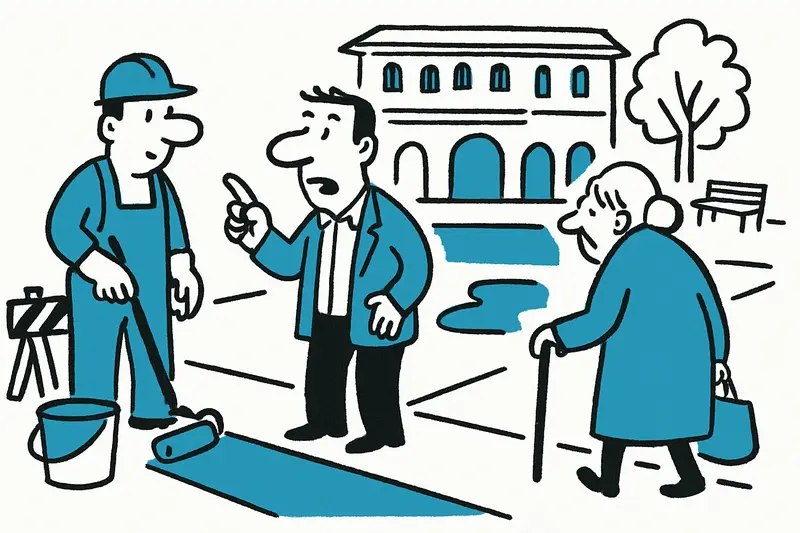
The city plans to upgrade Plaça del Mercat and Calle Unió: more space for pedestrians, new benches, improved drainage. Good ideas — but key questions remain unanswered: delivery logistics, climate resilience, long-term maintenance and the burden during construction.
Will Plaça del Mercat become a place for people — or a long-term construction site?
The announcement sounds friendly: level access, a uniform paving surface, a more modern stormwater system, fewer trip hazards and fewer puddles after a summer thunderstorm. But the central question remains: Will the redevelopment of Plaça del Mercat and the adjacent Calle Unió truly improve everyday life for residents, market traders and regular visitors — or will it create new problems that are not being discussed enough today?
What the plans specifically promise
The plan is for traffic calming with more space for pedestrians, additional seating and targeted greening. Work is scheduled to start in mid-2026, last about 20 months and is budgeted at around €4.4 million. A small but symbolically important commitment: Bar Alaska will remain in its place — for many a bit of everyday security.
The less visible questions
The proposals look good on paper. In practice, however, some ideas risk failing on details. One example: flat, uniform paving surfaces look modern, but without a well-thought-out gradient and sufficient retention volumes, even a new drainage system can fail in heavy rain. Mallorca now experiences more intense downpours, as anyone who watches the old town from their window knows when the sky opens and the alleys become small rivers within minutes.
Then there is the question of financing beyond the construction phase. Nice granite slabs and greenery need maintenance — regular cleaning, repairs, replacement when worn. Is the budgeted construction money enough? Who will pay in five or ten years for the renewal of individual areas? Such follow-up costs often become visible only late and expensively.
And finally the reality of daily use: weekly markets with early deliveries, refrigerated trucks, deliveries for cafés and small shops — this cannot simply be ignored. A traffic-calmed square makes sense. But: Are practical solutions proposed for delivery zones, time-limited access or temporary loading/unloading areas, or will traders be left to cope with problems on their own?
Concrete suggestions from the neighborhood
From the perspective of local people, some pragmatic measures would significantly improve the redevelopment. These are not pamphlet ideas but everyday practices that make the difference between a pretty photo motif and a functioning square:
1. Phased construction planning according to market cycles: Large construction sections should be scheduled so they do not coincide with the busiest market days. Early in the morning, when the delivery vans are humming and vendors are setting up their stalls, any closure is a problem.
2. Defined delivery windows and temporary loading zones: Instead of blanket driving bans, clear time windows for suppliers and modular loading zones that can be set up quickly when needed are required — pragmatic, not dogmatic.
3. Transparency about money: A publicly accessible cost and maintenance plan that accounts for additional funding and regular upkeep would build trust. It's not just the initial construction that counts, but what comes after.
4. Climate-proof drainage: Permeable surfaces, rain cisterns or small green islands for temporary water storage can help prevent flooding — rather than merely hiding shallow grooves under the paving.
5. Preserve the cityscape and ensure accessibility: Reuse of old materials, shade-giving plants that do not overgrow facades, and tactile guidance strips for visually impaired people. This keeps the old town lively and inclusive.
City communication — often underestimated, but crucial
The city has announced information leaflets and a contact point. That's a start. Even more effective would be a digital construction portal: live maps of current closures, contacts for traders, a hotline for urgent delivery cases and regular open construction meetings for neighbors. Explaining the construction to people reduces frustration — and prevents small problems from becoming major sources of anger.
Risks and opportunities
The risks are obvious: cost overruns, extended construction times, accessibility problems for small shops. These disadvantages often hit those with the least buffers — the market vendor, the small café, the elderly neighbor who carries groceries on foot.
The opportunities, however, are real: an accessible, clean square, fewer puddles after storms, comfortable seating and the preservation of local meeting points like Bar Alaska. If the city creates reliable rules not only for the opening but also during the construction phase and for long-term maintenance, a place could emerge that truly fits the old town.
My impression: The redevelopment has potential — provided planning meets practice. If the city takes into account the morning delivery noises, the murmur of market sellers and the clink of coffee cups at Bar Alaska, Plaça del Mercat will be more than just nice paving in the end. If it ignores these everyday rhythms, a long-standing construction site threatens to make life harder primarily for local people.
Similar News
Palma Invests More in El Terreno: What the Renovation Will Actually Deliver
Palma has kicked off the upgrade of El Terreno: new sidewalks, more greenery and utilities moved underground — the city ...

Sóller: Fàbrica Nova to be comprehensively restored – Island Council takes over and invests millions
The decaying textile factory Fàbrica Nova in Sóller gets a new chance: the Island Council has purchased the building and...
Late-night racing on Avinguda Mèxic: residents demand quiet
In the Nou Llevant neighborhood, daily illegal car races on Avinguda Mèxic are causing fear and sleeplessness. Around 50...
Actions for the International Day Against Violence Against Women in Palma
Palma takes to the streets: Two rallies start in the evening, municipalities offer additional activities — and the bus c...

Many conferences pull out: Hotel prices make Mallorca unattractive for business travel
Several larger companies have moved events off the island. Too-high room prices and the lack of availability for short s...
More to explore
Discover more interesting content

Experience Mallorca's Best Beaches and Coves with SUP and Snorkeling

Spanish Cooking Workshop in Mallorca
