
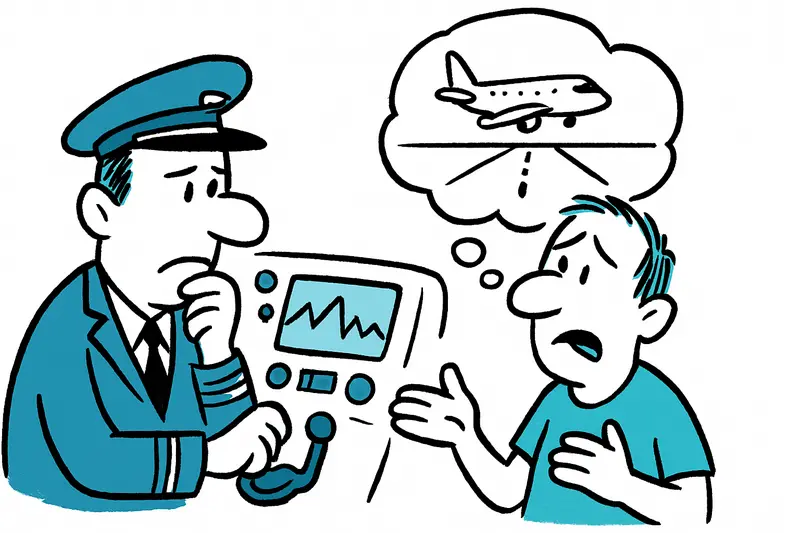
When the runway was no longer safe: How a Mallorca pilot made a decision
When the runway was no longer safe: How a Mallorca pilot made a decision
Shortly after two earthquakes radio contact with Caracas failed. An experienced pilot from Mallorca refused to land and initiated a diversion. A reality check on safety, procedures and what is missing in the discussion.
When the runway was no longer safe: How a Mallorca pilot made a decision
Clear head in an unusual situation — and what we should learn from it
On the evening of June 24 a plane was many kilometers off the Venezuelan coast, the sun low, the instruments flashing, and suddenly the connection to ground stations went dead. For the captain on board, a pilot with decades of experience, this meant: no confirmation, no landing clearance, no information about the condition of the runway. Intuition and procedure argued against landing at the planned airport in Caracas. The crew diverted — toward Curaçao — and brought the passengers safely to the ground.
Guiding question: Is today’s equipment, organization and training of airline crews sufficient to decide in situations that seemingly lie outside all scenarios? I do not want to leave this question only in cockpit logic, but bring it back to practice and politics on Mallorca.
Critical analysis: Radio failures are not new in aviation. There are established procedures — change transponder code, follow last clearance, fly to alternate airports. It becomes problematic when the cause of the outage is a terrestrial disaster: destroyed frequency networks, damaged infrastructure on the apron, no visual inspection possible. That is exactly what the incident describes: no feedback from the tower, no reliable information about the runway’s condition. The decision not to land contradicts short-term instructions but follows the long-term goal of protecting human lives. This reveals a discrepancy between rigidly regulated protocols and reality when several systems fail at once.
What is missing from the public debate: three things. First: an honest discussion about technical redundancy on board — satellite communications, data-driven position and infrastructure reports, and mobile backup channels are often only mentioned in passing. Second: the question of crew sizes. The crew in this case consisted of experienced professionals; the captain’s insight that fewer personnel increases risk deserves more weight in discussions about cost-cutting. Third: cross-border emergency corridors and coordinated procedures for natural disasters are hard to grasp when it comes to airports in seismically active regions.
An everyday scene in Mallorca makes this understandable: on the Passeig Mallorca, under the midday heat, people sit in street cafés, hear mopeds and tram noises, discuss delays and lost luggage. No one in the café expects communication networks to fail suddenly. But the same surprise can have dramatic consequences in the air. The crew’s responsibility is comparable to that of a waiter who recognizes a situation and acts immediately — only the consequences here are far more serious.
Concrete solutions: first, airlines and aviation authorities should mandate backup communication means — SATCOM channels, shortwave or secure data links that operate independently of ground radio. Second, regular simulations are needed in which cockpit and cabin crews act simultaneously under information shortages: passenger communication, coordination with other aircraft, fuel management and quick reroute decisions. Third, the debate about minimum crew levels must be reopened: reductions for cost reasons must be weighed against the increased risk in extreme situations. Fourth: airports in earthquake-prone zones need standardized, internationally coordinated checklists for the immediate assessment of a runway after a ground event, including drone reconnaissance or CCTV feeds that can be quickly released to inbound aircraft.
In addition, airlines and airports should have clear rules for information sharing: who is authorized to declare a runway safe, which visual or technical confirmations suffice, and how quickly are alternative landing sites available? Technically many solutions are possible. Legally and organizationally the challenge remains to regulate responsibilities and liability so that decision-makers are not pressured by fear of legal consequences.
What we can learn from the captain: courage guided by reason. Not every deviation from protocols is a rules violation — sometimes it is the only responsible action. This requires training, experience and the airline’s trust to accept decisions that protect people. In Mallorca people respect the sea and the weather; aviation needs the same attitude toward uncertainty.
Pithy conclusion: Technical plans are important — even more important are people who are allowed and able to take responsibility in critical moments. When we on the island talk about safety standards at the bar, we should not only talk about savings, but about the personnel and systems that protect lives.
In the heat of the city, where the seagulls screech and the tram runs along the Passeig, one notices: safety starts with simple things — clear rules, reliable channels and enough staff on duty to act in an emergency. That saved hundreds of people on board the day the plane did not land in Caracas.
Frequently asked questions
What happens when a plane loses ground-based radio contact and cannot confirm runway conditions?
Why is backup communication important for modern flights?
Should crews practice crisis simulations that include information shortages?
How does crew size affect safety in extreme situations?
What safety measures should airports in disaster-prone regions have for runway assessment after a ground event?
What can Mallorca residents learn from aviation safety discussions taking place near Passeig Mallorca?
How could Mallorca airports improve emergency readiness to keep flights safe?
How should travelers in Mallorca think about safety standards when planning trips?
Similar News
Found dead in Son Gotleu: Dog walk ends fatally — what is missing in the investigation?
A 68-year-old man was found dead on Sunday morning on Tomás Rullàn street in Son Gotleu. According to his partner, he ha...
Theft at Playa de Palma: How safe are tourists at night?
At Playa de Palma street vendors snatched a gold chain worth around €5,000 from a tourist. The National Police intervene...
Smoking Weed at the Ballermann: Why a Ten-Euro Joint at Playa de Palma Ends in Handcuffs
A street purchase for 10 euros at Playa de Palma led to an arrest. Why a simple joint on holiday can have serious conseq...
Push-ups on the Sea: Why Prone Paddlesurf is Taking Off in Mallorca
Those who crawl belly-down across the water aren't signaling for an ambulance but curiosity: prone paddlesurf — long, na...
When Bouncers Run Amok: Emmy Russ and the Question of Safety at the Ballermann
An incident at the Megapark involving reality TV figure Emmy Russ raises broader questions about the oversight of securi...
More to explore
Discover more interesting content

Boat Tour with BBQ along Es Trenc Beach

Private transfer from Mallorca Airport (PMI) to Pollensa
