
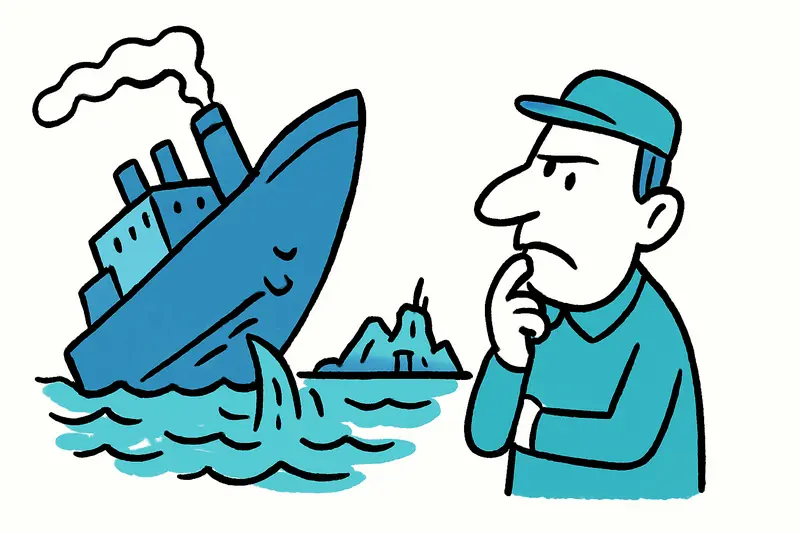
Tanker in Distress: Who Decides When No Port Will Take It?
A damaged ship off Ibiza raises an uncomfortable question: how do you organize help when every coastline is wary of the risks? Mallorca needs clear lines of responsibility and transparent emergency plans.
A disabled ship off Ibiza, a question for all the islands
Where do you take a damaged tanker when it cannot simply remain at sea—and no port wants to take it in? The case off Ibiza turns a technical salvage question into a political one. It is about safety, the environment and responsibility. And it is about the trust of the people who live along this coast.
There is no easy choice in an operation like this. Towing a ship into port can bring risks. Leaving it offshore can too. The decision has to take expert advice, port infrastructure, weather and the condition of the hull into account. It is complicated. That is precisely why the public should not be left with a simple “not here.”
The key question is not just: Is there room?
A port is not automatically a suitable port. Factors include water depth, access, berth availability and towing options, as well as whether fuel or other hazardous cargo can be safely recovered. The response team must also be able to work there safely. A port that looks close on a map may be unsuitable for a salvage operation. Conversely, distance alone cannot provide the answer.
The islands know their limitations. Not every quay is built for an emergency on this scale, and no one can pretend that missing specialist equipment and protective measures can be conjured up at a moment’s notice. That is no excuse to pass responsibility elsewhere. It is a reason to assess the available options openly and by the same criteria.
What can get lost in the debate
Public debate quickly turns to which region should take in the ship. Less visible is the plan for making that decision: Who is in charge of the operation? Who assesses the technical situation? What protective measures apply to the coast and the port? And who informs local councils, fishers, port operators and residents when the plan changes?
These questions are not secondary. Every hour counts in an emergency, but frantic communication does not make the situation safer. When different administrations know only parts of the picture, a vacuum forms. Rumours grow in that vacuum—and so does the feeling that no one is in control. Clear, shared updates on the situation are therefore part of emergency response itself.
The consequences for local people must also be part of the assessment. Fishers need to know whether they should restrict their work. Port workers need specific safety instructions. Local councils need to know whom to contact. For many residents, “salvage” sounds like something that happens out at sea, far away. In reality, it involves decisions that can affect daily life on land.
Daily life is never far from the sea
On Ibiza and Mallorca, the sea is never merely a backdrop behind the houses. Crates are moved on the quay, a delivery van manoeuvres, and gulls cry above the boats. In Palma, traffic can be heard along the Passeig Marítim, while a few streets away people carry their shopping home. The coast is a workplace, a transport route and a habitat all at once. That is why discussing a salvage operation is not just a matter of pointing to an abstract spot on a nautical chart.
A scene from daily life cannot replace measurements or technical expertise. But it serves as a reminder of what can be missing from public debate: the consequences for people who work and live by the water, and the question of how they can get reliable information.
What should be better organized now
The Balearic Islands need a publicly understandable procedure for major maritime emergencies, developed with the Spanish government and port authorities. This should include a list of potential ports of refuge with clear technical requirements—not as an automatic commitment to take in a vessel, but as a reliable basis for an emergency. The criteria should explain why a location is suitable or unsuitable.
Designated points of contact and a shared information centre are just as important. They should regularly provide confirmed updates: What is known? What is still being assessed? What decision is pending? Where there is no answer yet, that should be stated too. Caution builds trust; false certainty does not.
Emergency planning should also include alternatives: different towing routes, protective measures for changing weather and coordinated procedures in case the ship’s condition changes. These plans should be practised with port and rescue services—not only when a tanker is lying off an island and responsibility has become a point of dispute.
No coastline can talk its way out of responsibility
It is understandable to be concerned about bringing a risky operation into your own port. But a simple no does not answer the key question: who takes responsibility then, and according to what plan? In an emergency, the search for a suitable location must not become a contest in pointing as far away as possible.
The sea does not end at an administrative boundary. If every region looks only at its own coastline, the very thing that needs to be settled will remain unresolved: who protects it together?
Frequently asked questions
What happens when a damaged tanker is disabled near Mallorca?
Who decides where a distressed tanker should go in the Balearics?
How do authorities decide whether a port in Mallorca can take a damaged tanker?
Is it safer to tow a damaged tanker into port or leave it offshore?
Could a tanker emergency affect Mallorca’s coast and local communities?
How can people in Mallorca get reliable updates during a tanker emergency?
What should fishers near Mallorca be told during a tanker salvage operation?
How should the Balearic Islands prepare for future tanker emergencies?
Similar News

Palma: Investigations into education funds raise questions about oversight
Five arrests and further investigations, with around €300,000 under suspicion: The case in Palma has not yet been decide...
Freighter Capsizes off Ibiza: No Immediate Cause for Alarm, but 7,000 Tonnes of Diesel Remain a Risk
A capsized freighter lies northwest of Ibiza. An oil slick spotted earlier has disappeared, but the cargo still needs to...

A Century in the Same Place: Sa Pobla Jeweller Celebrates Its Family History
Since 1926, Joieria Fill de Jaume Segura has been part of the heart of Sa Pobla. For its centenary, the family business ...

Hotel Revenues in Mallorca: What Really Lies Behind the Millions
Meliá, Riu and other hotel companies report high revenues and profits. But the figures relate to different companies and...

Palma Airport Plans Four New Units on the Solarium Terrace
Aena is putting the terminal terrace expansion out to tender, with around €491,000 allocated for the work. What travelle...
More to explore
Discover more interesting content

Can Cap de Bou

Townhouse Lleo 72
