
An Unusual Name, an Ordinary Dream: Donald Joins Real Mallorca's E-Youth
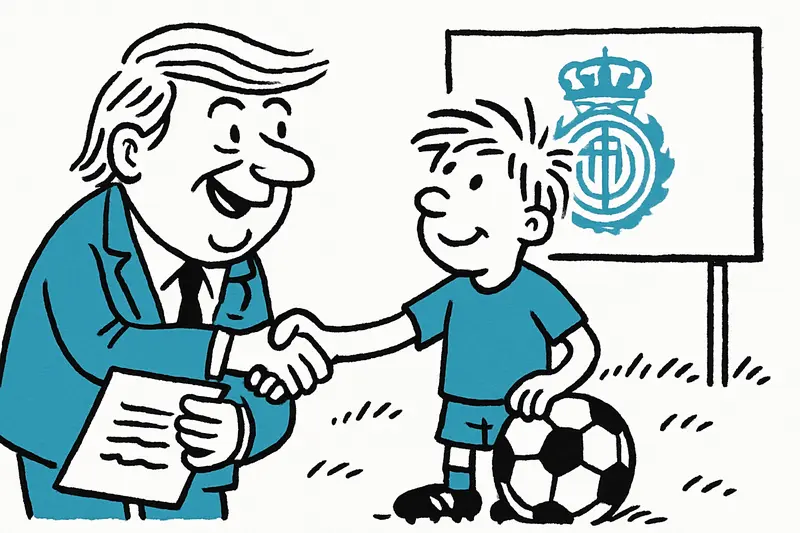
In a light north wind, an eight-year-old footballer named Donald signed the move from Sporting Ciutat de Palma to Real Mallorca's E-Youth. Name aside — on the island what matters most is that a young talent gets a chance.
From the playground in Palma to the youth academy
In the morning, when a light north wind swept over Palma and the autumn sky lay pale above the rooftops, something happened that prompted a smile in the old town's cafés: an eight-year-old boy named Donald signed the transfer from Sporting Ciutat de Palma to Real Mallorca's E-Youth. Not a big media spectacle, but a quiet act between clubs, parents and coaches — accompanied by familiar sounds: children's laughter, a ball thudding against the net, and the conversation of people in the stands. It was reported in Mallorca-Magic: Real Mallorca signs a Benjamín named Donald.
Not a PR stunt, but everyday football
That the name stands out is obvious. On the weekly market at Plaça sa Llotja the topic came up briefly, then people moved on to olives and freshly baked bread, as covered in Mallorca-Magic: 'Un niño, un nombre, un camino'. On Mallorca such little things are talked about and quickly forgotten. What matters here is the concrete work: technique, ball control, team spirit. Sporting Ciutat de Palma praises his attitude and courage, Real Mallorca highlights his physical attributes and his willingness to fit into a team. The parents say calmly: 'He should have fun first.'
What the move means for the boy
For Donald the step means more intensive training, new routines and different teammates. Three sessions a week, age-appropriate technique drills, basic tactical principles and above all: learning within a team. At an age when children form friendships on the pitch and experiment with their football, continuity in training and the calm that has now been created matter more than public attention. These aspects were also noted in Mallorca-Magic's English report on the newcomer.
The island perspective: why this matters
Real Mallorca's youth work is not tabloid material but part of the local sports culture, as shown on the Real Mallorca official website. Young players bring life to the clubs, fill Sundays with matches and ensure that pitches in S'Escorxador or Son Gotleu are not empty. For the city, such an arrival also means more parents on the sidelines, more children growing up with a ball, and in the long run a broader base for the club through the Real Mallorca Foundation youth programs.
More attention – but where should it go?
Of course an unusual name can attract attention. But those responsible apparently aim for a sensible balance: principles of youth development, transparency with the family and a focus on the child's well-being. Small sensations are often treated here with a wink; at the same time there is awareness that the youngest must be well protected — from overload and from premature media expectations.
A view from Mallorca's perspective
Whether Donald will one day make national headlines is unclear. What counts now is his behavior on the pitch: a missed shot, the straightening of the shoulders, another run. Such moments tell more about development than any headline. For the island it is a lovely reminder: young talents come, learn and grow — and sometimes they bring back simple joys, like the sound of a ball on a cool autumn morning.
Short and honest: The name may spark conversation, but for Real Mallorca, the coaches and the parents it is about something everyday and valuable: a boy's chance to play football and develop. And on Mallorca that is often enough a small piece of news.
Frequently asked questions
What does it mean for a child to join Real Mallorca’s youth academy?
How many training sessions do young footballers usually have in Mallorca?
Is Real Mallorca’s youth football focused more on results or development?
What should parents expect when their child joins a football academy in Mallorca?
Why do local youth football moves in Palma attract attention?
Where do Real Mallorca’s youth teams train in Palma?
How can young footballers in Mallorca avoid pressure from early attention?
Why is youth football important for Mallorca’s local sports culture?
Similar News
Who will clean up? Illegal rubbish heaps on the highway near Son Gual drive residents onto the streets
For months, construction debris and household waste have piled up along the highway between Palma and Manacor near Son G...

Amundi takes over Bikini Island & Mountain Port in Sóller – many questions remain open
The French asset manager Amundi has acquired the four-star Bikini Island & Mountain Port hotel in Sóller from an Austria...

Silvia was allowed to see the sea once more – a small farewell in Port de Soller
A team from the Balearic health service IB-Salut fulfilled a terminally ill woman's wish: one last trip to the water in ...
Magaluf: Imprisonment for Beach Club Employee after Theft of a Bag — What the Ruling Overlooks
A former dishwasher received a one-year prison sentence for stealing a Louis‑Vuitton bag. The appellate court upheld the...
Road collapse at Port de Valldemossa: Who will pay for the next wave of damage?
A section of the MA-1131 near Port de Valldemossa slipped after heavy rains from cold front "Adam". Residents are strand...
More to explore
Discover more interesting content

Can Cap de Bou

Townhouse Lleo 72
