
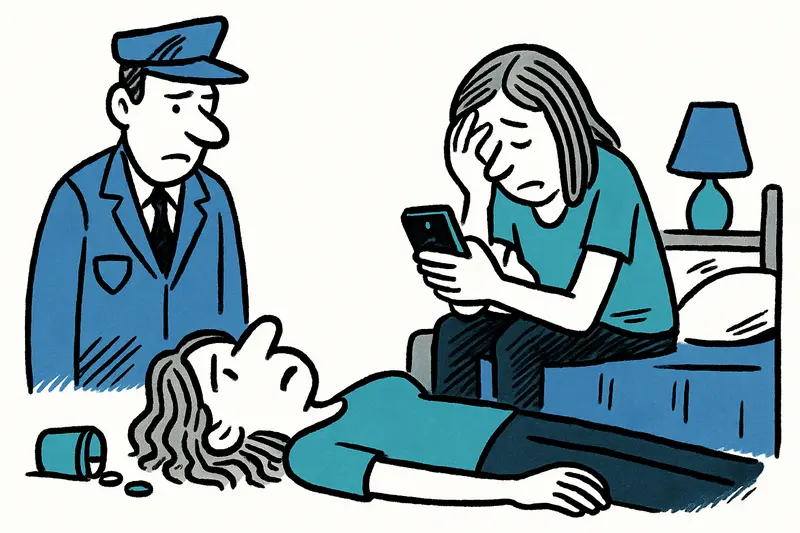
Palma mourns: 15-year-old dead – WhatsApp groups, pills and the unanswered question of responsibility
A 15-year-old schoolgirl was found dead in Palma. Investigations focus on possible toxic substances while circles of friends and messaging groups raise central questions. What is missing in prevention — and what can be changed in the short term?
Palma mourns: A young life, a quiet street and many questions
In the early morning an unusual calm lay over an apartment block in central Palma. No busy chatter from the market, no steady hum of delivery vans — only the distant clatter of trash bins and the occasional call of a neighbour. In one apartment emergency services found a 15-year-old schoolgirl dead; companions reported vomiting and unconsciousness, as reported by Mallorca Magic: Encuentran muerta en Palma a una chica de 15 años. An emergency call alerted the National Police and the ambulance service.
The forensic institute is still examining the cause of death. Initial statements from authorities point to a reaction to toxic substances, but the final results of the autopsy and toxicology tests are still pending. Until these are available, much remains speculation — and the waiting is wearing for the family.
Key question: How can dangerous substances be so easily accessed by minors — and who is responsible?
This question hangs over the case like a heavy curtain. A friend of the girl, also 15, reports active messaging groups where pills, medications and other substances are offered: “There are hundreds of people in there. Some offer things, also to peers.” She speaks of an alleged fentanyl patch; for information on that substance consult the WHO fentanyl factsheet and of pills that were reportedly traded for around one euro. Whether the fatal preparation came through such channels is part of the investigation — but the mere possibility is alarming.
Critical analysis: What is often missing in public debate
The issue is usually filed under the label “drugs”, quickly moralised and pushed aside. The mechanics are more complex: the everyday nature of exchanges among friend groups, the economics of offers, accessibility via digital platforms and gaps in prevention form a web that makes young people vulnerable, as discussed in a local analysis by Mallorca Magic: Cabeza entre rejas de ventana.
Messaging groups are technically not new, but their reach and anonymity have changed. Encryption protects privacy — yet it also makes detecting illegal offers harder. The legal handling is complicated: service providers, investigators and those affected operate in a grey area where snap reactions achieve little. At the same time, the role of peers is taken too rarely seriously. Young people talk to each other, not to adults; information therefore has to arrive where it is trusted.
What is often overlooked
Prevention limited to assemblies is not enough. Practical measures that reflect real situations are missing: How do I react if someone offers me a pill in a chat? When do I call for help? See general guidance on suspected poisoning from NHS advice on poisoning. Whom can I confide in without being laughed at or punished? The economic dimension also plays a role: for some young people low prices are a huge incentive to ignore risks.
Concrete opportunities and short-term effective steps
There is no simple silver bullet, but concrete measures that could strengthen Palma in the short term include:
Low-threshold support services: Evening-open counselling points in neighbourhoods, reachable by phone or chat — anonymous, confidential, without lectures.
Reality-based school projects: Interactive workshops instead of PowerPoint: reenact scenarios from chats, practise communication strategies, offer first-aid training for overdoses.
Strengthen peer networks: Train young people as first responders who act as trusted contacts in schools and clubs.
Cooperation between authorities and platform operators: Establish legally secure reporting channels for suspicious offers, combined with awareness campaigns on the platforms used.
Publicly visible helplines: Not only online, but on posters in sports clubs, youth centres, pharmacies and cafés — where young people gather.
What matters now
For the family the coming weeks will mean waiting and saying goodbye. For investigators it means securing traces — chats, money flows, contacts. And for the city administration, schools and social services there is a serious task: to expand prevention — and to rethink it. Not with scaremongering, but with low-threshold, practical offerings. We will continue to follow and report when authorities publish new findings; initial on-the-ground coverage can be found at Mallorca Magic: Encuentran muerta a una joven de 15 años en Son Oliva.
The silence of the night in Palma is deceptive; the questions are loud and urgent. Neighbours, friends, teachers: a tip that seems small at first can be a lead. We will continue to follow and report when authorities publish new findings.
If you have relevant information, contact the investigating authorities. Parents and young people: seek conversation even if it is difficult — and do not shy away from professional help.
Frequently asked questions
What is known about the death of the 15-year-old in Palma?
Can teenagers in Mallorca really get pills through WhatsApp groups?
What should I do if a young person in Mallorca may have taken pills or drugs?
Why are teenagers in Palma vulnerable to dangerous substances?
Is fentanyl a concern for families in Mallorca?
How can parents in Palma talk to teens about drugs without making them shut down?
Are there support options for young people in Mallorca who need help quietly?
What can schools in Mallorca do to prevent drug emergencies among students?
Similar News
More water than last year: Mallorca's reservoirs breathe easier
September rain refilled the Tramuntana's reserves: overall fill around 35 percent, Cúber at 40.42 percent, Gorg Blau at ...
Three Luxury Hotels in Banyalbufar: Lots of Money, Many Questions
A Danish investor plans three exclusive accommodations in Banyalbufar — including the historic Son Valentí. The announce...
2.1 tonnes of cocaine on sailing yacht off Spain's coast – a reality check for the coastguard
A 14-metre yacht was seized with 2.1 tonnes of cocaine. Who monitors the ports, how does the international hunt succeed ...
Heat Bonus in Mallorca: 100 Euros Extra for Outdoor Staff at MarSenses
MarSenses pays employees who worked outdoors in August an extra €100 as recognition. Lighter uniforms, reduced hours for...
Renovating in Mallorca: What You Really Can Do Without Neighbour Consent
Many think they can do whatever they want in their apartment. That's partly true — but only as long as structural elemen...
More to explore
Discover more interesting content

Can Cap de Bou

Townhouse Lleo 72
