
How a 76-Kilogram Sobrassada Made Sant Joan Laugh
An evening in Sant Joan when a 76-kilogram sobrassada filled the plaza: paprika in the air, neighbors with plates, and a slice of Mallorcan tradition come to life.
When the Sausage Conquered the Plaza
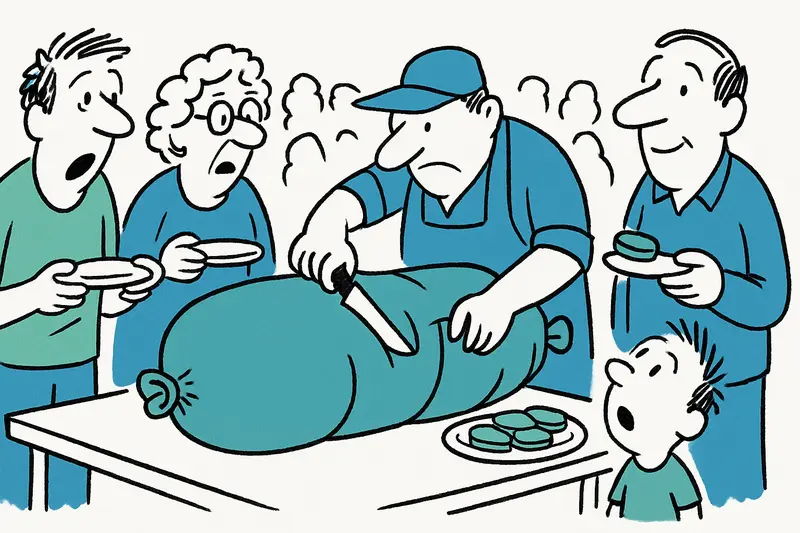
Last Saturday evening Sant Joan smelled of paprika and a little smoke, as if the island had briefly landed in another, more rustic place. No concert, no fireworks — but a sobrassada that, once placed on the scale, immediately drew everyone's attention: 76 kilograms, the helpers said, laughing as plates were cleared, as covered in Sant Joan: 76-kilo Sobrasada Brings the Plaça Together.
The scene played out around the cultural center; the bar 'Can Tronca' served as the improvised meeting point, a detail reported in Cómo una sobrassada de 76 kilos agitó el pueblo. Glasses clinked, somewhere a church bell rang, and a light evening breeze carried the scent of spices through the narrow streets. A farmer sliced thick pieces with practiced ease, as if this were perfectly normal — for him probably everyday life, for the rest of the village a spectacle not seen every day.
Craftsmanship You Can Taste
What many see as just a sausage is a small work of art on Mallorca. Sobrassada is made from pork and fat, seasoned with sweet paprika, salt and other spices. But quality comes from handcraft: the meat is finely ground — ideal particle size around 3–5 millimetres — and then matures slowly in cool, humid rooms. Typical conditions are temperatures of about 14–16 °C and air humidity of 70–85%, until the paste reaches the right smoothness.
For this giant sausage people said the meat came from a pig with a slaughter weight of about 356 kilograms. That is why, following old tradition, the mass was sewn into a previously prepared casing so the sobrassada would hold together. A bit archaic, yes — and precisely what made the evening so charming: the mix of craft, memory and a touch of theatre.
No competition, but sharing: Unlike some village events, it was not about grabbing the biggest slice. People tasted, debated heat and texture, gave children small samples, and grandmothers nodded in approval. Circles of voices formed around the tables, laughter and the occasional "Another slice?"
It was heartening to see the generations come together: young men from the football pitch, neighbours with shopping bags, tourists who happened to pass by and stopped in wonder. The sobrassada became an occasion to exchange recipes, talk about the quality of the paprika and recall memories of past festivities, as seen in Sant Joan corta una sobrasada de 76 kilos: el pueblo celebra la tradición en la plaça.
Why Evenings Like This Matter
In times when much is standardized and digitized, these small analog events are balm for the village soul. They preserve artisan knowledge, strengthen neighbourhood ties and offer visitors an honest, unstaged experience. For Mallorca, it is exactly these moments that sharpen the cultural profile: authentic, loud, sometimes a little chaotic — but warm-hearted.
And yes, such activities also have a practical value: young people get a taste of the craft, older ones pass on what they know. A local butcher who demonstrated how to grind and stuff the meat sparked curious questions about technique and maturation. This is more than gastronomy — it's education at the village table.
A small evening, big impact: The sobrassada event was not a poster campaign but a spontaneous, shared experience. That's exactly what you should look for when rediscovering Mallorca — not just the postcard views, but the evenings when one sausage is enough to bring a village together.
If you're in Sant Joan soon, watch for the little clues: a hung sign, voices in the evening, the smell of paprika. Often it's these unexpected attractions — an old recipe, a huge sausage, many voices and a gentle breeze — that stay in the memory and are later retold.
And so the evening ended: usable leftovers for neighbours, conversations that still echoed, and the certainty that sometimes a village only needs a good slice of sobrassada to keep a piece of tradition alive.
Frequently asked questions
What is sobrassada, and why is it such an important food in Mallorca?
How is sobrassada made in Mallorca?
What did the giant 76-kilogram sobrassada in Sant Joan represent?
Where does a village event like the sobrassada tasting usually take place in Sant Joan, Mallorca?
When is it worth visiting Mallorca for local food events like this?
Can visitors taste sobrassada at local festivals in Mallorca?
What should you wear or bring to an outdoor village event in Mallorca?
Why do Mallorca villages still value traditional food craft so highly?
Similar News
Release after bloody attack in Palma: Why the court's decision raises questions
An 18-year-old who allegedly inflicted a serious neck injury on a man at Plaza Gomila using a wristwatch wrapped around ...
Kidnappings in Inca: Three young men forced into car trunks and abused in the forest – a reality check
In Inca, three 18-year-old men were forced into car trunks by masked assailants at the Plaça des Bestiar, taken to a for...
Spreading Massification: The Brake That Still Has Much Work to Do
Marga Prohens announces limits on volume tourism. The measures sound harsh — but are they enough to save everyday life, ...

Through the Keyhole onto the Party Yacht: How Daniela Katzenberger Is Planning Her 40th on Mallorca
Daniela Katzenberger turns 40 and wants to celebrate it on the island — likely with a boat, cake and her mother. A relax...
By Boat Instead of the Road: Palma's Water Bus — a Reality Check
The 'Bus Nàutic' launches in two stages — but questions remain over interim operations, fares and environmental requirem...
More to explore
Discover more interesting content

Can Cap de Bou

Townhouse Lleo 72
