
8,000 People in Santa Ponsa: Who Thinks About Safety, Traffic and the Environment at Mallorca's Sky Spectacles?
The Guardia Civil's overflight video shows tightly packed people under beach umbrellas in Santa Ponsa. The scene was impressive — and raises questions about planning, safety and environmental protection. An assessment from everyday life in Mallorca and concrete proposals.
8,000 People in Santa Ponsa: Who Thinks About Safety, Traffic and the Environment at Mallorca's Sky Spectacles?
Analysis after the Guardia Civil overflight video
Key question: How well is Mallorca prepared when tens of thousands head to beaches and viewpoints for a once-in-a-lifetime event?
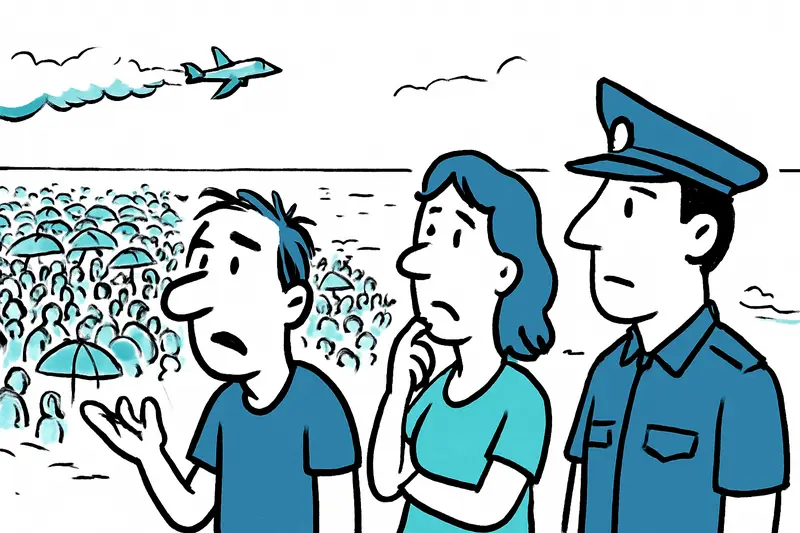
On the evening of 12 August 2026, crowds gathered along the coast to watch a rare celestial event. The Guardia Civil released an overflight video showing more than 8,000 people occupying the main beach of Santa Ponsa; the slopes above the bay were also full. On Playa de Palma, official figures reported around 60,000 people looking up at the sky — totality began in Palma at about 20:31 and lasted just under one and a half minutes. These are facts: brief, but striking.
Critical analysis: Such numbers are not a folkloric detail, they are an organizational problem. When thousands move at the same time, this affects multiple levels: traffic, public safety, medical services, waste volumes, and impacts on the natural coastal environment. The short duration of totality does not make the phenomenon harmless — on the contrary: concentration and expectation can create stress factors that challenge police and rescue services.
In public discourse, the connection between the "wow" moment and logistics is often missing. The aerial images are spectacular, but explanations often stay on the surface: "many people", "historic event." Less reported is the preparatory coordination: Who regulated the access roads? Were additional rescue routes provided? Were emergency services staffed up? These questions are not dry; they touch the safety of residents and visitors.
An everyday scene: The next morning I sat in a café at Plaça d’Espanya in Calvià. On the terrace shopkeepers and a bus driver were talking. The bakery had opened two hours later than usual because many visitors came home late. A beach vendor reported piles of single-use cups and sunglasses packaging he had collected overnight. These small observations show how an evening event pays out over days — not only with pleasant memories but also with burdens for the neighborhood.
What is missing in dealing with such events? First, systematic information work. If authorities communicate in good time and clearly — about arrival times, parking zones, closures and recommended viewing spots — that reduces improvised traffic and dangerous stopping on access roads. Second, temporary infrastructure: mobile toilets, additional first-aid posts, waste containers, and clearly marked rescue routes. Third, operational plans for traffic and public transport: extended bus lines or special trains prevent parking chaos along the coast.
Concrete solutions that are practicable on Mallorca:
1. Early coordination of all parties: The municipality, island government, Guardia Civil, emergency services and beach operators should hold meetings months before an announced event and define responsibilities.
2. Communication schedule: A single information channel — for example a central website plus official social media updates — with clearly visible maps for parking zones, closures and shuttle offers.
3. Temporary traffic solutions: Shuttle buses from park-and-ride areas, temporary no-parking zones at bottlenecks, clear signage and traffic control by staff on site.
4. Mobile services: Medical stations, drinking water points and sufficient toilets. This prevents improvised solutions like open taps or makeshift toilets in vegetation, which are both hygienically and ecologically problematic.
5. Environmental protection measures: In sensitive coastal zones, limits on accessible areas make sense; designated paths protect dunes and seagrass meadows. After the event, deployed teams should inspect the areas and collect waste thoroughly.
6. Resilient operational plans: Run through scenarios, train personnel and involve volunteers — rescue organizations, sports clubs and neighborhood groups can be logistical partners.
These proposals are not theoretical but practical: Mallorca already has experienced teams that organize large events. What is needed is better networking among the agencies that normally act separately — traffic, environment, tourism and security.
Concise conclusion: The image of 8,000 people under beach umbrellas in Santa Ponsa is impressive, almost poetic. At the same time it is a wake-up call. In the future, unexpectedly large gatherings will happen again — not only because of celestial events, but also during sports broadcasts or festivals. Those who want to enjoy the wonder should ensure that the framework conditions are right: well planned, safe and with minimal lasting damage to the island.
And a final local note: When the bells of Santa Ponsa ring again in the morning, guests should not only be proud of their photo, but also find the street clean — that would be a good measure of successful planning.
Frequently asked questions
What is the best time of year to visit Mallorca for sunny beach days?
What should I pack for a Mallorca trip in summer versus the shoulder seasons?
Can I swim in Mallorca's sea year-round?
What is the best way to get around Mallorca without a car?
Are Mallorca's beaches suitable for families and safe swimming?
Is it easy to hike in Mallorca, and what should I bring?
Are there day trips or scenic drives worth considering in Mallorca?
When is Mallorca most unpredictable in weather, and what should I pack for changes?
Similar News

Who is responsible — and what is missing: The case of the collision off Cala Bona under legal scrutiny
In August 2024 a 21-year-old angler died off Cala Bona; investigations have since targeted the German skipper of the yac...
Reality Check After the Eclipse: What Mallorca Needs to Learn from the Night
The total solar eclipse was a spectacle — and at the same time a stress test for Mallorca's infrastructure, environmenta...

Sky show over Mallorca: How we will experience the total solar eclipse on August 12
A hot August evening, a special flight above the cloud cover and dozens of viewing spots across the island — the total s...
Solar Eclipse Stress Test for the Island: How Mallorca Reached Its Limits on Wednesday
The partially or fully expected solar eclipse threw the west coast into disarray: packed viewpoints, closed access roads...
Deià Rations Water: Who Pays the Price for Luxury?
Due to extreme drought, Deià will impose water shutdowns three times a week from August 14. The Hotel La Residencia and ...
More to explore
Discover more interesting content

Boat Tour with BBQ along Es Trenc Beach

Private transfer from Mallorca Airport (PMI) to Pollensa
