
Crackdown at Camp de Mar and Sant Elm: Why beach checks are only half the answer
Crackdown at Camp de Mar and Sant Elm: Why beach checks are only half the answer
The local police of Andratx drove off unlicensed vendors at the beaches of Camp de Mar and Sant Elm, reported four women and confiscated a batch of fruit. A look behind the headlines shows: enforcement helps, but the underlying problems remain unresolved.
Crackdown at Camp de Mar and Sant Elm: Why beach checks are only half the answer
Key question
Why do illegal masseuses and street vendors repeatedly appear year after year on Mallorca's luxury beaches — and are the occasional crackdowns by the local police enough to solve the problem permanently?
Summary of the operation
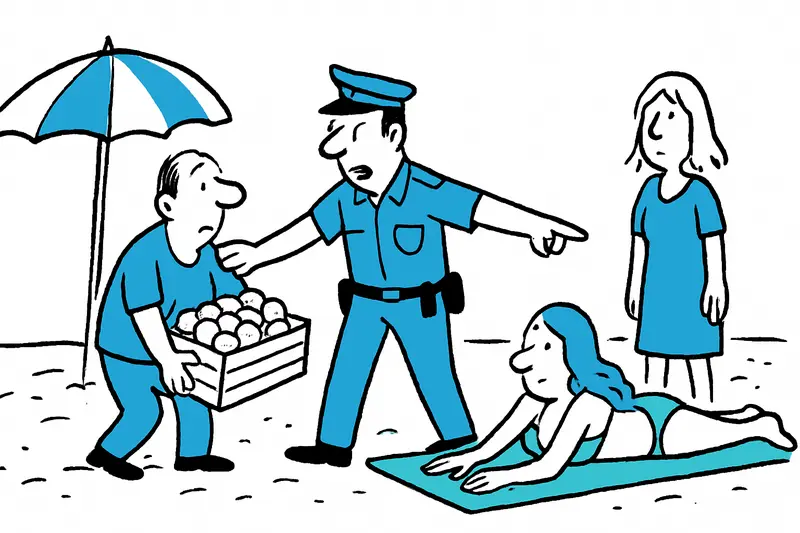
On Tuesday the local police of the Andratx municipality in the southwest of the island carried out a targeted control operation at the beaches of Camp de Mar and Sant Elm. Uniformed and plainclothes officers found several unlicensed activities: In Sant Elm a man was caught selling fruit, his goods were confiscated and he was removed from the beach. In addition, four women were reported for offering massages to bathers without official permission. The police also found a lost wallet in the Cala Blanca area and returned it to its rightful owner. Two people were reported for not disposing of rubbish properly.
Critical analysis
The images from the operation — plainclothes officers between sun umbrellas, uniformed patrols, the carrying away of fruit crates — are a familiar summer motif. Such checks bring short-term calm to the beach. Similar operations have raised questions about displacement rather than elimination, as in Raid at Ballermann: Does the Operation Clean the Souvenir Market or Shift the Problem?. At the same time they are often just symptom control: someone can reappear a few hours later or bring in colleagues, as seen in Playa de Palma: When Vendors Stop an Arrest — What System Is Behind It?, and the problem remains. The police measure targets the visible offer, but says nothing about the causes: why do people decide to work on the beach without a license? Who buys these services, and why do tourists or locals report incidents only sporadically?
What's missing in the public discourse
The debate about the shadow economy itself is missing; reports such as Credibility Needed: How Palma Should Really Tackle Illegal Street Vending explore the wider trust and regulatory issues. In conversations with beach vendors you hear about precarious incomes, lack of alternatives and language barriers. On the other hand, demand from holidaymakers facilitates the offer: a massage on a towel costs less than an appointment in a salon and many opt for it out of convenience or because it seems harmless. Authorities' measures are often presented purely as law-and-order policies, without addressing the social side. The perspective of vendors returning later — for example to neighboring coves — is also usually absent.
Everyday scene
Late in the morning in Camp de Mar the cries of the seagulls mix with the click of sandals on the promenade. Holiday accommodations fill up, delivery vans manoeuvre. Banning a fruit stall here does not eliminate the demand for cold drinks or a quick back massage. The scene is familiar: tourists spreading their towels on the warm stone, locals from Andratx drinking coffee on the promenade, and small improvised offers that fill exactly that gap.
Concrete solutions
1) Prevention instead of only deterrence: multilingual information campaigns that explain permitted selling times, hygiene rules and reporting channels. Signs at access points could help set expectations. 2) Clearer, practical permit regulations: short-term licenses for seasonal small businesses or a simple weekly pass would bring some vendors into a legal framework — combined with inspections and conditions. 3) Social alternatives: cooperation between the municipality, social services and employment agencies so that those affected can find paths to regular jobs, training or counselling. Repression without prospects often pushes people further into informality. 4) Targeted checks and transparency: instead of sporadic raids, regular, announced checks at changing locations plus a hotline for reports by beachgoers. That reduces uncontrolled practices and protects legitimate local providers, a debate echoed in Palma gears up: 170 new police officers for Playa de Palma – solution or placebo?. 5) Practical solutions to rubbish problems: better bin planning, robust lids and clear time windows — combined with visible penalties — prevent frequent offences, as the recent reports show.
Pointed conclusion
The police action at Camp de Mar and Sant Elm was necessary and right to maintain order and safety on the beach. However, the reappearance of sales and massage offers will continue as long as there is demand, precarious living conditions for some providers and a lack of practical, legal alternatives. Control actions are part of the solution — not the whole. If Andratx really wants calm on its beaches, policy must regulate, provide options and accompany the process: only then can the sight of plainclothes and uniformed officers between sun umbrellas change in the long term.
A local note: If you notice an illegal sales point or hygienically questionable treatments on the beach, you can report this to the municipality. One small additional success of the operation: the returned wallet showed that attention and prompt action by the officers directly help.
Frequently asked questions
Why do illegal beach vendors appear on Mallorca's beaches like Camp de Mar and Sant Elm?
Are beach checks by Mallorca police effective long-term, or do they only create short-term calm?
What practical steps could Mallorca towns take to regulate small beach vendors?
How can multilingual information help reduce informal selling at Mallorca's beaches?
How does tourist demand influence informal beach services on Mallorca?
What should beachgoers know about permitted services and cleanliness on Mallorca beaches?
If I notice illegal sales or questionable treatments on Mallorca beaches, how can I report it?
What alternatives exist for people who rely on informal beach work in Mallorca?
Similar News
Plata stays Plata: Young people take over, Llonguets remain
A small bar on Carrer de l'Argenteria will continue: Tolo Serra hands the place over to young Mallorcans at the end of t...

Unnoticed in the Luggage Compartment: How a Boy Traveled More Than 100 Kilometers in a Team Bus
A minor traveled in the undercarriage of a team bus for more than 100 kilometers until his cries for help were heard. A ...

Cap Vermell Grand: Second Michelin Key – a Gift for the East
The Cap Vermell Grand in Capdepera has been awarded its second Michelin key. For the region this elevates the luxury off...

Eurowings lets four aircraft carry names – a friendly idea that also reaches Mallorca
Eurowings is launching a campaign: four Airbus A320s are to carry the first names of people who help others in everyday ...

From the Reality Studio to the Pitch: Aleks Petrovic Makes Mallorca His Base
The former participant in numerous TV shows moves from Dubai to the island and launches a project with FC Germania Mallo...
More to explore
Discover more interesting content

Can Cap de Bou

Townhouse Lleo 72
