
Unnoticed in the Luggage Compartment: How a Boy Traveled More Than 100 Kilometers in a Team Bus
Unnoticed in the Luggage Compartment: How a Boy Traveled More Than 100 Kilometers in a Team Bus
A minor traveled in the undercarriage of a team bus for more than 100 kilometers until his cries for help were heard. A stark reminder of gaps in checks, responsibilities, and the protection of vulnerable people.
Unnoticed in the Luggage Compartment: How a Boy Traveled More Than 100 Kilometers in a Team Bus
Key question: How could a minor get unnoticed into the luggage compartment of a long-distance bus and cross the border without the crew or controls noticing?
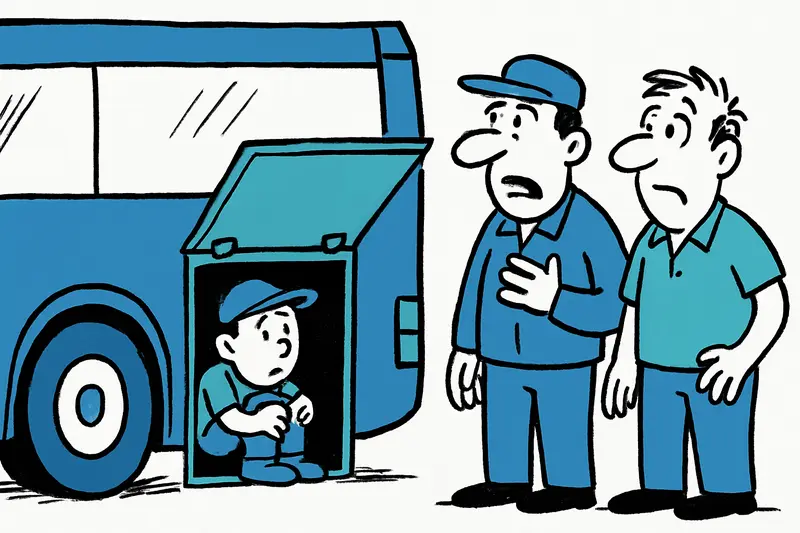
The core of the incident is brief: a minor boy hid in the undercarriage of a team bus and covered a distance of more than one hundred kilometers until his cries for help attracted the attention of passengers. Players and staff tended to him until emergency services took over. The Guardia Civil has launched an investigation. The facts are clear; the question is why this was possible.
Critical analysis: From a technical perspective there are several weaknesses. Luggage compartments are not designed to transport people, yet they can be physically entered. Visual checks by drivers or accompanying staff are often brief and focus on luggage, not on hidden cavities between axles. At border crossings and on ferries, inspections usually concentrate on vehicles, passports and hazardous goods — not on the interior of bus undercarriages, a blind spot highlighted by incidents like Dangerous braking maneuver on the Ma-20: When will authorities finally act effectively?. This creates a blind spot that people seeking protection can exploit.
Organizationally, responsibility meets invisibility: bus companies, team officials and port authorities share tasks, but practical coordination is often lacking. A team doctor, players and escorts can provide first aid in emergencies; proactively, however, they are not equipped to detect hidden persons. This shows that responsibilities on paper do not automatically translate into protection for people, as seen in Drunk Bus Driver Stopped in Petra: Who's Responsible for the Guests' Ride Home?.
What is mostly missing from public debate: the child's perspective. Why did a minor voluntarily hide in a storage compartment? Thoughts of escape, fear of deportation, desperation or the hope of reaching a destination overland — all of these are conceivable motives. Conversations with social services, NGOs and families are missing from the discussion, even in cases like Riddle in Coll d'en Rebassa: Six-Year-Old Girl Found Ten Kilometers Away. Rarely is there talk of repeated but unreported incidents; individual cases often remain isolated reports instead of becoming part of a systematic risk analysis.
A scene from everyday life here: early morning at Palma's ferry terminal you hear truck horns, the rumble of ferries and coffee machines at the kiosks. Drivers wear caps, glance at the clock, departures are scheduled; checks are routine, not meticulous. In this rush there is room for things no one expects — and that is exactly where people can remain unnoticed.
Concrete, pragmatic and implementable solutions: First: mandatory walkthrough checklists for drivers and accompanying staff before departure — including inspection of cavities, not just a look into luggage compartments. Second: technical upgrades for new buses: motion detectors or simple cameras in large luggage holds could report unusual presence. Third: clear protocols between bus companies and ferry operators — when vehicles are loaded, they should be briefly opened on entry or at least acoustically checked. Fourth: training for team staff, drivers and port personnel to recognize signs of hidden people; fifth: better networking with youth and social services so that found minors immediately receive child-appropriate care, interpreters are arranged and legal steps are transparent.
Preventive measures also include information campaigns in several languages about the dangers of hiding in vehicles. Young people acting out of desperation need alternatives and trusted contacts, not only punishment. Authorities should also view the issue from a humanitarian perspective: protection and security are not opposites to enforcement of checks.
What helps in the short term: clear checklists and awareness-raising. Medium to long term: investment in technology and binding coordination between transport operators and social services, to prevent incidents ranging beyond stowaways to collisions such as MA-10 under scrutiny: Head-on collision between intercity bus and delivery truck near Esporles. For football clubs and other teams additionally: lock team vehicles before departure, supervise freight loading, record responsibilities in writing — simple steps often overlooked.
Concise conclusion: The incident is not a mere slip-up but a warning signal. There is no magic formula to immediately eliminate human risks, but many small, realistic measures would significantly improve protection. Anyone standing at the port in Palma, smelling engine fumes, knows: time pressure is everyday life. It is precisely there that caution must become routine again — for the safety of travelers and those seeking protection.
Frequently asked questions
What is the best time to visit Mallorca for mild weather and outdoor activities?
Is it safe to swim in Mallorca in spring or autumn?
What should I pack for a week in Mallorca in spring?
What are good family activities in Mallorca besides beaches?
How should I plan for windy days in Mallorca?
What are easy day trips from Mallorca to nearby spots?
When is the sea warmest for swimming on Mallorca?
What practical tips help when visiting Mallorca in peak season?
Similar News

Cap Vermell Grand: Second Michelin Key – a Gift for the East
The Cap Vermell Grand in Capdepera has been awarded its second Michelin key. For the region this elevates the luxury off...

Eurowings lets four aircraft carry names – a friendly idea that also reaches Mallorca
Eurowings is launching a campaign: four Airbus A320s are to carry the first names of people who help others in everyday ...
From the Reality Studio to the Pitch: Aleks Petrovic Makes Mallorca His Base
The former participant in numerous TV shows moves from Dubai to the island and launches a project with FC Germania Mallo...

When the Phone Falls Silent: Concern for Sarah Joelle in Mallorca — and What It Reveals
After days without a response, the TV personality's unreachability in Mallorca sparked concern. Shortly afterwards an al...
Ultraluxury on the Ground: Four Seasons Jet in Palma — a Reality Check for Formentor and the Island
A high-priced flight crosses Mallorca and its guests stay for days at the Formentor resort. What does the island get bes...
More to explore
Discover more interesting content

Can Cap de Bou

Townhouse Lleo 72
