
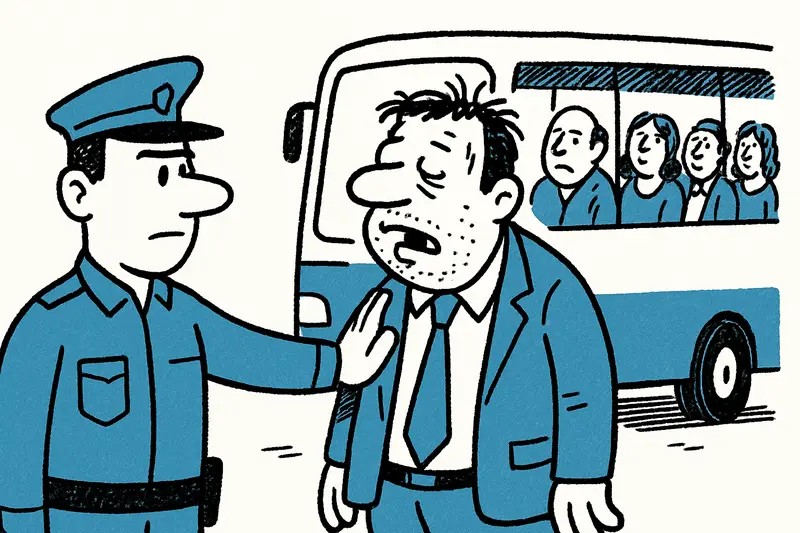
Drunk Bus Driver Stopped in Petra: Who's Responsible for the Guests' Ride Home?
A bus carrying wedding guests was stopped near Petra after the driver was found heavily intoxicated. Why such incidents are more than isolated mistakes — and how risks can be reduced.
Drunk Bus Driver Stopped in Petra: Who's Responsible for the Guests' Ride Home?
It was still twilight on the country road to Petra, the streetlights casting long streaks of light on the asphalt, and from the open doors of the stationary bus rose the smell of cold coffee and cigarettes. Occasional voices, a dog barking in a courtyard — for a wedding party the journey home ended abruptly when the Guardia Civil stopped the bus and prohibited it from continuing.
The Key Question
How could a professional driver with a blood alcohol level well above the legal limit be at the wheel of a vehicle carrying party guests? The answer cannot be dismissed with a shrug. It leads into areas often overlooked in public debate: organizational structures, economic pressure, control gaps, and insurance issues.
What the Check Revealed
The officers from Manacor reportedly observed clear signs of impairment. The breathalyzer test showed values far above the limit permitted for passenger transport. In addition, important documents such as the driver card were apparently missing, and there were indications of violated rest periods. The vehicle was taken out of service, the driver temporarily detained, and criminal proceedings were initiated for endangering road traffic. Similar problems have been recorded elsewhere, for example when Driving test on the Arenal motorway halted: instructor tested positive for alcohol — who protects the test-takers?
More Than an Isolated Error
The incident appears as a personal failure — but it is symptomatic. On Mallorca the village streets are narrow, turns are sudden, and buses often pass close to house facades. An unfit driver is not an abstract danger here but a real threat. Beyond that is the question of the client: Who arranged the trip? Was the company contractually vetted, and were insurance and licenses checked? There have also been incidents in Palma, for example when Paseo Marítimo: Taxi drivers stop drunk driver — a wake-up call for Palma's nightlife.
An often neglected point is the shadow economy in the transfer business: seasonal contracts, short-term subcontractors, sole proprietors operating with minimal margins. Those who take many jobs to bridge the season may juggle rest times or keep documents only rudimentarily. For couples and event organizers this seems cheap — until the price becomes apparent in the form of accident risks, liability disputes or denied insurance claims.
Legal and Insurance Consequences
Possible sanctions are severe: imprisonment, long driving bans, heavy fines. If violations of passenger transport regulations are added, the situation becomes more serious. Insurers can refuse coverage in cases of gross negligence, alcohol, or missing paperwork. For victims at the celebration, enforcing claims thus becomes significantly more complicated. Local cases show how complex enforcement can be, as in reports about Palma: Accident involving a drunk female driver — despite a license previously revoked.
What Is Often Left Out of the Debate
Besides individual guilt, we should shed more light on three structural points:
- Responsibility of the clients: Organizers, agencies and catering businesses have a duty of care when selecting transport providers.
- Economic pressure: Seasonality and low fees encourage precarious business models.
- Control density and prevention: Occasional spot checks are not enough; targeted prevention measures are often lacking.
Concrete: What Would Help Now
The case provides an occasion for concrete improvements:
- More checks at celebration hotspots: Police and authorities could increase spot checks at large events.
- Contractual proof: Organizers should only hire certified companies and document this.
- Transparency through technology: An online register or app with verified providers, reviews and mandatory documents could make service chains visible.
- Alcohol prevention in fleets: Breathalyzer devices in company fleets, clear zero-tolerance policies and training for companies.
- Education: Information campaigns for couples and hosts about risks, checkpoints and liability issues.
The Guests Are Left with a Bitter Aftertaste
Many of the wedding guests stood in the cool morning air, shivering, arranging taxis at short notice or calling relatives. A celebration that was meant to bring joy ended in uncertainty. A practical tip: clarify in advance who is organizing transfers, request proof from the company and save local taxi numbers. It may sound banal, but it can prevent a lot of unrest in an emergency. Incidents such as the Nighttime accident on the Paseo Marítimo: alcohol, a tripping hazard and many questions remind how quickly a night can turn dangerous.
The investigation is not yet concluded. The police are asking witnesses to come forward so that procedures can be fully reconstructed. On Mallorca, road safety often decides the difference between an unforgettable celebration and a tragedy — time to give it more room in planning and control.
Note: Information is based on statements from the relevant authorities; no final court judgment has been made.
Frequently asked questions
What should wedding guests in Mallorca do if their bus driver seems unfit to drive?
Who is responsible for guest transport at a wedding in Mallorca?
Can a bus company in Mallorca refuse coverage after a drunk driving incident?
Why are wedding transfers in Mallorca sometimes a safety risk?
Is Petra in Mallorca a difficult place for large buses to drive at night?
What documents should a bus company in Mallorca have for passenger transport?
How can couples in Mallorca avoid transfer problems on their wedding day?
What happens when police stop a drunk bus driver in Mallorca?
Similar News

When coercive fines aren't enough: Could holiday rental owners soon face prosecution?
The island administration is stepping up action against unauthorized holiday rentals: high daily coercive fines up to €5...

Palma Airport on an Expansion Course — Who Decides How Much Growth the Island Needs?
Aena and Madrid are planning multi-million euro investments for Son Sant Joan and project higher capacities. Concern is ...
Who Gets Left Out? Why Overbookings Will Hit Many Mallorca Travelers This Summer
On hot check-in days at Son Sant Joan, frustrated travelers pile up. New figures from Reclamador.es show that a large sh...
When the Handyman Came: How an Engagement Ring Disappeared in Mallorca and What It Says About Trust
During a repair in Andratx a highly personal engagement ring went missing — a case that calls not only for punishment bu...
How Burglars Test Fincas in Mallorca — and What You Can Do About It
The Spanish National Police warn of a simple but effective trick: small markings on doors reveal whether a finca is occu...
More to explore
Discover more interesting content

Can Cap de Bou

Townhouse Lleo 72
