
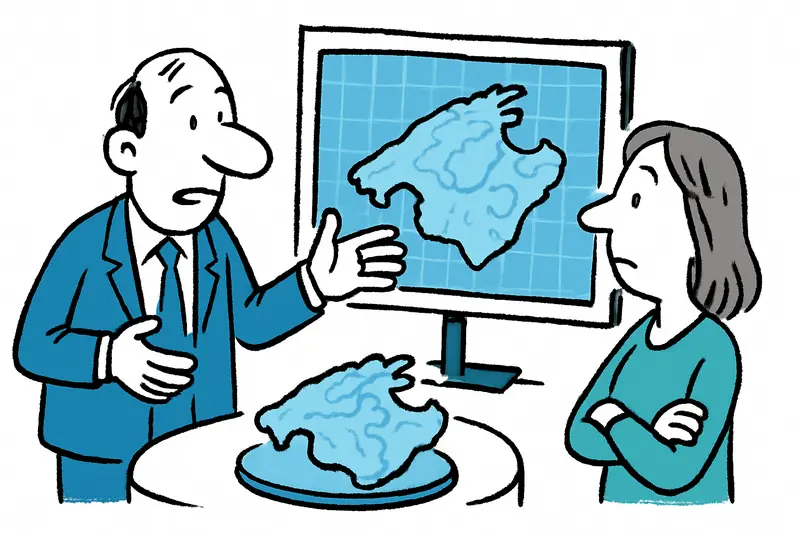
Digital Twin of the Balearics: An Opportunity for Mallorca — if the Island Makes the Rules
The regional government plans a digital twin of the Balearic Islands. Interest is growing at Parc Bit — but without clear rules, privacy, cost and power issues could arise. Proposals: a governance board, open source, visible pilot projects and protection for local companies.
A digital twin on Mallorca: great curiosity, strong winds
On a windy morning at Parc Bit not only the lines in the nearby harbor rattled, but also the coffee cups in the street cafés. The regional government's announcement to build a digital twin of the Balearic Islands was the topic at every bar and table: a real-time model meant to map traffic, water levels, energy flows and even waste logistics, echoing broader efforts such as the EU's Destination Earth digital twin initiative. It sounds modern, almost promising — and it has considerable implications for everyday life and administration on the island.
In short: No magic, but sensors, data, simulations and software. The first phase is estimated at around €4.6 million, and nearly €8 million in innovation funding is available to encourage local companies to participate. That is a lot of money — and a lot of potential.
What authorities and developers hope for
The ideas are tempting: test new bus lines virtually first, see how a hot summer strains the water supply, plan collection routes more efficiently. Such simulations can make decisions more informed, faster and less risky. In the offices at Parc Bit developers can be heard laughing softly in anticipation: jobs in data analysis, modeling and operations could emerge. Small companies hope they won't be overrun by large corporations but will get real shares in the project; this builds on initiatives such as Mallorca presenting an AI-supported sustainable travel system at the World Travel Market.
The decisive question: who owns the data?
So much technology also raises concerns. Will camera or mobile phone data, consumption patterns or local sensor data be collected? Official bodies speak of anonymized, aggregated datasets. For many this is not a sufficient guarantee. The central question is: who may see what, how long will data be stored and who is responsible if errors occur?
Less obvious but equally important: who writes the algorithms? What assumptions are built into the models? A traffic model that uses tourist averages could ignore the seasonal specificities of small villages and thus favour decisions that harm local realities. With changing tourism patterns — for example the recent decline of German visitors to Mallorca — averages may mislead.
Risks that are seldom loudly discussed
Besides privacy issues there are other often overlooked risks: vendor lock-in — the danger that the island becomes bound to proprietary systems in the long term. That means not only dependency but also higher follow-up costs. Algorithmic biases can further marginalize disadvantaged neighbourhoods. And the ongoing operational costs for maintenance, validation and adaptation are easily underestimated: a prototype is one thing, reliable long-term operation another.
Another point: models do not replace local knowledge. The bus driver who has known the congestion at a particular junction for years, or the neighbour who watches the groundwater level — such people provide context that a model cannot simply calculate. Technology should be a tool, not the sole decision-making authority.
Concrete proposals: how to do it better
If the digital twin is not to become a black box, clear rules and mechanisms are needed. Proposal number one: an independent data governance board with citizen representatives, academics, municipalities and IT experts to set access rights, retention periods and audit plans.
Second: mandatory privacy audits and regular impact assessments that are public and easy to understand. Third: open-source components and interoperability clauses in procurement so that no long-term dependence on a single provider arises.
Fourth: pilot projects that are visible locally — for example a traffic simulation for a specific route in Palma or a drought scenario for a small supply district. The results should be presented publicly and critically evaluated. Fifth: funding clauses that favour local companies and training so that knowledge and tools remain on the island.
Timeline, opportunities and one last look at the local
The first development phase is planned for next year, with expected prototypes for traffic data and water simulations within 12 to 18 months. If implemented responsibly, the platform can help respond more quickly to extreme weather and tourist peaks, and inform planning as population growth and structural change in Mallorca reshape services.
Leaving Parc Bit the wind blew over the storefronts, and somewhere in a side street a bicycle bell rang. Technology can represent many things — but whether it reflects the island correctly depends less on algorithms than on decisions: who sits at the table, who controls, and who benefits? Only if development is open, controllable and locally rooted will the digital twin become a useful, not externally driven, reflection of Mallorca.
The wind carried the conversations on: let us hope that upcoming decisions are made not only in server rooms but at café tables and on the village squares of this island.
Frequently asked questions
What is a digital twin for Mallorca, and what would it be used for?
How could a digital twin help Mallorca during summer pressure and drought?
Will a digital twin in Mallorca use personal data?
Why do people in Mallorca worry about who controls the digital twin?
Could a digital twin improve bus planning in Mallorca?
What safeguards should Mallorca have before using a digital twin?
Where in Mallorca could the digital twin be tested first?
When could Mallorca’s digital twin start producing results?
Similar News

Maribel: Five Decades of Service – Housekeeper from Peguera Celebrated with a Special Honor
Over 50 years in the hotel business: María Isabel “Maribel” Molinos was honored in Palma at the Nit del Turisme by Unive...

Orange Alert over Parts of Mallorca: Are We Prepared?
Dark clouds and an announced wet spell have triggered an Orange alert in parts of Mallorca. A reality check: what's miss...

Sundair & Co.: Sale speculation and what it could mean for Mallorca
Rumors about a possible sale of the airlines Sundair and Fly Air 41, which belong to Schauinsland-Reisen — and whether b...
Anne Wünsche in Mallorca: A job offer with a catch — who fits the role of personal assistant?
Influencer Anne Wünsche has left Berlin and is urgently looking for a full-time personal assistant in Mallorca. Why the ...

Daily from New York: Palma Between Boom and Strain
United will increase the Newark–Palma route to daily flights in 2027 using Boeing aircraft (231 seats). What does the in...
More to explore
Discover more interesting content

Can Cap de Bou

Townhouse Lleo 72
