
When the Newspaper Is Missing from the Kiosk: What Bild’s Print Exit Means for Mallorca
The print edition of Bild is no longer available to buy on Mallorca. This is more than an empty space on the newspaper rack: it shows how limited access to German-language print media can become on an island.
The newspaper that suddenly disappeared from the rack
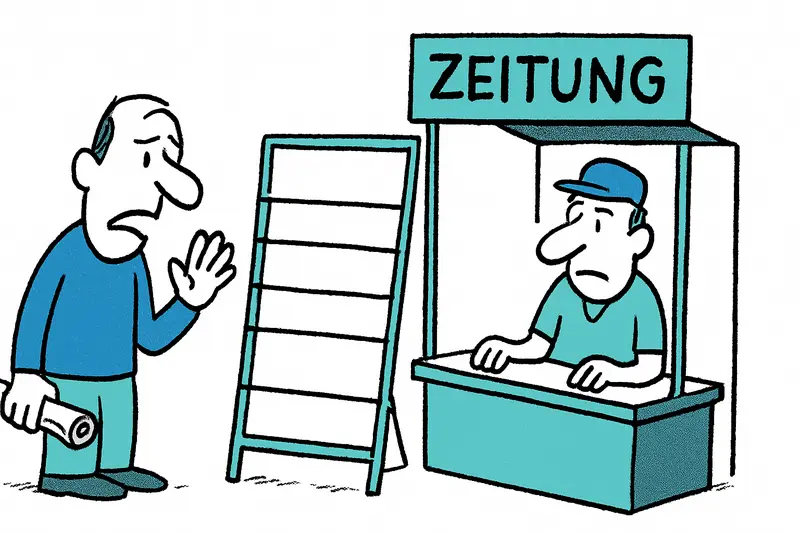
Anyone hoping to pick up a German newspaper on Mallorca in the morning will have to adjust: the printed edition of Bild is no longer available on the island. For many, this is just a small change to everyday life. For others, picking up a paper at the airport, at a kiosk or over coffee was simply part of the routine. A newspaper disappears, and with it a familiar habit.
So the key question is not just whether people miss a particular edition. It is this: what does it mean when printed newspapers are becoming harder for readers to find on Mallorca? The answer is less dramatic than some headlines suggest, but it is not insignificant. One distribution channel has disappeared. That alone says nothing about whether people will keep reading or whether a digital offering is enough for them.
An empty slot does not tell the whole story
Getting newspapers to an island is more complicated than supplying a city with a printing press and distribution centre around the corner. Printed editions have to be brought in, distributed and sold. If copies remain unsold, each individual sale becomes more important financially. The decision to stop offering an edition can therefore be understood as a straightforward calculation. What cannot be determined from the outside is how many people are affected, exactly what demand looks like or which costs were decisive in this particular case.
That distinction matters. The end of sales is no proof that “Germans on Mallorca” no longer read newspapers. There is no single, uniform audience by that name. Some people live here permanently, others come for a few weeks, some own a finca or travel back and forth between the island and Germany. Their habits differ, too: one reader enjoys leafing through a paper, another reads on a phone, and someone else buys an edition only on Sundays. The disappearance of one product does not add up to a general farewell to print.
Nor is a digital edition an equivalent replacement for everyone. A screen requires a device, an internet connection and often an account. Paper works without a charger and can be passed around. The difference is especially noticeable for people with poor eyesight, those who are not comfortable with apps or anyone who simply does not want to look at a screen over breakfast. By contrast, a digital edition is convenient for many residents: no need to search for a kiosk or wonder whether the issue they want has arrived.
What is easily overlooked in the debate
When a newspaper disappears, the discussion quickly turns to nostalgia or the sweeping story of print journalism’s demise. Both miss the point. In everyday life, straightforward availability matters, too. Is there still a reliable selection of German-language newspapers? Which outlets stock them, and how can customers find out what is still being delivered? These questions often go unanswered, even though they would be useful to both holidaymakers and people who live on the island year-round.
The impact on small retailers also deserves attention. A newspaper stand is more than just a rack: it brings customers into a shop and often offers local and Spanish publications alongside international titles. The loss of individual editions is not necessarily a major business issue for a kiosk. But a more limited selection could mean that fewer people look for printed newspapers at all. Without sales figures, it would not be responsible to claim that this is actually happening here. It is, however, a question that retailers and publishers could answer together.
A morning in Palma
It is easy to picture the scene: a grey November morning, cups clinking outside a bar, a delivery scooter passing along the pavement. Someone looks in the newspaper rack at the kiosk on the way to work, cannot find the familiar title and asks about it. The shopkeeper can only point to what is there. It is no major island event. But this is exactly how changes show up in daily life: not in an announcement in the town square, but as a missing newspaper among the chewing gum and bus tickets.
There are simple steps readers can take. Anyone who wants a paper can ask a regular kiosk which German titles are available on a consistent basis and whether pre-ordering is possible. Those switching to a digital option should check first whether it is available as a single issue or subscription, and which devices it works on. Retailers could make their current selection visible instead of leaving customers to search by chance. And publishers should communicate clearly when distribution and availability change—briefly, plainly and without pretending that paper and screens are the same for everyone.
The missing Bild edition is no proof that Mallorca has suddenly been left without a German-language press. But it is a concrete reminder of how dependent print offerings are on demand and delivery routes. Those who value paper will have to look for alternatives; digital readers have an easier time of it. A kiosk rack is not media policy. Even so, it offers a direct view of what people on the island can actually buy. That is what the discussion should focus on—not sweeping claims about an entire audience.
Frequently asked questions
Is the printed Bild newspaper still sold in Mallorca?
Why did Bild stop selling its printed newspaper in Mallorca?
Can I still find other German newspapers in Mallorca?
How can I find out which German newspapers a Mallorca kiosk stocks?
Can a kiosk in Mallorca reserve or pre-order a German newspaper?
Can I read Bild digitally while I’m in Mallorca?
Is a digital newspaper a good replacement for print in Mallorca?
Does Bild’s print exit mean people in Mallorca have stopped reading newspapers?
Similar News
A New Player, an Old Mallorca Question: When Does the Island Truly Become Home?
A German footballer has lived in Mallorca for six years and now plays for FC Germania. His journey raises a bigger quest...

Siurells de Plata 2026: Mallorca Honors Commitment to People, Culture and Nature
At the gala in Son Termes, people and institutions from social services, research, culture, the environment and sport we...

Drug Seizure at the Port? What Cannot Be Said Without Confirmation
A report about a possible cocaine seizure on a ferry raises questions. Without verifiable primary information, however, ...
Mallorca Property: Tax Deadlines Need a Fact Check
Non-residents who own a home in Mallorca should take their Spanish tax obligations seriously. But when it comes to deadl...

Award for Mallorca Rooftop Terrace: A View Across Palma Bay
The terrace at Katagi Blau in the Iberostar Llaut Palace in s’Arenal was named Best Terrace at the 2026 Hotel&Mantel Awa...
More to explore
Discover more interesting content

Can Cap de Bou

Townhouse Lleo 72
