
A New Player, an Old Mallorca Question: When Does the Island Truly Become Home?
A German footballer has lived in Mallorca for six years and now plays for FC Germania. His journey raises a bigger question: What turns a place of residence into a home—and what remains invisible in the island’s idyllic image?
A New Player, an Old Mallorca Question: When Does the Island Truly Become Home?
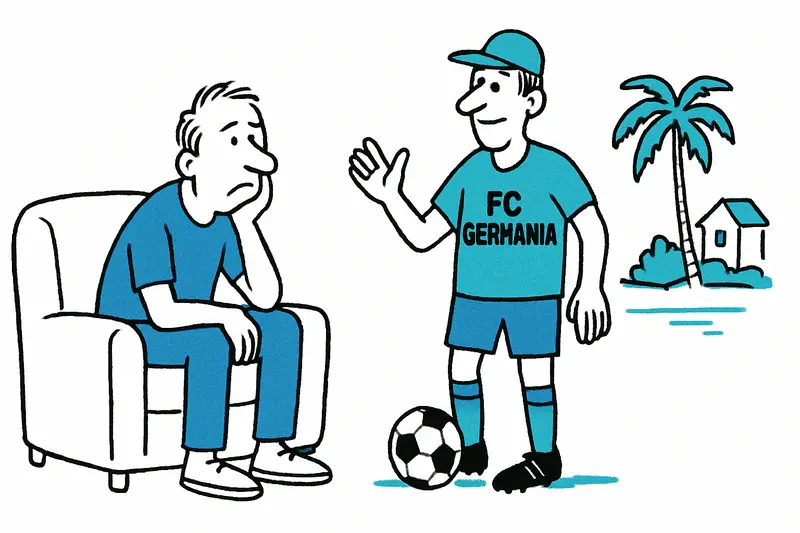
A move to a football club sounds like it is about sport. In this case, it also says something about settling in: Nawid Nesar, 36, has lived in Mallorca for six years and now plays in midfield for FC Germania. He previously played football in Germany. That is enough to raise a bigger question: When does Mallorca become more than just a place to live and start to feel like home?
The quick answer would be an easy one. Sun, sea, a club, new people—and there is your island story. But life rarely works like a holiday that happens to last longer. Moving across borders involves many small decisions: Where will you work? In what language will you handle the paperwork? How do you find a sense of belonging when everyday life is no longer made up of beach days and free afternoons?
The Club Is More Than a Training Ground
Football can be a way in. On the pitch, what matters at first is whether someone keeps up, makes themselves available for a pass, and fits into the team. Background and accent do not disappear, but for ninety minutes they are often less important. After training, the questions become very practical: Who is heading back towards Palma? Who knows where the match is next weekend? And who can explain once more what the coach said in Spanish?
This is not a romantic island backdrop, but ordinary everyday life. That is precisely why a sports club can create a sense of belonging that goes beyond a friendly “Hola” at the counter. You see the same faces again. People notice when you are missing. And you do not need to craft a perfect language-learning story before you can become part of a group.
FC Germania offers a distinctive setting: a German club on an island where people from many countries live and play. That can make it easier to get started. But it can also enlarge a comfortable bubble if connections with Mallorcan clubs and the community around the ground do not develop. The jersey alone does not determine whether it becomes a place of encounter. That depends on how the club interacts with other teams, how open it is in everyday life, and whether it sees itself as part of local football.
What the Island Image Often Leaves Out
Mallorca is often described in contrasts: grey life elsewhere, bright and carefree life by the sea. Such images may reflect a genuine personal experience, but they are not much use as a general explanation. Rents on the island are high, many jobs depend on the season, and some doors are harder to open without Spanish or Catalan. Anyone taking the bus in Palma in the morning also knows the other side: crowded vehicles, tight connections, and watching the clock when the next shift is waiting.
The question of whether to stay has a practical side, too. A player may have found a place at the club and still be struggling with temporary work, finding a home, or an uncertain future. Conversely, a life has not automatically failed if someone eventually moves back. Public narratives often turn such decisions into a verdict on two countries. In reality, they are usually more complicated and personal.
What is often missing is a look at the conditions that make a good life possible—not just the weather. Who can afford a home long term? Who helps newcomers learn the language? How can work schedules be balanced with training and club life? And how much contact with everyday Mallorcan life is possible if most of your friends are also recent arrivals?
Small Steps That Really Help
Sports clubs could make a real difference with a few simple measures: a designated contact person for new players, support with language and club administration, and clear communication with clubs in the neighbourhood. Joint youth or training days do more than a friendly greeting before kickoff. And on an island where training grounds are not always easy to reach by bus, carpooling is more than a nice gesture.
The same principle applies in reverse to newcomers: do not just look for a club where you understand everything right away; also take opportunities that may initially feel awkward. A conversation at a café, in a shop, or at the sports ground sometimes takes longer than expected. That is not a glitch in the routine. Often, it is the beginning of familiarity.
Picture a scene that might unfold at a ground on the outskirts of Palma on a windy evening: studs scrape across the artificial turf, someone waits with a bag on the touchline, and after training the team briefly discusses who will be missing at the weekend. It is not a grand measure of integration. But it is a piece of shared everyday life—and it is exactly from such pieces that a home is made.
Nesar’s move to Germania does not prove that Mallorca works better for everyone than Germany. It shows something smaller, and therefore more credible: settling in can begin with a ball, a training schedule, and familiar faces you see again and again. The island is not automatically a paradise. But it can become the place where you build a life. What matters is less the postcard scenery than whether you can truly find a place within it.
Frequently asked questions
How long does it take to feel at home in Mallorca?
How can newcomers make friends in Mallorca?
Do you need Spanish or Catalan to settle in Mallorca?
What can make it difficult to build a life in Mallorca?
Can joining a football club help you settle in Mallorca?
Can joining a German club in Mallorca help you integrate?
Is it easy to get to football training by bus in Mallorca?
Does moving back from Mallorca mean you failed to settle?
Similar News

Siurells de Plata 2026: Mallorca Honors Commitment to People, Culture and Nature
At the gala in Son Termes, people and institutions from social services, research, culture, the environment and sport we...
When the Newspaper Is Missing from the Kiosk: What Bild’s Print Exit Means for Mallorca
The print edition of Bild is no longer available to buy on Mallorca. This is more than an empty space on the newspaper r...

Drug Seizure at the Port? What Cannot Be Said Without Confirmation
A report about a possible cocaine seizure on a ferry raises questions. Without verifiable primary information, however, ...

Mallorca Property: Tax Deadlines Need a Fact Check
Non-residents who own a home in Mallorca should take their Spanish tax obligations seriously. But when it comes to deadl...

Award for Mallorca Rooftop Terrace: A View Across Palma Bay
The terrace at Katagi Blau in the Iberostar Llaut Palace in s’Arenal was named Best Terrace at the 2026 Hotel&Mantel Awa...
More to explore
Discover more interesting content

Can Cap de Bou

Townhouse Lleo 72
