
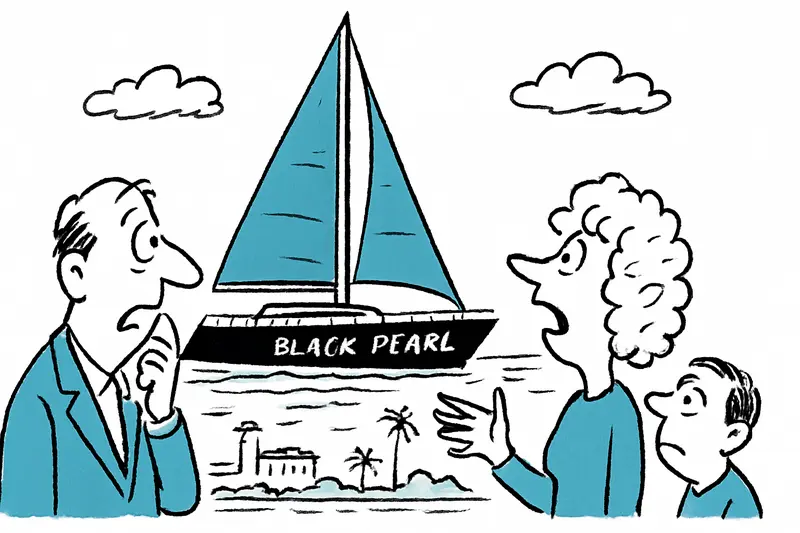
Black Pearl in Puerto Portals: Luxury Sailing Yacht, Sustainability Promises and Open Questions
The Black Pearl is moored in Puerto Portals — a sailing colossus that impresses and raises questions: How credible are its environmental claims, and what consequences do ownership structures have for Mallorca?
Huge, quiet, but not without question marks: the Black Pearl in Puerto Portals
In the morning, when a southern wind lightly rippled the bay and the sun still shone pale over the roofs of Portals, a new sight drew attention: Black Pearl sighting at Puerto Portals. Those walking along the wooden jetty heard above all the clicking of camera shutters, the chirping of a distant swallow and the soft bumping of fenders — engine noise was nowhere to be found. A floating garden in technical perfection, a yacht that feels more like a park than a machine.
Key question: How sustainable and how transparent are such superyachts — not only for their owners, but for an island like Mallorca?
The figures impress: around 107 meters in length, three carbon-fiber masts each almost 70 meters tall, a DynaRig system that sets sails at the push of a button. Sail area amounts to around 2,900 square meters — a feast for any ship enthusiast (see Black Pearl (yacht) specifications). But technology alone does not answer the big questions: Is the system as economical in everyday use as advertised? How can the claimed low diesel consumption be verified?
Against the backdrop of the cafés of Puerto Portals, where dockworkers compare their coffee cups and photographers their lenses, doubts arise. Anecdotes about crossings with only 20 liters of diesel sound attractive. Practical tests or published consumption reports are missing. The consequence: sustainability promises remain a privilege of the owners — public interest and oversight often end at the ship's bow, a concern echoed in discussions around the Cruise Guide Awards 2025.
Technology, image and the limits of transparency
The Black Pearl combines sails, solar and a propeller-turbine system. On paper this sounds like a model for the future of the deep-sea fleet. In reality, however, independent consumption and emissions data are rarely accessible. Without measurement protocols that ports or independent assessors can inspect, much remains one statement against another. For Mallorca this is not an academic problem: it's about air quality, noise, port load and ultimately about trust in the sustainable development of tourism.
Added is the perception on land. Port workers report additional logistics, special equipment and occasionally long berthing times that take space from other boats. Locals strolling the quay see not only luxury but also the question: Who really benefits from it?
Ownership questions: legal details with local effect
The discussion about the Black Pearl touches another point: ownership. Until recently the name of an internationally known entrepreneur appeared in connection with the yacht; after his death the ownership apparently became part of disputes. Such legal details are more than formalities. Ownership determines who decides about berth times, whether events take place on board, and how much is spent on maintenance, crew and taxes.
If ownership structures remain opaque, the port authority and municipalities have little leverage to secure revenues or enforce environmental regulations. For Mallorca this means: missing port fees, unclear levies on events and a lower transfer of know-how to local shipyards and service providers.
Concrete opportunities — and how to realize them
But there are ways to increase the benefit for the island. First: mandatory, regularly published consumption and emissions reports for yachts above a certain length. For simplicity, ports could require standardized test protocols — for example measurements when entering and leaving and certified smart meters on board.
Second: clear rules on port fees and events. Temporary events on board should be subject to a transparent levy system that strengthens local infrastructure. Third: fundable cooperations between yacht owners, shipyards and vocational training centers. Technology transfer only works if knowledge is shared — for example through internships during maintenance, joint studies on battery systems or shared workshops for port staff.
Fourth: a modernization of port equipment. More shore power connections, certified disposal stations and mandatory waste and wastewater management plans for large yachts would reduce the burden on the coast. And fifth: transparency in ownership. If the port authority requires meaningful information about economic beneficiaries, revenues can be tracked better and potential risks to the local economy minimized.
A realistic outlook at the quay wall
In the afternoon, over an espresso at the harbor bar, the conversation continues: the Black Pearl is undoubtedly a technical work of art — and a case study. It could be a role model if its technology proves verifiable and its operation is integrated into a local value chain. Without these proofs, however, the impressive sight at the mole remains above all one thing: a pose that leaves questions.
Mallorca is not opposed to luxury; examples such as the Explora II docking in Palma show the scale of high-end visitors. But the island should not be lenient when it comes to coastal protection, transparency and fair economic benefits. The wind can fill the sails. Even more urgent, however, is that the information ashore does not blow away. As soon as ports, politics and society introduce clear rules and control mechanisms, the Black Pearl can become more than a photo subject: an opportunity to make the island smarter and more sustainable.
Frequently asked questions
What is the Black Pearl yacht seen in Puerto Portals?
Is the Black Pearl really a sustainable yacht?
Why does the Black Pearl matter for Mallorca?
What makes Puerto Portals a notable place for superyacht sightings?
How quiet is a sailing superyacht like the Black Pearl?
Can visitors see the Black Pearl at Puerto Portals?
Why are people asking about ownership of the Black Pearl?
What rules could make superyachts more transparent in Mallorca?
Similar News

Cafetería San Siro: A Meeting Place on Schinken Street Since 1966
In the middle of Schinken Street, Cafetería San Siro has been offering Mallorcan hospitality for more than six decades —...

From Ballermann to Prison: What the Verdict Against the Femina Operator Means for Palma
The Munich Regional Court convicted a German operator for subsidy fraud. What does the verdict mean for the Femina Club,...

Underpass Verge de Lluc: 19-year-old fights her way out of flooded car – a warning sign for Palma
A 19-year-old recently escaped swimming from her car after the Verge de Lluc underpass held up to one and a half meters ...

When the Floodgates Open Again: Why Palma's Floods Aren't a Coincidence
A sudden heavy downpour around 5 p.m. brought Palma to a standstill: flooded streets, full basements, panicked commuters...

Playa de Palma: Life-saving at Balneario 11 – Lifeguards Act Quickly
A German holidaymaker suffered cardiac arrest at Playa de Palma. Lifeguards resuscitated her on the beach; emergency ser...
More to explore
Discover more interesting content

Can Cap de Bou

Townhouse Lleo 72
