
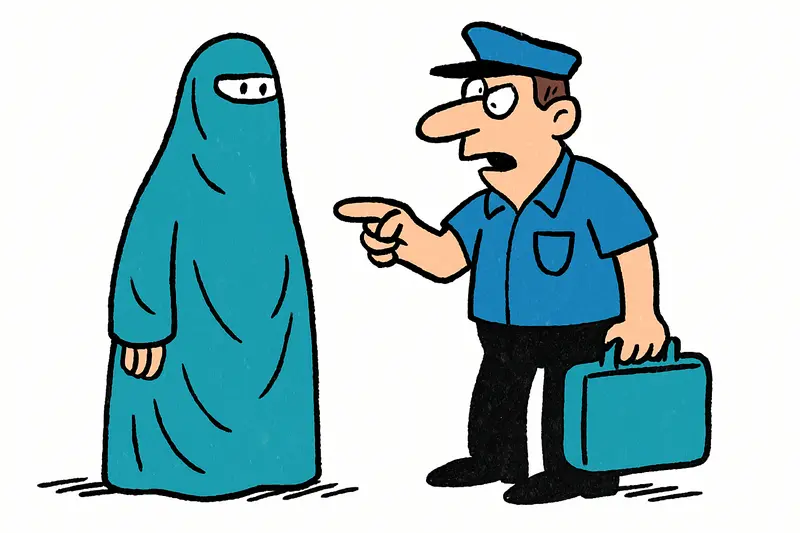
Burqa Ban on Mallorca: Between Symbolic Politics and Practical Reality
Burqa Ban on Mallorca: Between Symbolic Politics and Practical Reality
The governing party is calling for a ban on full-body coverings in public spaces. Our reality check asks: What would such a ban actually trigger — and what is missing from the debate in Mallorca?
Burqa Ban on Mallorca: Between Symbolic Politics and Practical Reality
Key question: Does a ban protect women's dignity — or does it shift the problem without helping those affected?
The conservative party governing Mallorca recently proposed banning full-body coverings such as the burqa and niqab in public spaces. The justification cited human dignity, equality and the prevention of discriminatory practices. In Europe, proponents of such bans point to countries like France, Belgium, Denmark, Austria, Bulgaria or Switzerland that have similar regulations. The debate over bans has surfaced before in regional discussions, for example when the Parliament rejected a motion to ban public celebrations of Eid al-Adha.
That sounds convincing on paper. On the streets of Palma the situation looks different: at the Olivar market hall vendors stand with bags, pensioners read the local paper on benches along the Passeig, and young parents push prams past Plaça Mayor. Fully veiled women are hardly seen here — headscarf wearers more often, but full-face coverings remain an exception.
The political question therefore has two levels: the legal and the practical. Legally, the proposal refers to the constitution, equality and the dignity of the person. Practically, the question of proportionality arises: How many people would be affected, how would a ban be enforced, and what consequences would it have for people who are already marginalized?
A ban can have symbolic effect. It sends a clear societal signal against visible forms of patriarchal control. At the same time, there is a risk that the measure further marginalizes those affected. People living in situations of existential dependency or under pressure are not made more protected by an item of clothing — on the contrary: sanctions can lead to social isolation, conflicts during identity checks and increased mistrust of authorities.
What is often missing in the public debate is the perspective of the women concerned as well as assessments from social workers, schools and legal advisors on the island. There is a lack of reliable data on the actual prevalence of full veiling in Mallorca and analyses of whether the practice is driven by coercion, religious conviction or personal choice. Without this foundation any political decision risks being more symbolic than effective.
Concrete approaches that are neglected in the debate can be clearly formulated: First, targeted prevention work against forced marriage and genital mutilation — there are already criminal and counseling options here, and it makes sense to expand them. Second, the expansion of low-threshold counseling centers and anonymous reporting offices in municipalities such as Palma, Inca or Manacor. In other policy areas the government has shown a preference to favor education and local solutions over blanket bans. Third, clear procedural rules for identity checks so that women are not discriminated against or criminalized during controls; encounters with police and administration should be trained and handled sensitively.
Fourth: dialogue with Muslim communities and women's organizations in the Balearics. A ban without exchange feels top-down; participation creates legitimate solutions. Fifth: legal clarification at the regional level so that any potential ban does not conflict with fundamental rights or lead to contradictory court rulings.
A practical everyday tip: If you stroll through the Mercat de l'Olivar on a Saturday and hear a discussion about public order — ask for facts, not fear. Those affected should be heard; those making policy should explain how sanctions would be carried out and which support services would be set up in parallel. Public authorities sometimes prefer advisory measures, as seen in discussions around the mask recommendation in the Balearic Islands, which illustrates the role of guidance over enforcement in some contexts.
Conclusion: A ban on full-body coverings does not automatically solve the problems raised by the initiators. It can be a political signal, but without a solid inventory, dialogue and accompanying social measures the risk remains high that the island will produce conflicts rather than solutions. A sober debate, accompanied by concrete support services and legal reviews, would be the better path — less striking, but more effective for the people it should serve.
Frequently asked questions
Is Mallorca actually considering a ban on burqas and niqabs in public?
Would a burqa ban in Mallorca help women or make things harder for them?
How common are burqas and niqabs in Mallorca?
What are the legal concerns around a burqa ban in Mallorca?
What support exists in Mallorca for women who may be under pressure to cover themselves?
Where in Mallorca would a burqa ban be discussed or enforced most visibly?
Why are some people in Mallorca calling for dialogue instead of a blanket ban?
Has Mallorca used education and local solutions instead of bans before?
Similar News
Mistaken identity with fatal consequences: Brutal assault in S'Aranjassa — what's missing in the follow-up?
At S'Aranjassa a visitor to a finca was tied up, beaten and thrown out of a van. Three men have been arrested, including...

High heel slips, car accelerates: accident on Camí de Son Hugo
A woman lost a high-heeled shoe on the forecourt of the sports facility at Camí de Son Hugo. The car accelerated, mounte...

Phone Scam: How Two Hotel Employees at Playa de Palma Lost Thousands of Euros
One morning in September, two reception employees at Playa de Palma were pressured by alleged alarm-company staff — in t...
When the Wallet Becomes a Danger: Attack in Peguera and Lessons for Mallorca
In Peguera, two women are said to have stolen the wallet from a 75-year-old German couple. When the victim intervened, t...
Plata stays Plata: Young people take over, Llonguets remain
A small bar on Carrer de l'Argenteria will continue: Tolo Serra hands the place over to young Mallorcans at the end of t...
More to explore
Discover more interesting content

Can Cap de Bou

Townhouse Lleo 72
