
Cool Donkey Work in Sóller: Twelve Gray Donkeys Keep the Streambeds Short
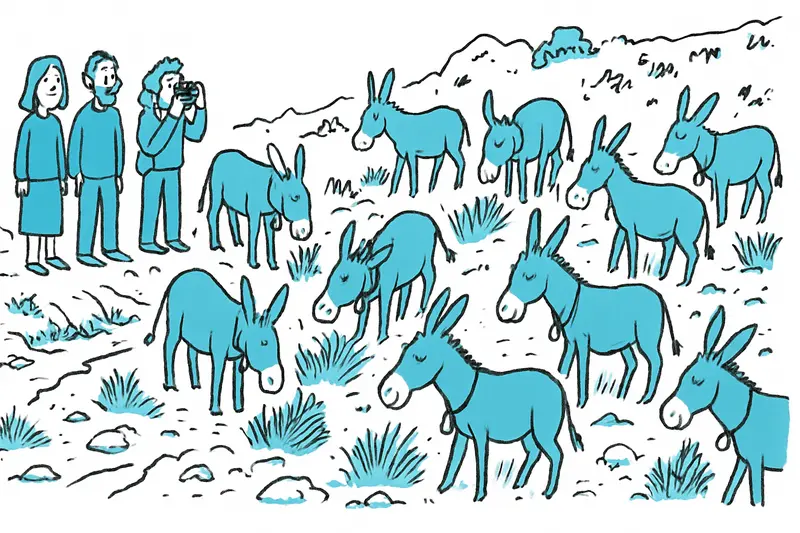
Twelve Mallorcan donkeys are grazing this autumn in Sóller's seasonal streams. Quiet, emission-free and effective, they reduce vegetation — a reminder that not every task requires a machine.
Cool Donkey Work in Sóller: Twelve Gray Donkeys Keep the Streambeds Short
If you walk through the orange valley near Sóller in the morning, you first hear the soft tinkling of horse or donkey bells, the scent of damp earth after a cool autumn rain and the distant roar of the Tramuntana. Not the thunder of an excavator, but the leisurely snorting of animals fills the air: this year twelve Mallorcan donkeys are at work in several sections of the dry torrents to mow the vegetation in the streambeds — in their own particular way.
The method is simple: the animals graze down the grown vegetation, eating grass, reeds and young shrubs where heavy machines can hardly reach. The result is not only a tidier streambed but also less dust, no engine noise and no exhaust — aspects that matter more than you might think in a sensitive valley like Sóller's, between orange groves and steep torrent banks.
A 2015 study shows that grazing can significantly reduce plant cover; the donkeys' work can significantly lower plant biomass, in some cases by up to around 52 percent. That makes the animals a surprisingly effective complement to mechanical interventions, especially in hard-to-reach areas.
On the ground the scene seems almost nostalgic: walkers along the Camí del Castell stop, photographers search for the best light, and children from the Plaça watch with wide eyes as the animals leisurely nibble along the riverbank. Residents appreciate that the work is done without construction noise and that the donkeys reach spots where no shovel would fit. At the same time, the measure is pragmatic: less biomass means a lower fire load and thus a small but tangible increase in safety during the drier months.
Of course this raises questions. Donkeys can only be part of a holistic management plan; some sections still need technical interventions. And there are animal welfare and conservation aspects to consider: anyone expanding grazing must pay attention to grazing schedules, protecting rare plants and the health of the animals. Practically, this means clear fencing in sensitive areas, regular veterinary checks, well-trained herders and established water points for the animals.
Those who want to view the whole thing as a model can start with a few concrete steps: municipalities could map vulnerable stream sections, involve local donkey herd owners in management plans, create funding guidelines for sustainable grazing and set up simple monitoring points — photo trails, fixed measurement points and volunteers from the neighborhood who observe changes in vegetation. Schools could organize visits so children learn how traditional livestock can help shape modern problems.
A small coordination with the fire brigade and foresters is also conceivable: if the donkeys systematically reduce the fire load in certain months, this can be incorporated into preparations for hot summer months. Small pilot projects can be tested relatively inexpensively in Sóller and quickly provide data on whether the approach can be transferred to other valleys.
In the end one simple thought remains: not every task always needs more technology. Sometimes patience, a few carefully selected grey animals and people who organize the interaction between nature and use are enough. In the orange valley you see that every day — and instead hear only the soothing clink of bells marking a sustainable order.
A resident of Sóller who often walks along the torrent and observes scenes like this knows the value of this mix of tradition and forward thinking. Maybe this is exactly the small impetus Mallorca needs for quieter, greener maintenance.
Frequently asked questions
What is the donkey grazing approach used to manage streambeds in Sóller?
How does donkey grazing affect safety and the environment in Mallorca’s Sóller valley?
Can visitors watch the donkey grazing in Mallorca’s Sóller area?
What are the practical considerations for using grazing animals in Mallorca’s stream management?
What planning steps could help scale donkey grazing in Mallorca?
When is donkey grazing most suitable in Mallorca, and does weather matter?
How does donkey grazing compare with traditional mechanical maintenance in Mallorca's valleys?
Could donkey grazing become a model for other Mallorca valleys?
Similar News

'We must be very careful'? A reality check on Mallorca's tourism debate
Hoteliers and politicians draw a mixed assessment of the season: economically satisfied, socially strained. Key question...

Prominence Alone Is Not Enough: The Case of Germania Mallorca and the Reality Behind the Dream
After six games the coach is gone. What does that say about ambitions, leadership and everyday life at FC Germania Mallo...

Blackboard on Mondays, Microphone on Weekends: How a Teacher Conquered the Ballermann Stage
She carries teaching materials and playback kits with her: once an elementary school teacher in Germany, today a fixture...
No More Coal Dust: Es Murterar Becomes an Energy Runway for the Future
End of an era: The last coal units at the Es Murterar power plant are being shut down. For Mallorca this means cleaner a...

Winter over the island: Who keeps flying, who pauses — and what does that mean for Mallorca?
Palma airport reports almost eight million seats for the coming winter season. Between expansion by some carriers and co...
More to explore
Discover more interesting content

Can Cap de Bou

Townhouse Lleo 72
