
Where is my tree? Pere Garau marks the gaps in urban greenery
Pere Garau fights for shade: residents mark bare tree pits with cardboard trees, calling for replanting, care sponsors and binding rules for street works.
Where is my tree? Pere Garau marks the gaps in urban greenery
When you stroll along Calle Reyes Católicos from the market in the morning with a coffee, it’s not only the heat that stands out. It’s what is missing: shade. Already in the first meters you notice the bare spots — empty tree pits, concreted-over holes, exposed roots where trees once stood. The neighborhood smells of fried fish, car paint and dust, the vendors’ voices echo, yet the share of green is shrinking.
The guiding question everyone is asking now
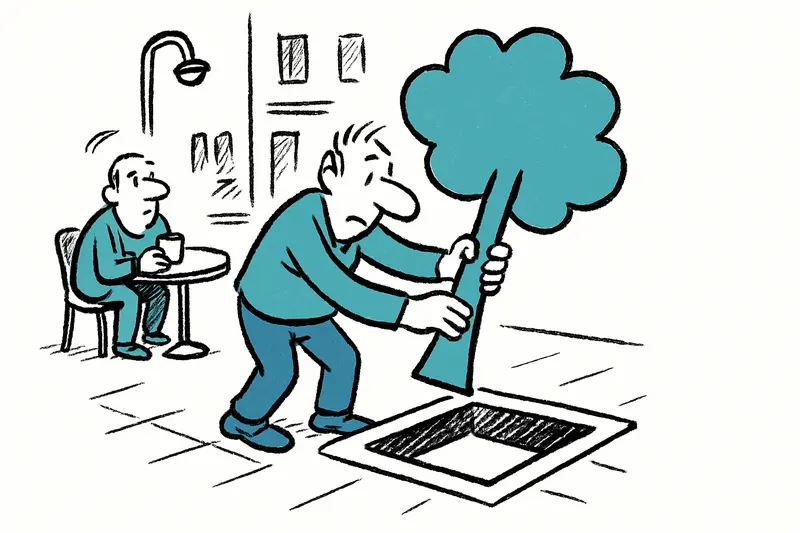
Who is responsible when avenues develop gaps? Is it the Ayuntamiento, the contractors, delivery drivers or the long series of small decisions that mean saplings never grow up? ¿Dónde está mi árbol? Vecinos de Pere Garau marcan huecos en la vegetación urbana, a group of committed neighbors, has made this a public question. They have drawn maps, collected photos and instead of forgotten stumps set up small cardboard trees — visible, ironic and uncomfortable.
More than just an aesthetic problem
The loss of urban trees is not only a planting issue but an infrastructure issue. More shade means lower temperatures on summer days, less dust, less noise, more outdoor meeting places. A resident at the market stall describes how the asphalt is already reflecting heat back at eight in the morning. Children walking to school find shaded spots less often. And business owners speak of fewer customers on hot streets.
What the map shows — and what is rarely debated
The map by “Pere Garau saludable” documents nearly 15 years of change: street works, new driveways, delivery zones, but also long-term neglect. Little noticed in public debate is that many tree pits are concreted over out of convenience or for short-term logistical advantages — often without long-term permits and without replacement. Saplings disappear not only because of vandalism, but because of missing irrigation, unsuitable species choices and the fact that planting obligations during construction are not enforced.
Concrete deficits on site
In Pere Garau the basics are often missing: sufficiently deep planting pits, simple irrigation connections, protective edges against parked delivery vans. Some young trees are planted without anyone ensuring they are watered through the first summer. Others are placed where there is too much foot traffic or are squeezed by makeshift paving works. And repeatedly public space is subordinated to pragmatic uses: a free tree pit is more quickly reallocated as a loading zone than replanted.
Proposals from the neighborhood — practical and concrete
The initiative does not stop at criticism. Their demands are pragmatic: a binding replanting obligation for all street works, a municipal tree register with photos and a care plan, visible sanctions against illegal concreting Alarma en Palma: el vecindario se opone a las talas de árboles en la Plaza Llorenç Villalonga and the introduction of care sponsorships where neighbors water together and report damage. Technical proposals: permeable surfaces instead of concrete, deeper rather than shallow pits, and Mediterranean, resilient species such as Holm oak (Quercus ilex), carob (Ceratonia siliqua) or hardy olive trees as first choices along sunny stretches.
Why this is more sustainable than symbolic plantings
Planting alone is not enough. Care concepts, budgets for regular replanting and clear responsibilities between the Ayuntamiento and subcontractors are needed. Only this way can you prevent the street becoming bare again after a few years. A municipal tree plan, tied to building permits and funds for maintenance, could close gaps before they appear.
Get involved — and join in
Those who want to get involved: “Pere Garau saludable” meets on October 18 at 19:00 in the market hall. Topics include specific locations, care sponsorships and a list of tree species that can cope here. Bring a water bottle — the discussion could get heated, and shade is scarce.
Conclusion: Urban trees are not an ornament but part of the city’s infrastructure. In Pere Garau it becomes clear how quickly this infrastructure is undermined — not only by large construction projects but by a sequence of small decisions. The map of cardboard trees is therefore less a reprimand than a call to action: act before the street becomes a sunlit canyon for good.
Frequently asked questions
Why are some streets in Pere Garau so hot and lacking shade?
What is the best time of year to walk around Palma if you want more shade?
Can you still walk with children through Pere Garau in summer?
What should you wear or bring for a walk in Pere Garau on a hot day?
What is happening with the trees in Pere Garau, Palma?
Who is responsible for planting and maintaining street trees in Mallorca neighborhoods?
What tree species work well in hot, sunny streets in Mallorca?
How can residents help improve urban greenery in Pere Garau?
Similar News
Release after bloody attack in Palma: Why the court's decision raises questions
An 18-year-old who allegedly inflicted a serious neck injury on a man at Plaza Gomila using a wristwatch wrapped around ...
Kidnappings in Inca: Three young men forced into car trunks and abused in the forest – a reality check
In Inca, three 18-year-old men were forced into car trunks by masked assailants at the Plaça des Bestiar, taken to a for...
Spreading Massification: The Brake That Still Has Much Work to Do
Marga Prohens announces limits on volume tourism. The measures sound harsh — but are they enough to save everyday life, ...
Through the Keyhole onto the Party Yacht: How Daniela Katzenberger Is Planning Her 40th on Mallorca
Daniela Katzenberger turns 40 and wants to celebrate it on the island — likely with a boat, cake and her mother. A relax...
By Boat Instead of the Road: Palma's Water Bus — a Reality Check
The 'Bus Nàutic' launches in two stages — but questions remain over interim operations, fares and environmental requirem...
More to explore
Discover more interesting content

Can Cap de Bou

Townhouse Lleo 72
