
Drones over Son Rutlan: Why Palma's new surveillance flight is not a simple solution
Drones over Son Rutlan: Why Palma's new surveillance flight is not a simple solution
Since April SFM has been using drones with thermal cameras and loudspeakers to prevent graffiti on trains and depot grounds. A reality check: what the technology can do, what it doesn't solve and which questions remain open.
Drones over Son Rutlan: Why Palma's new surveillance flight is not a simple solution
A reality check on drone surveillance against graffiti on Mallorca's railway premises
Guiding question: Can nighttime drone flights over shunting tracks really solve the problem of graffiti, or do they merely shift it — and at whose expense?
Since April, drones equipped with thermal cameras and loudspeakers have been flying in the area of the SFM Son Rutlan depot. In addition to the drones, the railway company has incorporated more security staff, new cameras, a dog unit and the expertise of a handwriting specialist into its security concept. The company states there are 20 to 25 patrol flights per night. The background is significant costs: last year the company reported six-figure cleaning and damage expenses; 37 wagons alone were affected. This year further incidents with five-figure damage sums have been recorded.
It sounds like a clear message: more technology, more personnel, tougher enforcement. At first glance this is an understandable reaction: trains and rail facilities are partly protected monuments and their operation depends on how clean and intact carriages and tracks are. But when you pass Son Rutlan at night and the distant lights of the Plaza in Palma fade, you still hear the clatter of trains and sometimes distant barking. These sounds make clear that this is about more than paint on metal: it's about public space, maintenance costs and the question of how a city enforces order.
Critical analysis: drones provide visibility and deterrence, but they are not a cure-all. Thermal images help detect people in the dark, and loudspeakers can deter intruders. But graffiti artists often act quickly, organized through international networks and social media channels. Meeting points, "hit-and-run" actions at remote locations and well-prepared groups cannot be permanently stopped by surveillance copters alone. In addition: if footage such as flight recordings is to be used in court, the chain of evidence must be documented lawfully — from identification to data storage (see Drone in the Sky over Palma: Why 35 Minutes of Chaos Aren't the Whole Story).
What is missing in public debate: 1) A clear discussion about privacy and the legal basis for nighttime drone flights over urban areas and operational sites (as highlighted by Drone over Son Sant Joan: Investigations, Gaps and the Question of Effective Prevention). 2) Transparent information on storage, access and retention periods for the recorded images. 3) A cost-benefit analysis: how much does drone operation cost per year, and what is the expected saving from avoided cleaning and damage? 4) Plans for prevention instead of only repression: schools, legal walls, educational work with young people.
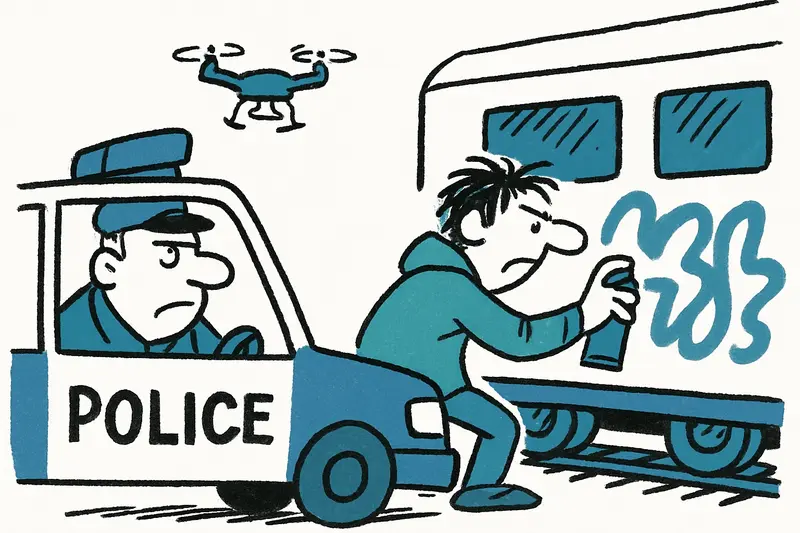
An everyday scene: it's Wednesday, just before midnight; on the street behind the Son Rutlan depot a train is rolling toward Estació Intermodal. Nearby a patrol car stands with a small drone on its roof, which is just making its rounds. A guard shines a headlamp over the premises, dogs pant. An older resident opens a window and asks whether the flights will also record his surveillance camera. The question echoes — not only in this street. Many people want security, but not permanent monitoring of their living environment (a concern sharpened after incidents such as Drone paralyzes Palma — why a small device makes our airport vulnerable).
Concrete approaches beyond drones: first, rapid cleaning and repair teams that remove visible damage even faster; that reduces the "stage" for copycats. Second, comprehensive anti-graffiti coatings on trains and key facilities that make cleaning easier. Third, legal wall spaces and a commissioned art program for young people as an alternative to illegal spraying. Fourth, transparency rules and an independent body to oversee drone and camera data, including deletion deadlines. Fifth, cooperation with platform operators to make coordination among international groups harder, and preventive measures in schools and youth centers.
Legal and ethical protocol: if image material is to serve as evidence, clearly defined rules are needed — who analyzes it, who stores it and how long the material remains accessible. Without such rules there is legal uncertainty that could later complicate or invalidate proceedings. The effectiveness of the new tactic should also be measurable: fewer incidents, lower costs, faster case resolution. Otherwise it remains expensive technology with unclear impact.
Conclusion: the drones are a clear signal — the railway no longer wants to stand idly by. But surveillance alone will not make the graffiti phenomenon disappear. Anyone who wants to change things in the long run must combine surveillance, prevention and participation. Son Rutlan needs cameras and dogs, yes, but also cleanliness strategies, legal transparency and opportunities for creative expression. Without this trio the island will remain in repair mode — and paint on the trains will keep coming back.
Frequently asked questions
Why is Palma using drones at the Son Rutlan railway depot at night?
Can drones actually stop graffiti on Mallorca railway property?
What kind of security measures are used at Son Rutlan besides drones?
Is it legal to fly surveillance drones over railway areas in Mallorca at night?
Are drone cameras in Palma recording nearby homes and private spaces?
How expensive is graffiti damage on Mallorca’s trains and depots?
What else could Mallorca do to reduce graffiti on trains apart from drones?
What is the goal of Palma’s drone patrols at Son Rutlan?
Similar News
When the Wallet Becomes a Danger: Attack in Peguera and Lessons for Mallorca
In Peguera, two women are said to have stolen the wallet from a 75-year-old German couple. When the victim intervened, t...
Plata stays Plata: Young people take over, Llonguets remain
A small bar on Carrer de l'Argenteria will continue: Tolo Serra hands the place over to young Mallorcans at the end of t...
Unnoticed in the Luggage Compartment: How a Boy Traveled More Than 100 Kilometers in a Team Bus
A minor traveled in the undercarriage of a team bus for more than 100 kilometers until his cries for help were heard. A ...

Cap Vermell Grand: Second Michelin Key – a Gift for the East
The Cap Vermell Grand in Capdepera has been awarded its second Michelin key. For the region this elevates the luxury off...
Eurowings lets four aircraft carry names – a friendly idea that also reaches Mallorca
Eurowings is launching a campaign: four Airbus A320s are to carry the first names of people who help others in everyday ...
More to explore
Discover more interesting content

Can Cap de Bou

Townhouse Lleo 72
