
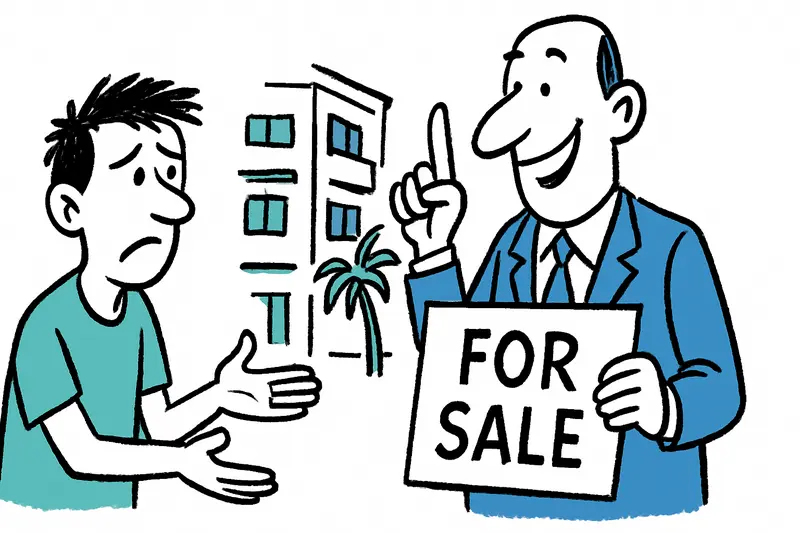
When Every Fourth Apartment Goes to Foreigners: Mallorca Between Investment and Living Space
When Every Fourth Apartment Goes to Foreigners: Mallorca Between Investment and Living Space
The Spanish central bank reports: in 2025 every fourth buyer in the Balearic Islands had no residence in Spain. On the streets of Palma this is already everyday life. What does this mean for young Mallorcans — and what could the island do now?
When Every Fourth Apartment Goes to Foreigners: Mallorca Between Investment and Living Space
Key question: How can Mallorca remain a place to live for locals when a significant share of sales goes to non-residents?
Almost every second property in the Balearic Islands in foreign hands – what does this mean for Mallorca? in 2025 on the Balearic Islands every fourth sold property was purchased by a person or buyer without Spanish residency. This is not an abstract statistic: you can see the consequences in the city — in the shadow of the cathedral, in the La Lonja quarter and along the Passeig del Born. Estate agents often have shop windows full of offers, and in the evenings you hear in many neighborhoods, alongside the tourist noise, the voices of buyers who rarely see the garbage collectors.
Critical analysis: outside money drives prices up (Mallorca in the Stranglehold of Speculation: When Apartments Become Financial Products). When demand no longer stems only from the local labor market, purchase and rental prices move into a different sphere. Life becomes tighter for young people, apprentices, healthcare and care workers. The national central bank points out that high purchase and rent prices make access to housing more difficult; at the same time the stock of publicly available social housing in Spain is small (Balearic Islands: Housing Becomes a Luxury — Who Will Stay on the Island?). On an island whose economy depends heavily on tourism, this creates a tension: investors see safe assets, island residents search for a roof over their heads.
What is missing from the public debate? Three things in particular: first, concrete transparency about the use of acquired properties — second homes, short-term rentals, long-term rentals or vacant investments? Second, reliable local data: which municipalities are permanently losing residents, which areas are becoming pure second-home zones? Third, a tangible strategy for how public housing can be expanded without trapping the island in bureaucratic pitfalls.
A scene from everyday life: mid-morning at the Plaça Major a baker who has worked here for 25 years sits down. In the past two young families lived in the adjacent houses. Today they are often short-term renters or holiday guests. The small neighborhood shop complains about declining regular customers; regulars no longer earn enough, they say, to live nearby. This is not an isolated outburst of feeling, this is a change you can smell — fresh bread versus the diesel of delivery vans for holiday apartments.
Concrete approaches that could work in Mallorca:
1) Build more social housing targetedly: Municipalities should actively secure land and, together with regional authorities, construct affordable housing. New buildings with commitments to longer-term leases could be promoted through subsidies or expedited permits.
2) Fiscal steering: A model with tiered tax rates: higher charges for vacant properties or units primarily used for short-term rentals; tax relief for owners who rent long-term to local tenants.
3) Transparency register: A public, locally maintained register of property ownership and usage types would enable decision-makers to steer more precisely. This requires clear data-protection rules, but it is not rocket science.
4) Municipal acquisition options: Municipalities should be given preferential pre-emption rights in larger sales so that affordable housing does not disappear entirely into private hands.
5) Cooperative models: Community land trusts or cooperative housing can take land out of the speculative market. On an island with strong neighborhoods, trust in such models can grow.
These proposals are no panacea. They run into legal constraints, national tax rules and a real estate industry that seeks returns. But they are practicable if politicians, municipalities and civil society act with clear priorities.
What to do now: The discussion must not stop at headlines. A local inventory is needed — who buys, how are properties used, how is the population structure changing in the neighborhoods? At the same time, immediate measures must take effect: record vacant apartments, create incentives for long-term renting, advance municipal construction projects (Buying and Renting in Mallorca: Why Prices Are Pushing Locals to the Edge — and What Could Help Now).
Concise conclusion: A goal of keeping a third-of-a-million population will not succeed if housing becomes a pure capital investment. Mallorca faces a decision: make space for investors — or create paths so that the people who work and live here can continue to live here. Those who still want to hear the voices of young people at the evening markets of Santa Catalina should act now.
Frequently asked questions
Why is Mallorca's housing market becoming more challenging for locals when many buyers are foreigners?
What concrete steps could Mallorca take to keep housing affordable for locals?
How would a transparency register help Mallorca manage housing better?
Could municipalities have a tool to keep affordable homes in the market in Mallorca?
What role could public housing play in Mallorca's housing strategy?
How might cooperative housing help Mallorca communities?
What immediate actions could Mallorca take to address housing pressures now?
When is Mallorca most pleasant for exploring its neighborhoods and markets?
Similar News
Bloody clash in Canòdrom Park: What is missing in addressing violence on Mallorca's streets?
At midday on October 23, an 18-year-old man was critically injured in Canòdrom Park in Palma. The attack raises question...

Palma raises bus fares: Who pays the bill for public transport?
Single tickets rise from €2 to €3, airport trips have a reference price of €4.50. It remains unclear whether residents w...

Palma's New Indoor Pool: Sea View, Sunbeds and Space for Everyone
At Aigua Dolça, near the Paseo Marítimo, Palma has a new municipal indoor pool. For a small fee people can now train, re...
How Four Burglars Emptied Ten Houses with a Simple Trick — and What It Means for Mallorca
Four men used the impressioning technique, posed as delivery workers and accepted two years in prison. A reality check f...
Bundles of Drugs, Containers and Open Questions: A Reality Check for Mallorca
3.3 tonnes of marijuana, 80 kilos hidden in golf-ball vending machines and a 44-year-old German released on conditions i...
More to explore
Discover more interesting content

Can Cap de Bou

Townhouse Lleo 72
