
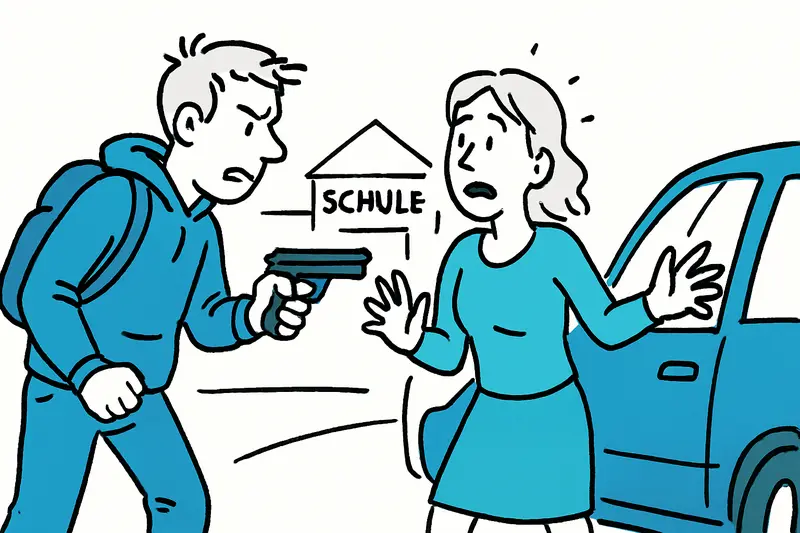
With a Fake Pistol in Front of the School: How Safe Are Morning Drop-off Zones in Bendinat?
A 16-year-old in Bendinat tried to wrest a car from a woman with a fake pistol. The incident during drop-off time raises questions about prevention, communication and youth work.
With a Fake Pistol in Front of the School: How Safe Are Morning Drop-off Zones in Bendinat?
Key question: How could a 16-year-old almost steal a car in the middle of the morning chaos at a school zone?
Early in the morning on Calle Arquitecto Francisco Casas, when the sun already warms the narrow sidewalks and the smell of coffee and croissants drifts from the cafés across the street, Bendinat is usually bustling; recent incidents such as Aggressive driver in Bendinat: Why the streets can no longer remain calm show tensions. Parents get out, children with backpacks hurry to the gate of the IES Bendinat, cars stop briefly – a hustle many of us know. Exactly at that moment, around 8:30 on a weekday, a scene escalated that usually only appears in bad thrillers: A 16-year-old student approached a waiting vehicle and pointed a weapon that looked real at the driver. The supposed pistol later turned out to be a replica. An officer of the local police who was directing traffic intervened and stopped the youth until reinforcement arrived.
At first glance this sequence sounds like a fortunate outcome: Thanks to swift action it ended with a scare. But the episode reveals several problem areas. It raises questions about school concepts, police presence in school areas, prevention work with young people and, not least, how to deal with copycat perpetrators who use fake weapons to intimidate.
What is missing in the public debate? First: motives and background. We know the suspect is 16 years old and attends IES Bendinat. But we do not know why he did it. Was it a criminal attempt born of financial need, an impulsive youthful prank with dangerous escalation, or an expression of personal problems? Such answers are often lacking because data protection, juvenile criminal law and the reserve of schools obscure details. It is also not regularly made transparent which prevention services schools and communities actually offer – from mediation to youth work, as highlighted in Alone in the Son Ferriol Schoolyard — a Wake-up Call for Greater Care.
Another blind spot is the infrastructure around drop-off zones. Many streets in front of schools are not designed for increased traffic. In Bendinat the Calle Arquitecto Francisco Casas runs along school grounds and residential areas; short-term stopping, parent taxis and pedestrians mix. Such bottlenecks create situations in which perpetrators can more easily exploit victims' attention. Added to this are social factors: mixing of different age groups, lack of supervision at certain spots and the routine that makes many parents prone to distraction – an open window, a smartphone, a glance backward.
What should be done? Concrete, locally implementable proposals are obvious: First, clear rules and visible markings for drop-off zones, reinforced by temporary bollards or areas with absolute parking bans during entry times. Such measures exist elsewhere on the island and reduce opportunities for direct approaches to vehicles. Second, coordinated presence – not static militarization, but short, regular control phases by the local police in cooperation with school staff, especially in the first weeks of school and after holiday periods, when restlessness and imitation tendencies rise. Third, low-threshold prevention for young people: workshops at school on legal consequences, the impact of imitation weapons and conflict resolution; accompanying offers such as mentoring programmes or leisure activities that catch impulses before they escalate.
Practical and local: Schools could involve 'parent marshals' from the neighborhood more strongly, i.e. volunteers who provide visibility in the mornings and at the same time act as contact persons. Municipal administrations could test mobile cameras at particularly vulnerable points in coordination with the police – privacy-friendly, time-limited and with clear rules of use. It is important that measures are not only reactive; they must explain why they make sense so that residents and parents support them.
The role of the police deserves a sober assessment. In this case a bold intervention prevented worse. That shows that presence works; similar swift interventions are reported elsewhere, for example Old Town Alarm in Palma: Three Off-Duty Police Stop Handbag Robbery — Time for a Security Check?. At the same time public safety must not be understood as a task for the police alone. Cooperation of schools, families, social services and municipalities is crucial so that the causes – frustration, peer pressure, lack of prospects – are addressed.
An everyday scene from the neighbourhood describes it better than any statistic: A father who in the morning buys the newspaper at the market by the church in Bendinat stops, hears the sirens, sees the police and the agitated parents. The conversations are short, the voices subdued. Some ask: Is my child safe? Others murmur that more programmes for young people would help. Other incidents, such as Attentive passerby stops suspected pickpocket at Mercat de l'Olivar – Why is vigilance alone not enough?, show that vigilance helps but is not sufficient. Such impressions show that safety issues are not abstract here, but negotiated between park benches, schoolyards and street cafés.
Conclusion: The incident with the replica is a warning sign, not an isolated case. It calls for a combined strategy: sensible traffic management at schools, visible – but proportionate – presence, and above all preventive offers for young people. Those who drop their children off at school tomorrow should not only hope that a police officer arrives in time. Instead we need clear rules, open communication and offerings that reach young people before they get the wrong idea. Bendinat can become safer – if municipality, school and parents act together now.
Frequently asked questions
How safe are school drop-off zones in Mallorca during the morning rush?
What makes school streets in Mallorca more vulnerable to incidents in the morning?
What should parents in Mallorca do at school drop-off time to stay safe?
Are replica weapons a real concern in Mallorca schools?
What is being done to improve safety around IES Bendinat in Mallorca?
Why do morning school zones in Bendinat need better traffic management?
Should Mallorca schools use more police presence at drop-off times?
How can Mallorca schools prevent youth incidents before they happen?
Similar News

Born conflict: Who owns Palma's most elegant promenade?
The city ordered bars on Passeig del Born to dismantle their terraces ahead of a planned sit-in. Residents, restaurateur...
Unidentified body near Tolleric: How can a person be overlooked in the middle of the island?
An older man was found dead in a patch of woodland near the cliffs of Tolleric. He had no identification, showed signs o...

Water shortage in Mallorca: Reserves shrinking, answers lacking
Despite rainfall, reservoir volumes remain low: Gorg Blau falls, Cúber rises slightly — together only 39.9 percent. Key ...
Arrest in Frankfurt after Mallorca Flight: What the Case Reveals About Gaps in the System
A 67-year-old Dutchman was arrested during a check in Frankfurt. Behind the scenes is an international warrant from Spai...
Chairs gone, debate remains: Who can really use Palma's Born in the evening?
The city had terraces on Passeig del Born dismantled shortly before a planned public action. A conflict between restaura...
More to explore
Discover more interesting content

Boat Tour with BBQ along Es Trenc Beach
Private transfer from Mallorca Airport (PMI) to Pollensa
