
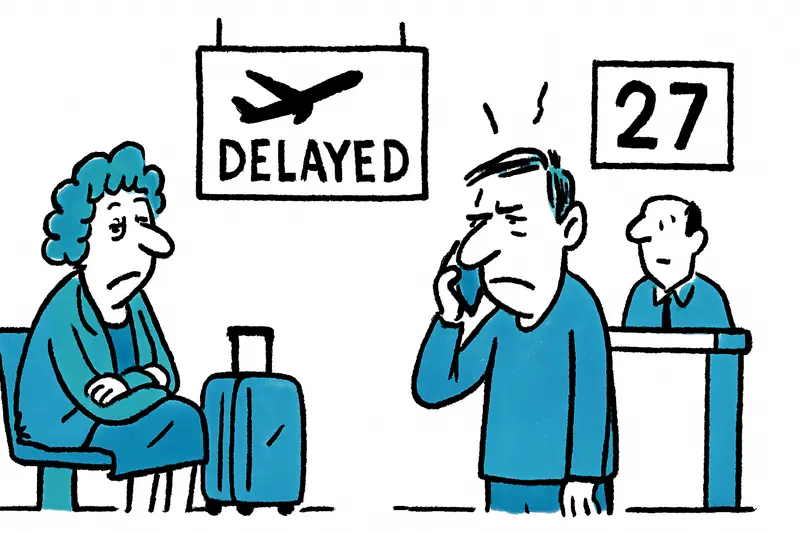
Hours of silence at the gate: Who pays for the information blackout during flight delays?
Hours of silence at the gate: Who pays for the information blackout during flight delays?
A Ryanair flight from Nuremberg to Palma departed 4 hours 34 minutes late — and many passengers received no explanation. Why are reliable updates missing, and what could change in Mallorca?
Hours of silence at the gate: Who pays for the information blackout during flight delays?
Key question: Why do people sit stranded at the gate and on board while neither ground staff nor crew provide reliable information — and who will ensure this doesn't become the norm in Mallorca?
On Sunday evening passengers on a Ryanair flight from Nuremberg to Palma waited for many hours: originally scheduled for 19:50, the aircraft did not depart until 0:24 — a delay of 4 hours and 34 minutes. Numerous flights at Palma Airport were delayed that day; the national weather service AEMET had warned of heavy showers and thunderstorms. Hours on Board: Ryanair Shock at Cologne/Bonn — Who Pays for Delayed Arrivals in Palma?
Critical analysis: More than just bad timing
Delays due to bad weather are annoying but understandable. The problem arises when communication is lacking. According to reports, at the Nuremberg gate the departure time was repeatedly pushed back without a clear explanation; boarding began at 22:00, but information on board remained sparse. This is not a harmless service glitch: missing announcements create uncertainty, frustration and often cascade into further problems — missed connections, lost pre-booked transfers or overpriced overnight accommodation in Mallorca. Reporting on hours-long delays at BER shows similar breakdowns in passenger communication.
The ripple effects are easy to observe on the island: taxi drivers on the Passeig Marítimo report calls from desperate holidaymakers, landlords in Cala Major complain about night-time key handovers, and restaurants in the old town have to shift reservations. The storms in the west, over Andratx and Sóller, are real; so too are the hours in which people are neither informed nor advised.
What is missing from the public debate
The discussion often stalls at the weather. Communication is its own problem area. No one asks loudly enough: What information chains exist between AEMET, airport management, ground handling and the airline? Who is responsible for announcements at the gate, for proactive customer notifications via app, and who should assist at night when hotels or car rental companies mistakenly book? The debate also touches on operational moves such as Ryanair postpones the switch to digital boarding passes.
Equally rare is a discussion about the practical implementation of EU passenger rights. Compensation may be possible, but many affected travellers do not know the deadlines, do not know what documentation is required and shy away from the effort — especially while on holiday.
Everyday scene in Mallorca
It is just after midnight in Palma. Rain lashes the street lamps on Avinguda Joan Miró, and the airport smells of wet asphalt and diesel. A young taxi driver waits for the arrival list, worry lines on his forehead: 'People call, they're tired, they have no message, nobody helps them.' Beside him sits an older woman whose suitcase stands in the rain; she had hoped for a notification that never arrived.
Concrete solutions
1) Binding communication protocols: Airports and airlines should agree on mandatory updates — at the latest every 30 minutes for delays of one hour or more. These announcements must be made in several languages and also delivered digitally via gate displays and push notifications to booked passengers.
2) Weather integration into operational planning: AEMET warnings should be automatically prioritized so that airports and airlines can adjust staffing and ground processes early (extra staff at gates, clear on-site contacts).
3) Visible help points for stranded travellers: Extra desks with trained staff for accommodation, transfers and rebooking — reachable at night as well. Partnerships with local transport providers and hotels could secure short-term capacity.
4) Transparent information on passenger rights: Airports could provide visible on-site and online summaries and links to EU Regulation EC261; airlines should additionally offer simple online claim forms and extend service hours.
Conclusion
Weather remains unpredictable, but information policy does not have to be. The scene at the gate in Nuremberg and the empty streets before a rainy Palma show: clearer processes and more responsibility from airlines and airports are needed — not just on paper. For travellers this means: collect receipts, stay calm and know that rules exist. For decision-makers it means: less operational myopia, more channels of communication and infrastructure that works in stormy hours. Seven Hours of Waiting at BER: What the Mallorca Weekend Taught Us
Frequently asked questions
When is the best time to visit Mallorca for good weather and fewer crowds?
Is it safe to swim in Mallorca's sea in the summer?
What should I pack for a trip to Mallorca?
How can I get around Mallorca without a car?
Which places are must-see on a first trip to Mallorca?
How does Mallorca's weather and sea temperature vary through the year?
Are there family-friendly activities in Mallorca suitable for kids?
What should I know about language and money when visiting Mallorca?
Similar News

From the Reality Studio to the Pitch: Aleks Petrovic Makes Mallorca His Base
The former participant in numerous TV shows moves from Dubai to the island and launches a project with FC Germania Mallo...
When the Phone Falls Silent: Concern for Sarah Joelle in Mallorca — and What It Reveals
After days without a response, the TV personality's unreachability in Mallorca sparked concern. Shortly afterwards an al...
Ultraluxury on the Ground: Four Seasons Jet in Palma — a Reality Check for Formentor and the Island
A high-priced flight crosses Mallorca and its guests stay for days at the Formentor resort. What does the island get bes...

Death of a Witness and the Justice Backlog: Why the Kegel Brothers Trial Matters in Mallorca
A witness in the Playa de Palma fire case has died, and the trial against eight German holidaymakers has been delayed un...

Champagne Reception, Red Carpet and Mini Originals: The Pre-Nit del Art at Gallery Mensing
Almost 400 guests, champagne, pop-art feats by Tom Boston and a raffle for the Parkinson's foundation: Gallery Mensing t...
More to explore
Discover more interesting content

Can Cap de Bou

Townhouse Lleo 72
