
How serious are the threats from "Blocus Mallorca"? A reality check from Palma
A call, a provocative poster, the mention of "terror" — and a city securing its shop windows. What is behind the escalation, who benefits, and what is missing from the conversation?
How serious are the threats from "Blocus Mallorca"? A reality check from Palma
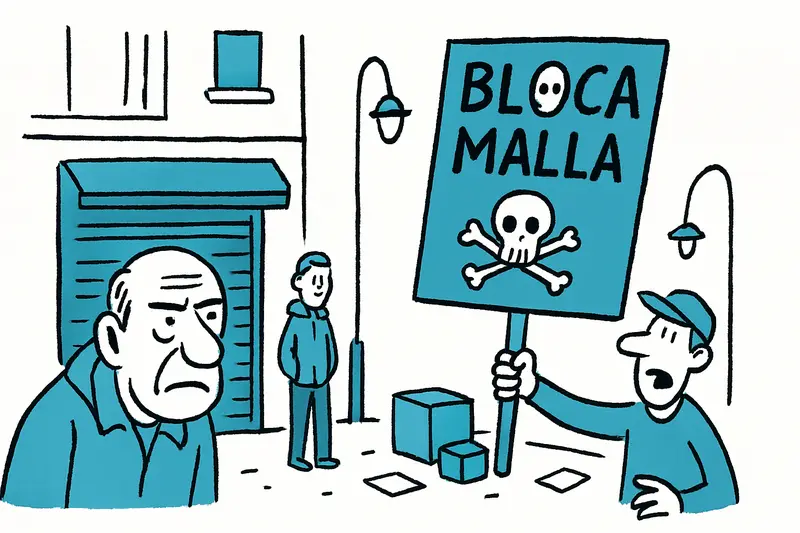
Key question: How dangerous is the threat circulating on social networks under the name "Blocus Mallorca", and how should Palma respond? In recent hours the group spread a provocative poster loaded with drastic wording that speaks of a renewed mobilization for the evening. At the same time, images from Friday come to mind: clashes on Plaça d'Espanya, fireworks, arrests — and six minors in whose possession police mannequins and corrosive liquids were found.
Critical analysis: The problem has several layers. First: the mobilization technique. Anonymous accounts, virality via Instagram, TikTok and encrypted messaging services allow an idea to become visible on the streets in a short time. The message itself — the threat of a "terror" as it was disseminated — is deliberately exaggerated. That stokes fear and creates polarization. Second: the composition of participants. Observers see young people driven by the dynamics of social networks, and at the same time aesthetic elements that can be adopted by right-wing circles. Third: the real danger. Despite dramatic wording, concrete evidence of planned attacks is not publicly verifiable; yet the behavior of individuals — fireworks, stalking, carrying objects that appear dangerous — has already created a risk to public safety.
What is missing in the public debate: The discussion so far focuses on images and headlines. There is a lack of sober information about who is behind the calls, which channels they use, and which concrete measures the police and city administration are taking. Another deficit is prevention: Why are minors so easy to mobilize? What role do schools, families, youth work and digital education play in this dynamic? And: How do shop owners, the Mercat de l’Olivar and business associations coordinate their protection measures with the police?
Everyday scene from Palma: Anyone walking along Plaça d'Espanya at dusk notices the change: shutters slowly being pulled down; a bakery at the edge of the plaza whose owner nervously places cardboard in front of the window; the streetlights casting a yellow glow on scattered leaflets. An older passerby shakes his head: "We've had noisy nights here before, but such threats make you afraid." Police sirens cut through the air, and business owners whisper to each other about whether they should close earlier today.
Concrete solutions: First, create transparency: city authorities and security agencies must clearly communicate what findings exist without jeopardizing investigations. A daily situation report for traders by SMS or via the municipality's official channels would reduce uncertainty. Second, digital prevention: schools and youth centers need ready-to-deploy information packages that explain how disinformation works and how groups can avoid being drawn into escalating dynamics. Third, targeted police strategy: presence where escalation potential is high, combined with de-escalation teams and mediators who can intervene between groups. Fourth, legal and regulatory steps against repeat offenders and against the use of certain messaging channels for concrete planning of crimes — always within the bounds of the rule of law. Fifth, coordination with retailers: a situation center for residents and shopkeepers, short phone numbers for quick reports and agreed protection plans for central nights (for example on Halloween) would strengthen the sense of security.
What the city can do immediately: visible but proportionate police presence on Plaça d'Espanya and around the Mercat de l’Olivar, public guidance to avoid rumors (facts instead of speculation), and an offer for young people to take part in calm, moderated forums. Platform liability remains a difficult field; in the short term, local communication and prevention work is more effective.
Why caution is advised: Overreactions are dangerous. Too harsh measures against freedom of assembly or hasty blanket condemnations of young people feed the narrative of threat and can further inflame the situation. At the same time, the safety of citizens, businesses and children must not be sacrificed to the risk of allowing radical groups to act unchecked.
Concise conclusion: The dramatic threat is frightening, but above all it acts as an accelerant in an already tense situation. What matters now is to deliver a mix of transparency, prevention, targeted policing and social outreach. Palma needs rationality instead of rhetoric — and quick, visible steps so that fear and improvised protective measures do not dominate the city's evening scene again.
Frequently asked questions
Is the threat from Blocus Mallorca real, and should I be worried when visiting Palma?
How is Palma responding to the Blocus Mallorca threat?
What should residents and visitors do to stay safe in Palma during tense evenings?
What role do schools and youth centers play in preventing digital mobilization in Mallorca?
How should shop owners respond to potential disruptions in central Palma?
What is the real level of danger behind the social media posts about Blocus Mallorca?
How can the public avoid being drawn into escalating dynamics online in Mallorca?
What immediate steps can Palma take now to reduce fear and maintain calm on Plaça d'Espanya?
Similar News
Ceiling collapses in tapas bar in Palma - three guests slightly injured, establishment temporarily closed
In the Mavi tapas bar on Carrer 31 de Desembre, an approximately 16-square-meter section of a suspended ceiling collapse...
How clean is our La Seu? – Giant rats in front of the cathedral force Palma to a reality check
Large rats were sighted at the base of the cathedral in Dalt Murada. A local review: who is responsible, what is missing...
Cool Donkey Work in Sóller: Twelve Gray Donkeys Keep the Streambeds Short
Twelve Mallorcan donkeys are grazing this autumn in Sóller's seasonal streams. Quiet, emission-free and effective, they ...
'We must be very careful'? A reality check on Mallorca's tourism debate
Hoteliers and politicians draw a mixed assessment of the season: economically satisfied, socially strained. Key question...
Prominence Alone Is Not Enough: The Case of Germania Mallorca and the Reality Behind the Dream
After six games the coach is gone. What does that say about ambitions, leadership and everyday life at FC Germania Mallo...
More to explore
Discover more interesting content

Can Cap de Bou

Townhouse Lleo 72
