
Car on the Paseo Marítimo in Flames – Bang, Smoke and Many Questions
A BMW burned out on the Paseo Marítimo. Fortunately the driver was uninjured. But how safe is the promenade — and what could have been avoided?
Bang in the evening, flames in seconds: a car burns out on the Paseo Marítimo
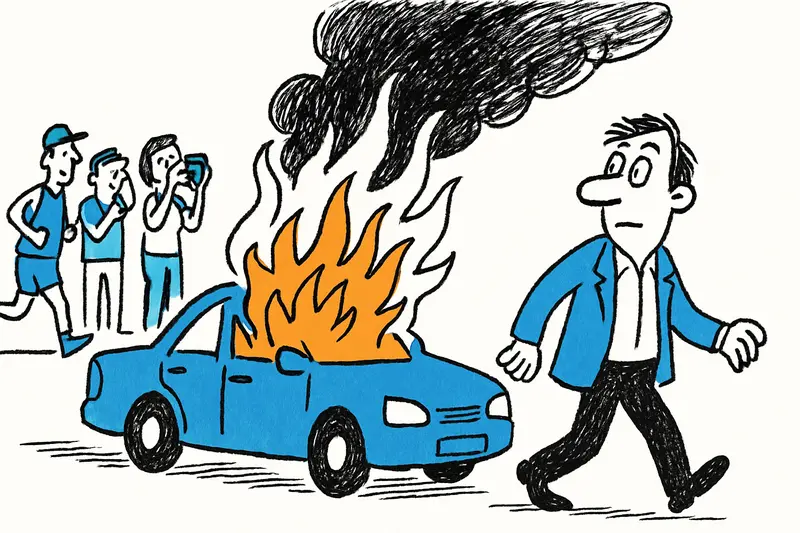
It was just before 9 p.m., the promenade still humming with life: joggers with headphones, a few photographers, the lapping of the harbor basin, and the scent of coffee and sea. Then a loud bang — and seconds later flames shot up beneath a parked car. Excited voices, the beep of mobile cameras, dogs barking: this is how an evening that quickly took a different turn for a stretch of the Paseo Marítimo began, as reported in Coche en llamas en el Paseo Marítimo: estallido, humo y muchas preguntas.
What exactly happened?
Witnesses described the vehicle as a BMW 318. A woman from a street café watched the driver get out, close the door and walk away. Shortly afterwards flames rose beneath the car and a dense, dark grey plume of smoke drifted across the street, as detailed in Fuego en el Paseo Marítimo: un coche en llamas, muchas preguntas. A bus driver immediately grabbed a handheld fire extinguisher and tried to douse the fire — a brave effort, but only briefly effective.
The port police cordoned off the area, arranged diversions and managed the first minutes until Palma’s professional fire brigade arrived with breathing apparatus and hoses. The emergency services extinguished the fire, but the car was largely burned out. The driver remained uninjured and did not require medical treatment.
Could the fire have been prevented? The central question
This scene raises a guiding question: could a technical defect, regular maintenance or quicker intervention have prevented the car from burning out? Official investigations into the cause of the fire are still underway, but the incident raises larger questions that often get too little attention in public discussion.
First: How often are vehicles parked in the promenade area even though many pedestrians use the space? Second: Are there enough easily accessible extinguishers for passersby to bridge the critical first minutes? And third: Are older vehicles on Mallorca’s roads more frequently affected because of faulty wiring or neglected maintenance?
Everyday operations: between horns, sirens and dismay
Typical Palma: taxis honked, delivery vans twisted through a diversion, and passersby gathered to watch or to continue their evening. The voices of harbor workers mixed with police instructions. For a short time the smell of burnt rubber and petrol dominated the bay while seagulls continued circling undisturbed. Such small escalations are over quickly, but they leave an uneasy memory for many.
Aspects often overlooked
Public perception usually focuses only on fire safety or traffic disruption. Less attention is paid to organizational points: How well are emergency routes along the promenade kept clear? Are parking areas in tourist-sensitive spots regularly inspected? And how is information provided to residents and business owners about first aid for vehicle fires?
Another technical point concerns modern vehicles: the combination of high temperatures, damaged wiring or a ruptured fuel line can quickly escalate. Electric or hybrid vehicles bring other risks — batteries that enter thermal runaway in batteries. Although this case involved a conventional combustion engine, preventive measures are urgently needed in the long term.
Concrete opportunities and solutions
What can be done? In the short term, visible handheld extinguishers or fixed extinguishing points at heavily frequented spots on the Paseo Marítimo could help, consistent with guidance about fire extinguishers. The city administration could install information signs guiding passersby on how to behave in the event of a vehicle fire.
In the longer term, regular targeted inspections of parking areas would be sensible, especially in the evening hours when the promenade is full of people. An awareness campaign about vehicle maintenance and simple fire safety measures — for example how to deal with a burning hood — could reduce many small risks, following practical vehicle maintenance tips.
Finally, a look at infrastructure is worthwhile: wider emergency lanes, clearly visible no-parking zones in sensitive spots and joint exercises by port police, fire brigade and municipal services would save minutes in an emergency.
What matters now
Investigations into the cause of the fire are ongoing. Anyone who saw anything is asked to contact the police. The lesson for residents and visitors: an evening stroll along the bay can quickly be interrupted by an unfortunate incident. It’s good that no one was hurt this time. Even better would be if we derived concrete safety improvements from such incidents — so that on the Paseo Marítimo the sound of the waves is once again the focus and not the smell of smoke.
Frequently asked questions
What happened on the Paseo Marítimo in Palma when the car caught fire?
Is it common for cars to catch fire on Mallorca roads?
What should I do if I see a car fire in Palma?
Why is the Paseo Marítimo in Palma so busy and difficult in an emergency?
Could a vehicle fire on Mallorca be prevented with better maintenance?
Were there any injuries in the Paseo Marítimo car fire in Palma?
Can a handheld fire extinguisher really help with a car fire in Mallorca?
What does the car fire on Palma’s Paseo Marítimo mean for local safety?
Similar News

Release after bloody attack in Palma: Why the court's decision raises questions
An 18-year-old who allegedly inflicted a serious neck injury on a man at Plaza Gomila using a wristwatch wrapped around ...
Kidnappings in Inca: Three young men forced into car trunks and abused in the forest – a reality check
In Inca, three 18-year-old men were forced into car trunks by masked assailants at the Plaça des Bestiar, taken to a for...
Spreading Massification: The Brake That Still Has Much Work to Do
Marga Prohens announces limits on volume tourism. The measures sound harsh — but are they enough to save everyday life, ...

Through the Keyhole onto the Party Yacht: How Daniela Katzenberger Is Planning Her 40th on Mallorca
Daniela Katzenberger turns 40 and wants to celebrate it on the island — likely with a boat, cake and her mother. A relax...
By Boat Instead of the Road: Palma's Water Bus — a Reality Check
The 'Bus Nàutic' launches in two stages — but questions remain over interim operations, fares and environmental requirem...
More to explore
Discover more interesting content

Can Cap de Bou

Townhouse Lleo 72
