
Mallorca in a Dilemma: 1.5 Million Inhabitants, Traffic Jams and Housing Shortage – A Reality Check
Mallorca in a Dilemma: 1.5 Million Inhabitants, Traffic Jams and Housing Shortage – A Reality Check
The 2025 indicators report warns of an island with 1.5 million inhabitants, massive traffic problems and an increasingly thinned-out housing and agricultural structure. What is missing from the public debate — and what can be done locally?
Mallorca in a Dilemma: 1.5 Million Inhabitants, Traffic Jams and Housing Shortage – A Reality Check
Key question: How threatened is the island really if the population grows toward 1.5 million and in summer up to two million people are present at the same time — and what is missing from the public debate?
Critical Analysis
The 2025 indicators report from the civil society forum is not science fiction; it lists development trajectories: projections of up to 1.5 million permanent residents, as discussed in a Mallorca Magic report on demographic boom in the Balearic Islands, seasonally even two million people, air and sea traffic that could reach 56 million passengers by 2050, and already today 29 tourists per resident (figure 2024). These numbers meet an island whose economy depends about 70 percent on the service and hospitality sector. The consequences are measurable: households here spend on average 56.4 percent of their income on mortgages; seven percent live in extreme poverty, and among families with children it is more than eight percent. In terms of traffic, residents lose on average 17 minutes per day over just ten kilometers — Mallorca ranks high nationwide for time lost due to congestion. At the same time, water consumption and waste volumes are rising; renewable energy projects are expanding, but their effects are being eaten up by population and usage growth.
What Is Missing from the Public Debate
Talk about "sustainability" and an "eco-tax" is not enough when central steering instruments are missing or do not work. The debate systematically neglects: binding capacity limits for certain areas, transparent long-term planning for housing versus tourist use, as examined in an analysis of how many inhabitants Mallorca can support, a clear strategy for reclassifying land (instead of blanket approval of green fields for photovoltaics) and genuine cost-reflective pricing for water and waste. Political consensus is often invoked — in practice there are hardly any binding mechanisms to enforce spatial planning and social housing provision.
An Everyday Scene
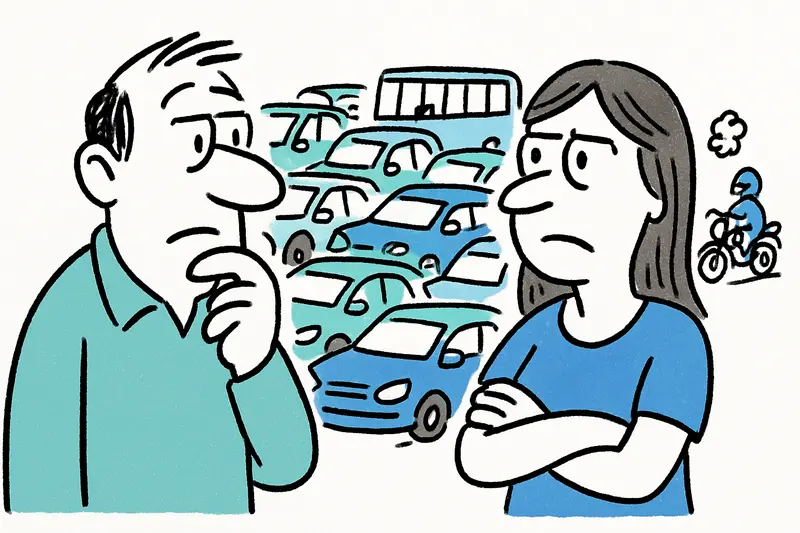
Imagine a Tuesday morning on the Vía de Cintura: buses squeeze into lay-bys, cars move in stop-and-go, motorcyclists look for gaps. On the Passeig Mallorca a young family is on the phone: they have a viewing in Santa Catalina, the apartment is above their budget. An older farmer in the Pla de Mallorca is thinking aloud about leasing a plot to an operator for solar modules because the rent seems more stable than apple farming. Scenes like this are increasingly seen in many parts of the island.
Concrete Approaches
1) Binding island plan: A recognized, legally binding master plan with annual indicators (population, visitor numbers, traffic, water, housing) and clear thresholds that trigger concrete rules when exceeded (e.g., limits on short-term rentals in certain zones). 2) Mobility policy with priorities: Expansion of the island rail and bus network, zones with car-free main axes (Palma-Born, historic center corridors) and pilot urban toll or fee models for heavily burdened corridors; more park-and-ride facilities on through roads. 3) Housing fund and binding quotas: A public-private fund for affordable housing, backed by binding quotas for new construction projects and a real registry for short-term rentals with sanctions. 4) Protect agriculture, targeted energy sites: Subsidies and tax incentives for land management, fire protection premiums for active farmers, photovoltaics prioritized on roofs, industrial and fill sites rather than fertile land. 5) Water and waste policy with price signals: Advanced tariff models, investments in reuse and planned desalination capacity combined with consumption reduction through technology grants. 6) Institutional reform: A citizens' forum plus an independent indicators office for public data transparency and annual audit reports; regional coalitions instead of short-lived council majorities.
What Is Needed in Practice
Many of these approaches are not new — the problem is their interplay and implementation. It requires politicians who enforce long-term rules and administrations that do not treat land as a short-term source of income. It also requires bold pilot projects: a car-free holiday zone, a ten-year trial for restricting new short-term rentals, targeted support for farms that commit to preservation.
Concise Conclusion
Mallorca is not inevitably heading for catastrophe, but the fog of routine makes decisions costly. Numbers like 1.5 million inhabitants or 56 million passengers are clocks that are ticking. Without binding steering instruments, growth will bring scarcer space, higher prices and greater social fractures. The island still has resources: engaged municipalities, active farmers, start-ups and craftspeople who want to operate differently. If politics and civil society do not tackle and test the instruments now, it will be decided in the coming years whether Mallorca remains an orderly island or becomes a patchwork of overloads.
A reality check also means: speak honestly about uncomfortable truths and start locally. Look out for your neighbor, go to the town hall meeting, ask about the indicators — or watch the Vía de Cintura next Tuesday.
Frequently asked questions
Why is Mallorca under so much pressure from population growth and tourism?
Is it still possible to find affordable housing in Mallorca?
How bad is traffic in Mallorca during the year?
What practical changes could help Mallorca manage growth better?
What is the Vía de Cintura like during rush hour in Palma?
Why is housing in Santa Catalina so hard to find?
What is the situation for farmers in the Pla de Mallorca?
Can Mallorca still balance tourism, housing, and daily life?
Similar News
Why the End of "Los Últimos Mohicanos" Is More Than the Closing of a Bar
With squealing tires and one last glass, an icon on the Palma–Manacor expressway closes. Why the demise of this German b...

Protest camp on Plaza España: Who asks for solutions to the right to housing?
Around 30 activists set up a tent camp on Palma's Plaza España to push for stronger tenant rights. Our analysis asks: Ar...

In the Name of a Gang: Alleged Extortion in El Molinar and What It Reveals About the Protection of Sex Workers
A man is accused of posing as a member of the Hells Angels and extorting two women at accommodation in El Molinar. The s...

When Chile Meets the Mediterranean: A New Flavor at Can Bordoy
At Can Bordoy in Palma's old town, Chilean chef Jhonatan Maldonado combines Patagonian seafood with Mediterranean island...
End of an Era on the Ma-15: Why the Biker Hangout at Son Gual Is More Than Just a Restaurant
"Los Últimos Mohicanos" closes unexpectedly. A meeting place for motorcyclists on the Palma–Algaida border is disappeari...
More to explore
Discover more interesting content

Can Cap de Bou

Townhouse Lleo 72
