
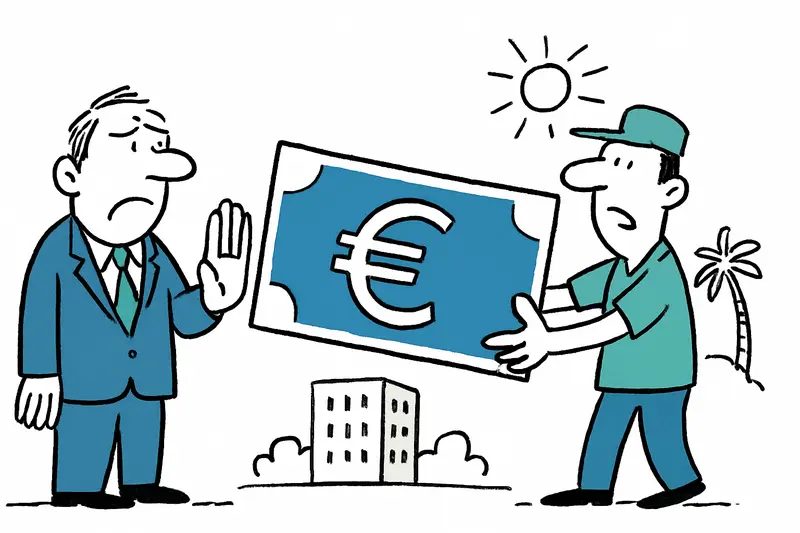
Mallorca and EU Funding: Sustainability Also Needs Limits
Funding can make hotels and municipalities more efficient. But using less water per guest still does not answer how much tourism the island can withstand.
If tourism funding is to be called sustainable, it must also address limits
Can public money actually reduce the pressure tourism puts on Mallorca—or does it simply make the existing model a little more efficient? That is the question that should be on the table every time a new funding round begins. A more water-efficient system, a digital visitor counter or a newly renovated public square can all be useful. But they do not tell us whether less water is ultimately being used, less land is being taken up, or life is becoming easier for the island’s residents.
The word “sustainability” is convenient. It fits solar panels, better waste sorting and modernised pipes. All of these can make a difference. But they can also lead a business to accommodate more guests while using less per person, leaving the overall burden largely unchanged. Efficiency is not the same as setting limits. This distinction often gets lost in political debates because the former is easier to translate into building plans and funding guidelines.
What actually counts as success?
Funding programmes often measure whether a project has started, a system has been installed or a target has been reached. For the island, a different balance sheet matters: How is the overall burden changing? Is less water actually being used during the high season? Is more space remaining available for public use? Are traffic flows being eased, or is visiting simply being organised more conveniently? And does a municipality benefit beyond the funding period—not just an individual business?
New infrastructure may be necessary, but that does not automatically make it a remedy for having too many visitors. If a municipality upgrades its wastewater system, that is generally beneficial for the environment and residents. But it does not follow that additional demand would have no consequences. Assessing funding solely by whether it pays for visible improvements confuses repair with a change of course. The real political question is: What kind of development should this money enable—and what should it avoid fuelling further?
The gap between green technology and less pressure
On Mallorca, the tension is easy to spot in everyday life. In summer, people wait at a bus stop in Palma as suitcase wheels rattle over the paving stones and the bus is already crowded. In another town, it gets packed by the water, even though residents still need to shop, get to work and go about their daily lives in August. Such scenes are not statistics and cannot replace measurements. But they show why “better organised” does not automatically mean “less pressure.”
Public discussion often lacks a question about distribution: Who decides which places receive funding? Who bears the costs of construction, increased traffic or additional operations? Who can later check whether a project delivers on its promises? And what happens if it does not? Without clear answers, “sustainable” remains a label that can be attached to very different projects.
The timeline matters too. A project may save energy in the short term while supporting greater demand over the years it operates. Conversely, an unremarkable measure—such as better tracking of water use or visitor numbers—may make political decisions possible in the first place. That may be less photogenic than a new building. But on an island with limited resources, good measurement can be more important than another opening ceremony.
What better funding policy would look like
First, funding goals should include a measurable impact on the overall burden, not just on consumption per business or per guest. Second, they should include clear baselines and publicly accessible assessments: What was the situation before, what has changed, and who is checking? Third, some funding should explicitly support projects that protect land, restore nature or limit use of sensitive places—provided they are soundly planned and agreed with local communities.
Fourth, potential side effects need to be assessed honestly. If a project encourages additional hotel beds, more journeys or new seasonal peaks, that should be stated openly. Fifth, municipalities and residents must be involved early, not only once a plan is practically complete. This is more demanding than distributing funds quickly. But funding is public money, and on Mallorca the consequences of poor planning are not abstract: they show up on roads, in pipes, on beaches and in municipal budgets.
This does not mean that every investment in tourism is wrong. A broken pipe remains broken, however complicated the political debate may be. But maintenance should not be presented as proof that growth itself has become sustainable. A green roof does not resolve the question of how much pressure a place can bear. An efficient system cannot replace a decision about how much use a place can withstand.
The reality check is simple: Good funding should not merely make Mallorca better equipped to handle more tourism. It must also be able to help reduce pressure—and do so in a verifiable way. As long as this impact is not the central criterion, sustainability remains an improvement within the system, not necessarily an answer to its limits.
Frequently asked questions
¿Qué significa que el turismo sea sostenible en Mallorca?
¿Pueden las ayudas de la UE reducir la presión turística en Mallorca?
¿Ahorrar agua por huésped significa que Mallorca consume menos agua?
¿Cómo se puede saber si una ayuda turística ha funcionado?
¿Por qué renovar una infraestructura no siempre reduce el turismo?
¿Qué deberían tener en cuenta los municipios de Mallorca al repartir ayudas turísticas?
¿Cómo afecta la presión turística a la vida diaria en Mallorca?
¿Qué tipo de proyectos pueden ayudar a proteger los recursos de Mallorca?
Similar News

Free Buses in Mallorca: Relief with No Clear End in Sight
Madrid wants to extend free travel on season passes and multi-journey tickets through 2027. Before parliamentary approva...
Mallorca’s Olive Oil in Storage: A Rule That Hits Small Mills Hardest
Spain is requiring olive mills to withhold twelve percent of their monthly production until autumn 2027. In Mallorca, th...

Mallorca and the Vehicle Limit: The Crucial Questions Are in the Fine Print
A limit on cars in Mallorca sounds simple. In practice, exceptions, enforcement and reliable alternatives will determine...

On the Board, Not on the Towel: Learn to Surf in Palma Bay
When autumn swells roll into Can Pastilla, the bay becomes a place to practise. Beginners quickly discover that surfing ...

Formentor: Wildfire Remains Active—What the Hectare Count Doesn’t Tell Us
Fire crews are still battling a blaze on the Formentor peninsula that has affected at least 280 hectares, according to t...
More to explore
Discover more interesting content

Can Cap de Bou

Townhouse Lleo 72
