
Mallorca as a Postcard Image: When Advertising Kisses the Cliché
An airport poster shows Palma as an idyllic fishing alley. Key question: Does such advertising romanticize our island — and who really benefits?
Mallorca as a Postcard Image: When Advertising Kisses the Cliché
Key question: Does attractive advertising also sell the truth about our island?
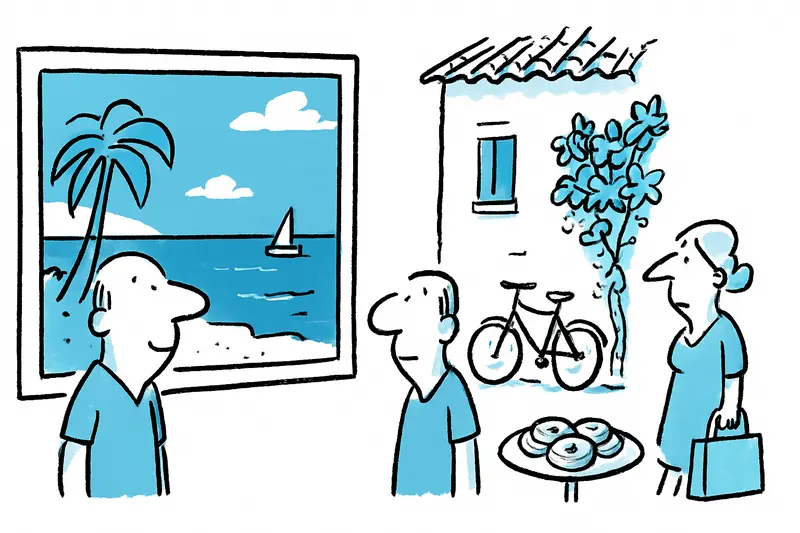
A large advertising poster at the airport Posters, Provocation, Polarization: How Mallorca's Streets Become a Campaign Ground, a bicycle at a flowering house corner, ensaimadas on a table, and behind them the azure-blue sea — this is how a recent campaign shows Mallorca. Beautiful to look at, no question. But the small scene raises a bigger question: Do such image snippets turn our living environment into a cliché conveniently digestible for tourists and thereby render invisible the everyday reality on the ground?
The critical analysis begins with the image itself. Es Jonquet, narrow alleys, blooming sidewalks, a boat on the horizon — all of that belongs to the island. At the same time, the loud engine noises from the Passeig Marítimo New Dining Spaces on the Quay: Between Postcard Scenery and Real Neighborhood Life, the queue of taxis at the airport, and the focal points of the modern port with cruise ships and yachts are missing. An advertising message selects; it stylizes. It becomes problematic when the selection repeatedly reproduces the same narrative: Mallorca as a little Mediterranean-romance snack, free of traffic problems, housing shortages or seasonal overloads — Reality Check: Why Mallorca Can Hardly Escape Massification.
In public discourse it often remains unexamined how such images shape visitors' expectations. If travelers only have postcard motifs in mind, they encounter a different island upon arrival. Disappointment is preprogrammed, and the local reaction can range from indifference to resentment. Also rarely discussed: who benefits economically from these images — In the Rhythm of the Night: Who Really Benefits from Mallorca's Tourism? Airlines, hotels and short-trip providers sell longing. The people who live here often bear the costs of scorching summers, rising rents and overcrowded beaches.
An everyday scene in Palma in the early evening: On the Plaça de la Llonja restaurant owners chat while a delivery van honks as it passes the corners. Two older women with shopping bags sit down, a boy whizzes by on a scooter, and the smell of fried fish mixes with the exhaust of a nearby bus line. Such moments are missing from the perfect advertisement because they are complex — and therefore harder to sell.
So what is missing in the public conversation? First: the perspective of residents. How do pedestrian zones, parking, noise levels or rents look from the everyday point of view? Second: transparency about image selection processes. Who decides which Mallorca reality is shown? Third: a debate about responsibility in advertising. Visualizations influence mobility, expectations and thus also political issues like urban planning and tourism management.
Concrete approaches. Municipalities could promote image databases with authentic local motifs — available for campaigns that show the island's diversity. A voluntary code of conduct for tourist advertising, developed with entrepreneurs, photographers and resident representatives, could provide guidelines: no downplaying of problems, labeling of strongly stylized depictions, and inclusion of local providers. Airports and outdoor advertisers can involve local bodies in ad reviews instead of deciding solely on aesthetic criteria.
Further measures would be pragmatic: more funding for campaigns that highlight jobs and traditional businesses; support for local photographers and agencies Mallorca Seen Anew: A Photobook That Slows You Down; mandatory accompanying texts on large-format advertisements that provide context — in short: a balance between selling a dream and an obligation to truth.
A possible pilot project would be cooperation between a municipality like Palma and an airline: instead of showing only the postcard motif, a series of images could accompany an information campaign about sustainable mobility, local offers and behavioral tips for guests. That can boost sales and at the same time set expectations more realistically.
Pointed conclusion: It is not a crime to show Mallorca as beautiful. It becomes problematic when beauty becomes a one-way street that overlooks other realities and downplays local burdens. Advertising has power — it shapes images in people's minds. We on the island should ensure that these images also depict the life that takes place behind the facades. Only then will Mallorca remain more than a postcard.
Frequently asked questions
When is the best time to visit Mallorca for beaches and hiking?
What should I pack for a trip to Mallorca?
Can you swim in Mallorca year-round?
What are classic Mallorca towns to visit on a short trip?
How can I get around Mallorca without a car?
Are there family-friendly activities in Mallorca?
Is the sea safe for swimming for beginners in Mallorca?
What should I know about Mallorca's weather by season and packing tips?
Similar News
Palma–Lyon in Winter: Two Weekly Flights Bring Fresh Momentum
From October Transavia France will connect Palma and Lyon in winter as well: Wednesdays and Saturdays, around 17,000 sea...
Budget holidays in Mallorca: What thriftier tourists really mean
Visitors are spending less: shorter stays, fewer restaurant visits, fewer excursions. A reality check for Mallorca's eco...
Mallorca gets winter link to Lyon: Transavia France flies from October
Transavia France will launch a winter direct connection Palma–Lyon from late October: twice weekly, around 17,000 seats ...
Ses Fontanelles: 1,700 Years Underwater – the Wreck That Makes Mallorca Proud
A Roman merchant ship lay hidden for 1,700 years off Can Pastilla. Now Ses Fontanelles is in the spotlight: salvage, con...
Mini-tsunamis in Mallorca: Harmless natural phenomenon — or an underestimated danger?
Two harbor towns in Mallorca recorded unusual water level fluctuations. An analysis: How rissagas form, who is at risk —...
More to explore
Discover more interesting content

Boat Tour with BBQ along Es Trenc Beach
Private transfer from Mallorca Airport (PMI) to Pollensa
