
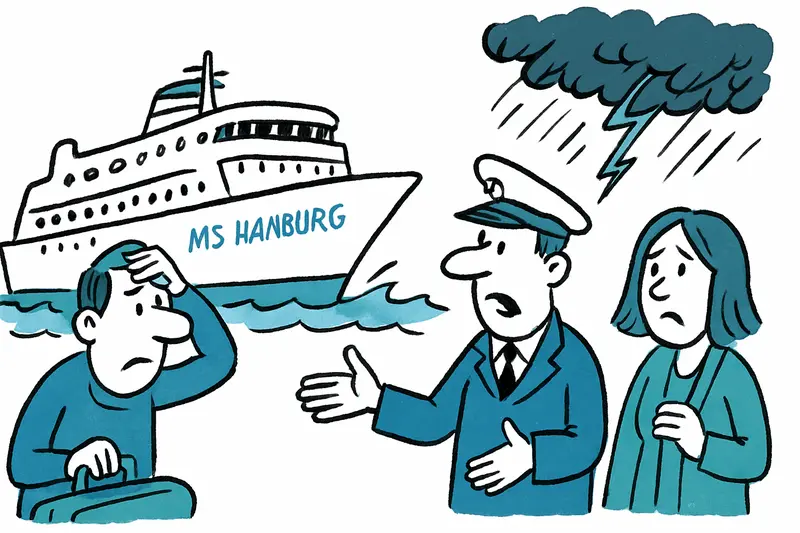
"MS Hamburg": Storm in the Bay of Biscay Delays Departure – Safety Decision or Logistical Fiasco?
"MS Hamburg": Storm in the Bay of Biscay Delays Departure – Safety Decision or Logistical Fiasco?
Shortly before departure, the MS Hamburg's embarkation port was moved from Hamburg to Genoa due to an expected storm with waves up to ten meters. Was this unavoidable, how were guests cared for, and what is missing in the public discussion?
"MS Hamburg": Storm in the Bay of Biscay Delays Departure – Safety Decision or Logistical Fiasco?
Key question: Was moving the departure port to Genoa the only sensible option — or could the damage to passengers and the operator have been reduced?
In the morning, when the refuse collectors sweep the last olive leaves off Passeig Mallorca and the espresso still steams in the café across the street, travel agencies on Plaça de Cort debate the headlines. Here on the island we also received the news: the small cruise ship "MS Hamburg", known as Germany's smallest ocean liner, will not begin its world voyage as planned in Hamburg. The tour operator Plantours justified the change with a storm over the Bay of Biscay, where waves of up to ten meters are expected.
At first glance the decision seems simple: captain and operator see a risk — and choose safety. But on closer inspection a series of practical and organizational questions arise that hardly appear in the public information.
The main points in the fact check: the itinerary would have crossed the Bay of Biscay during the first leg. In this sea area short, very high waves and steep seas can occur; a forecast of up to ten meters must be taken seriously. At the same time, the MS Hamburg is not a vessel on the scale of large cruise liners, so wave size plays a different role here than for giant ships.
How transparent are the reasons for the decision? The operator stated that safety takes priority. That sounds plausible. But: which criteria were applied? From what wave height is it considered "not safe enough"? Who sets that threshold — the ship, the operator, the coast guard? Such threshold values are rarely specified in communications, yet they are decisive for travelers.
Logistically, moving the departure from Hamburg to Genoa is a challenge. Plantours announced it would transport guests to Italy by bus or plane so that no one misses the cruise. A noble intention. In practice this means: long transfers, rebookings, hotel nights, luggage logistics — and inevitably time pressure. Who bears the additional costs, who arranges medical care for travelers with limited mobility, and how are transfer times coordinated with onboard check-in? These questions are compounded by other disruptions such as a recent jet fuel shortage in Hamburg.
What is often missing from the public debate are the consequences for individual passengers: families with small children, older people with medication schedules, or travelers who rely on connecting flights. Information on how to obtain refunds or on insurance coverage often remains vague. The question of whether rebooking may have fiscal or visa-related consequences is rarely raised; similar operational breakdowns have been seen in the storm chaos in Palma, which caused hundreds of delays and cancellations.
Another aspect: how well is coordination between the shipping company, the tour operator, port authorities and weather services? In Mallorca we know AEMET forecasts and the dramatic differences between a stormy Tramuntana night and a calm bay. For a world cruise that crosses the Atlantic you need coordinated, reliable information and realistic contingency plans — not just a short notice on the day of departure.
A brief look at the voyage: the MS Hamburg is scheduled to call at four continents — from European ports via Lanzarote to Rio de Janeiro and Buenos Aires, onward to the Antarctic, then Cape Town and Madagascar. The price is just under €18,000 per person. That means every change to the itinerary is more than a mere logistical annoyance: it involves substantial sums, holiday dreams and often long-planned time windows.
What is missing from the debate? First, clear, publicly available guidelines for weather-related departure postponements. Second, binding standards for guest care in the event of sudden route changes — from transfer organization to alternative accommodation. Third, transparency about financial consequences: who pays extra costs, who grants refunds, and how are connection problems handled?
Concrete proposals for how operators and authorities could manage such cases more customer-friendly and safely in the future:
1. Standardized risk thresholds: Shipping companies and organizers should publish the meteorological parameters that trigger a departure postponement. That creates predictability.
2. Pre-arranged transfer plans: For long-distance trips there must be firm agreements with bus and airline partners, including contingents for sudden relocations.
3. Transparent cost rules: Clearly listed rules in the terms and conditions about who covers extra costs and how refunds are processed.
4. Special assistance for vulnerable groups: Pre-registration for guests with mobility or health needs so that transfers and assistance are not improvised.
5. Better information chains: Coordination between operators, ports and national weather services (such as AEMET in the Balearics) for earlier warnings and aligned decisions.
6. Sustainability review: If moving the ship requires additional flights, the ecological footprint should also be discussed transparently.
On the street in front of our office at Passeig Mallorca 9A I occasionally hear the rattle of motorbike taxis and the laughter of guests still buying tickets for the markets in Inca. For those affected by the MS Hamburg voyage this incident is less of a joke: it is a reminder of how much travel dreams depend on wind and weather — and how little consumers sometimes know about the mechanics behind safety-driven decisions.
Conclusion: moving the departure to Genoa is understandable from a pure safety perspective. What remains critical, however, is the question of transparency and practical implementation. It's not just about wave height, but about clarity for people who pay a lot and expect a smooth process. Operators, shipping companies and authorities should take the opportunity to establish clear rules and better service chains — so that future storms become less of a burden and more a well-organized precaution.
Frequently asked questions
Is it safe to sail in the Bay of Biscay during rough weather?
Why do cruise departures get changed because of storms?
What happens if my cruise departs from a different port than planned?
Who pays for extra travel costs when a cruise port changes?
How can cruise passengers prepare for weather-related changes?
What role do weather forecasts play for travel in Mallorca?
Is Palma Airport affected by storms and travel disruptions?
What should travellers know about AEMET weather warnings in Mallorca?
Similar News
Nine Months on the Beach: Why Pollenca Ultimately Removed the Stranded Sailboat
A single-masted vessel lay on Tamarells beach since the storm 'Harry' in January. After the owner became insolvent, the ...

Iris Berben live in Mallorca: Award and Talk at the Evolution Film Festival
German actress Iris Berben is coming to the Evolution Mallorca International Film Festival: presentation of the Evolutio...

Serious Accident in Son Ferriol: A Car Falls from the Roundabout — What's Wrong with This Spot?
A 77-year-old driver fell on Saturday morning with his car from the upper part of a roundabout in Son Ferriol down to th...

When a Taxi Fare Dispute Turns Violent: What the Magaluf Case Reveals About Safety and Prevention
In Magaluf a 2023 dispute over a taxi fare escalated: an 18‑year‑old British man is accused of seriously injuring a taxi...

Bloody clash in Canòdrom Park: What is missing in addressing violence on Mallorca's streets?
At midday on October 23, an 18-year-old man was critically injured in Canòdrom Park in Palma. The attack raises question...
More to explore
Discover more interesting content

Can Cap de Bou

Townhouse Lleo 72
