
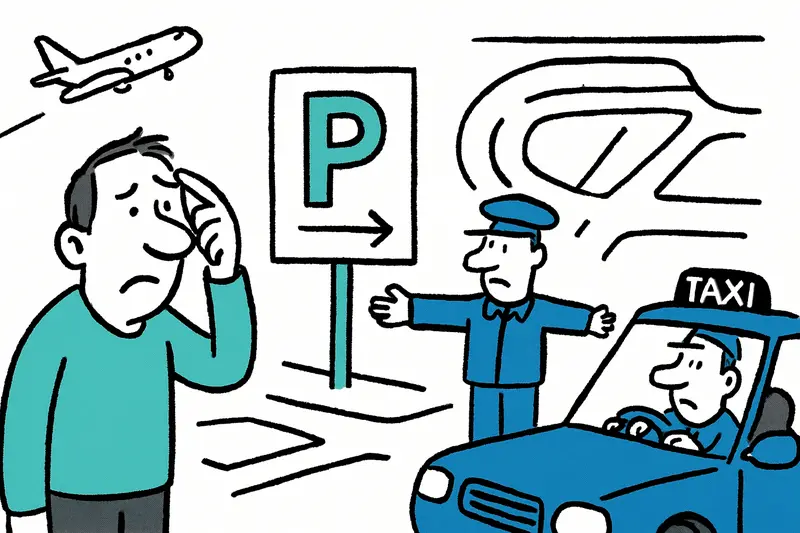
New access to airport parking at Palma: structure instead of chaos — or just shifting the problem?
New access to airport parking at Palma: structure instead of chaos — or just shifting the problem?
At Palma Airport there is a new entrance that divides parking traffic in advance. A practical solution or a source of new confusion for travelers and taxi drivers? We check what changes, what is missing and how it could work better.
New access to airport parking at Palma: structure instead of chaos — or just shifting the problem?
What the change practically means for arrivals, departures and commuters
Key question: Does the new arrangement of the barriers really prevent traffic jams — or does it create new bottlenecks because drivers, unprepared, choose the wrong lane?
Since mid-May the entrance to the parking areas at Palma Airport has been rebuilt: the barriers were moved forward, placed before the curve that leads to the arrivals terminal. Three lanes lead directly to the regular car park, three more to the express area at arrivals. Once a driver has passed through one of the barriers, they can no longer change between the parking zones. The operators state the goal is clearer traffic guidance and less congestion, similar to Palma: Elevated connections at the airport aim to ease crowding.
In the asphalt area in front of the entrance a typical picture emerged in the first days: suitcases rattling on trolleys, air conditioners humming, two taxi drivers consulting at the edge, a family hurriedly trying to find the right lane. Several older drivers stopped briefly, somewhat confused — resulting in short braking maneuvers that reached back to the access curve. The change is therefore not just a technical detail, it affects the dynamics in an area where time often equals money and patience, and it occurs alongside other adjustments at the site such as Construction at Palma Airport: Taxi stand in front of the terminal moved to the left.
Critical analysis
The idea of structuring traffic flow early has advantages. If all drivers know in good time and clearly where they must go, zigzag maneuvers and sudden lane changes can be avoided. The measure becomes problematic when advance information is insufficient: missing signage, unclear pictograms or poor navigation instructions lead holidaymakers, rental car drivers or visitors to change lanes at the last second — exactly where it is now even tighter.
A second point: the special needs of taxis, buses, people with reduced mobility and delivery vehicles. These groups often have different routines than a private car that simply wants to drop someone off. Are the parking operators' staff sufficiently trained and are stopping zones for these road users clearly marked? From on-site observations so far, visible rules for this are lacking, even as the airport implements measures like the New central bus platform at Palma Airport: clarity instead of luggage scramble.
What is missing from the public debate
Public discussion usually focuses on avoiding congestion and the free minutes. Rarely discussed are the transition phases: the first two weeks after the changeover, when uncertainty is particularly high. Also seldom mentioned is how changes in traffic routing can specifically help or hinder people with reduced mobility. The perspective of residents along the access roads — more backups at peak times, additional exhaust exposure — also hardly appears.
Concrete everyday suggestions
Daily observation at the terminal suggests simple measures that could have a quick effect: clear, large-format signs in several languages placed 300–400 meters before the split; ground markings that remain readable in low light; temporary staff on weekends and during holidays to guide drivers; and electronic displays showing available spaces in both areas in real time. For people with mobility impairments a reserved access with visible signage and staff assistance would be useful.
Technology can help: push notifications in parking apps that confirm the chosen zone upon entry, or a short information screen at the barrier explaining that a switch is no longer possible afterwards. More monitoring with cameras — not for punishment but to analyze bottlenecks during the initial operating period — would provide decision-makers with concrete data.
Conclusion
The new entrance is not a mistake but an attempt to bring order to an unclear area. Whether the measure will bring lasting relief or merely shift the location of problems depends on the implementation: information, staff and small technical improvements are decisive. Without these, the picture at the access remains that of a morning scramble: suitcases, quick decisions, a measure of frustration — and the hope of choosing the right lane next time.
Frequently asked questions
When is the best time to visit Mallorca for good weather?
Is Mallorca warm enough to swim outside of summer?
What should I pack for Mallorca in spring or autumn?
What is Mallorca like in summer for visitors?
Is Palma de Mallorca a good place to stay for a first trip?
What is Port de Sóller like for a holiday in Mallorca?
Is the weather in Mallorca reliable for a beach holiday?
Can you still enjoy Mallorca if you are not going for the beach?
Similar News

More water than last year: Mallorca's reservoirs breathe easier
September rain refilled the Tramuntana's reserves: overall fill around 35 percent, Cúber at 40.42 percent, Gorg Blau at ...

Three Luxury Hotels in Banyalbufar: Lots of Money, Many Questions
A Danish investor plans three exclusive accommodations in Banyalbufar — including the historic Son Valentí. The announce...
2.1 tonnes of cocaine on sailing yacht off Spain's coast – a reality check for the coastguard
A 14-metre yacht was seized with 2.1 tonnes of cocaine. Who monitors the ports, how does the international hunt succeed ...

Heat Bonus in Mallorca: 100 Euros Extra for Outdoor Staff at MarSenses
MarSenses pays employees who worked outdoors in August an extra €100 as recognition. Lighter uniforms, reduced hours for...

Renovating in Mallorca: What You Really Can Do Without Neighbour Consent
Many think they can do whatever they want in their apartment. That's partly true — but only as long as structural elemen...
More to explore
Discover more interesting content

Can Cap de Bou

Townhouse Lleo 72
