
Water main break in Palma: Why a burst pipe means more than just a traffic jam
Water main break in Palma: Why a burst pipe means more than just a traffic jam
A burst water main near La Vileta flooded streets and parts of the ring road. A reality check: How well is Palma's infrastructure really prepared?
Water main break in Palma: Why a burst pipe means more than just a traffic jam
Key question
What does today’s water main break at La Vileta say about the condition of the city’s infrastructure — and how can similar traffic restrictions be prevented in the future?
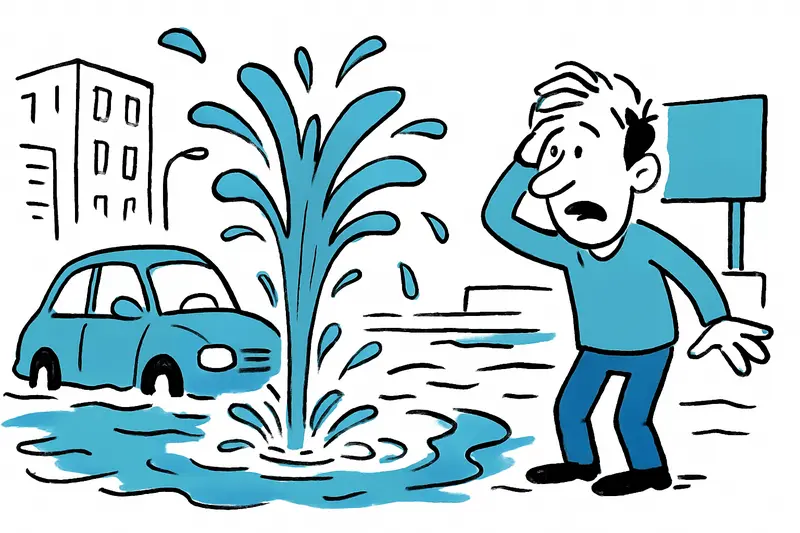
Yesterday afternoon the La Vileta roundabout briefly turned into a landscape of puddles: according to Emaya wants to renew Palma's pipeline network faster – Between promises and construction reality the water at times stood three hand-widths high on the roadway. The flood reached the ring road; towards Andratx there were backups of up to five kilometers. Several emergency teams were dispatched, the local police directed traffic, repairs began.
These scenes are familiar in Mallorca: cars honking, a bus inching slowly over the stalled roadway, and pedestrians waiting at the roadside with jackets raised and wet shoes, as seen after Burst Pipe in Palma's Old Town: Carrer Oms Underwater — A Wake-up Call for Deteriorating Pipes. In the dusk the air smelled of damp asphalt; outside a bakery on Avinguda Joan Miró a woman with her shopping trolley commented dryly: "They could have replaced that yesterday too." That small sentence hits the problem squarely: infrastructure work usually happens only when it is no longer sufficient.
Critical analysis
A pipe burst is technically a sudden, visible disruption. Politically and in planning terms it is often a symptom: aging pipes, a lack of priority for renewals, fragmented budget planning. The traffic-chaos effect arises because emergency planning and diversion management are not cleanly integrated with water management. When water runs onto the ring road the result is not only congestion, but also danger for vehicles, buses and cyclists — and for supply chains that depend on timely deliveries.
The readiness of the response teams is praised in reports, and rightly so. At the same time, the question of causes is often missing: When were the affected pipes last inspected? Are there pressure monitors or automatic leak detection on the main supply lines? As long as the answer to such questions remains unclear, we will continue to experience localized failures that have citywide consequences.
What's missing in the public debate
The city talks quickly about the immediately visible chaos — traffic jams, wet streets, bus lines held up. Less audible is the debate about systemic priorities: long-term replacement plans, transparent investment lists, prioritization by risk rather than by quarterly budgets. The interaction between water companies, road authorities and traffic control centers is also too rarely questioned publicly. It is exactly this interaction that determines whether a pipe burst remains a local nuisance or becomes hours-long traffic chaos.
Concrete solutions
1) Expand early-warning systems: Pressure sensors and acoustic leak detectors along key mains can detect leaks early and automatically notify response teams and traffic control centers.
2) Priority replacement plans: A publicly available map of the pipelines most urgently in need of replacement would create transparency and could be linked with traffic management for planned closures.
3) Enforcement and traffic concepts: Standardized diversion routes for different scenarios must be practiced; temporary signage and digital displays could be rolled out faster.
4) Less patchwork, more replacement: Budget planning by risk rather than short-term savings logic: when main supply lines age, a new lane does little good.
5) Communication to the public: Real-time information via app, SMS or roadside displays reduces uncertainty and helps commuters choose alternative routes.
Everyday observations
The day after the incident, workers return with rubber boots and toolboxes; residents sweep puddles out of their doorways. Residents of La Vileta report earlier small leaks that recurred, similar to Pipe burst in Calle Olmos: a warning sign for Palma's aging infrastructure. Such anecdotes are no substitute for technical data — but they provide clues about where the city should look more closely.
Those who drive the route towards Andratx in the morning feel the long-term effects: pupils arrive late to school, delivery vans with refrigerated goods sit in traffic, and the mood in cafés along the road is subdued. This is not an isolated case but an example of how infrastructure problems affect everyday life.
Conclusion
The pipe burst at La Vileta exposed a stress point in the urban network. Repair teams and police reacted quickly — that's good. The real challenge, however, remains structural: aging pipes, missing prioritization and patchy coordination turn individual defects into citywide problems. If Palma does not want to see such scenes more often, it needs clear, comprehensible plans, technical upgrades and open communication. In the short term a pipe will be replaced. In the long term the city must treat its infrastructure as a system — not as a series of individual construction sites.
Frequently asked questions
What is the weather usually like in Mallorca in spring?
Can you swim in Mallorca in spring?
What should I pack for Mallorca in spring?
Is spring a good time to visit Mallorca?
What is the weather like in Palma de Mallorca in spring?
Is April a good month for Mallorca beaches?
What is Sóller like to visit in spring?
What can you do in Mallorca if the spring weather is mixed?
Similar News

More water than last year: Mallorca's reservoirs breathe easier
September rain refilled the Tramuntana's reserves: overall fill around 35 percent, Cúber at 40.42 percent, Gorg Blau at ...

Three Luxury Hotels in Banyalbufar: Lots of Money, Many Questions
A Danish investor plans three exclusive accommodations in Banyalbufar — including the historic Son Valentí. The announce...
2.1 tonnes of cocaine on sailing yacht off Spain's coast – a reality check for the coastguard
A 14-metre yacht was seized with 2.1 tonnes of cocaine. Who monitors the ports, how does the international hunt succeed ...

Heat Bonus in Mallorca: 100 Euros Extra for Outdoor Staff at MarSenses
MarSenses pays employees who worked outdoors in August an extra €100 as recognition. Lighter uniforms, reduced hours for...

Renovating in Mallorca: What You Really Can Do Without Neighbour Consent
Many think they can do whatever they want in their apartment. That's partly true — but only as long as structural elemen...
More to explore
Discover more interesting content

Can Cap de Bou

Townhouse Lleo 72
