
New access at Palma Airport: traffic management or confusion?
New access at Palma Airport: traffic management or confusion?
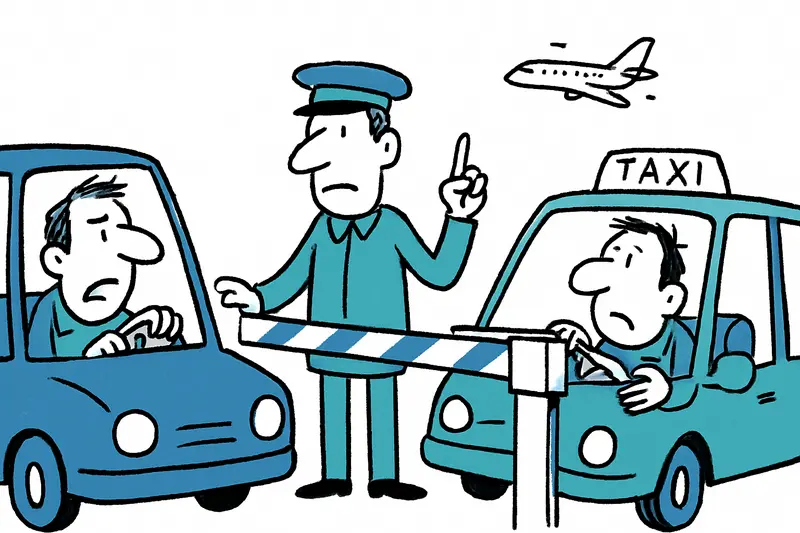
At Palma Airport the barriers are now positioned further forward. AENA intends to prevent traffic jams — but the new rule raises questions for drivers, taxis and travelers.
New access at Palma Airport: traffic management or confusion?
What has changed, what problems may arise and how it could be improved
The facts are brief and visible: At the entrance to the car park and the express parking at Palma Airport, the barriers are now positioned further forward, even before the curve to the arrivals area. According to the signs, three lanes lead to the regular car park and three more to the express parking at arrivals. Once a driver has passed one barrier, they cannot simply switch between the parking areas. AENA justifies the measure with the aim of better directing traffic and avoiding congestion, a change discussed alongside proposals such as Palma: Elevated connections at the airport aim to ease crowding. Free parking remains possible — 15 minutes at the express parking by arrivals, 10 minutes at departures.
Key question: Does this change actually lead to smoother traffic — or does it just introduce new pitfalls for the people in front of the terminal?
On paper the change sounds sensible, because any junction and any backup at the airport entrance can immediately trigger bumper-to-bumper collisions on the access road. In practice, however, airport accesses are hectic: delivery vans, taxis, rental car drivers with GPS and holidaymakers who are still running through their checklist mentally. If the decision about which of the six lanes to take has to be made earlier than before, chaos increases at the first fork. Choosing the wrong lane means for many: no possibility to turn back, unloading luggage in the wrong place, additional walking distances with suitcases, frustration, phone calls at the traffic light.
What is particularly critical and rarely discussed publicly is the transition phase. There is no reliable, publicly available information about how long the new routing will remain in place, how staff will be deployed during peak times or how strictly the entrance will be controlled, a lack of clarity also highlighted in Central Bus Stop at Palma Airport: Relief — and Open Questions. Accessibility is also insufficiently addressed: people with reduced mobility often need more time to get in and out; clearly reserved areas and assistance staff are now more important than ever.
An everyday scene: Friday morning, 8 a.m. The sun glints on the asphalt. The clatter of rolling suitcases comes from the terminal, a taxi driver calls out names, a delivery van beeps cautiously. At the new barrier layout two families hesitate, a large family with a stroller performs a half-circle turn. The parking machine speakers blare Spanish and English. A few meters further on a small queue is already forming — not because there is too little space, but because people are unsure whether they are allowed to turn left or right now, even as elsewhere the airport has tried to simplify flows such as with the New central bus platform at Palma Airport: clarity instead of luggage scramble.
These are not horror scenarios, but normal consequences of unfamiliar routing. And they can be avoided. Concrete solutions that could help quickly:
1. Visible, multilingual signage and road markings — large, at eye level and with pictograms for tourists and professional drivers. Colors on the pavement (e.g. blue for Express, green for car park) reduce decision time while driving.
2. Staff during peak periods — traffic attendants directing vehicles on site for the first two weeks to correct mistakes immediately. A short hand signal can prevent larger backups.
3. Digital pre-information — integration into rental car apps, on AENA websites and in navigation services with a clear announcement: "In 500 m: Express left, car park right."
4. More flexible turning and transfer options — temporary barrier openings or a clearly designated turning area for people with documented needs, families or in case of a wrong turn.
5. Monitoring and data disclosure — short-term traffic counts and a public evaluation after four weeks so that it is known whether congestion has actually decreased. Transparency builds trust.
Technical measures alone are not enough. Communication is crucial: many problems arise because travelers only see the change at the last moment. A small note at the rental car check-in, a sticker on tickets, an announcement in the terminal could make the route clearer than another barrier.
My conclusion: The new access has potential — but its effectiveness depends on details that AENA and the airport operator must explain, plan and control. Otherwise, an attempt to avoid queues could turn into a new confusion. That would be unfortunate for people arriving with suitcases and children. A little more staff, more information and an eye on the data would quickly calm the curve.
Frequently asked questions
What has changed at the access road to Palma Airport?
Does the new Palma Airport traffic layout reduce congestion?
Can you still park for free at Palma Airport?
What should drivers know before arriving at Palma Airport?
Is Palma Airport easy to access for people with reduced mobility?
How can visitors avoid taking the wrong lane at Palma Airport?
How long will Palma Airport’s new access system stay in place?
What signs would make Palma Airport access clearer for travellers?
Similar News

Rental Car Theft in El Arenal: What This Incident Reveals About Our Gaps
A teenager steals a running rental car in El Arenal, flees on foot, climbs over walls and is caught by the Guardia Civil...
Red Rope in Palma's Library: What Helps Against Selfie Tourism — and What's Missing
Palma's city library cordoned off an area with a red rope to keep selfie tourism away from reading and working activitie...
Fort San Carlos: Museum, Harbor Dispute — and a Conflict That Demands Answers
The military museum at Fort San Carlos sits right on Palma's harbor, with unexpectedly quiet rooms filled with cannons a...
Old Town Under Pressure: When a Doorway Becomes a Sleeping and Shower Place
For months a woman has been living with a parasol, a clothes rack and personal belongings next to the social welfare off...
When Shopping Weighs Heavier: Mallorca Demands a Tax Pause on Food and Fuel
Rising prices are putting pressure on households and agriculture. The Balearic Islands are calling for temporary tax rel...
More to explore
Discover more interesting content

Can Cap de Bou

Townhouse Lleo 72
