
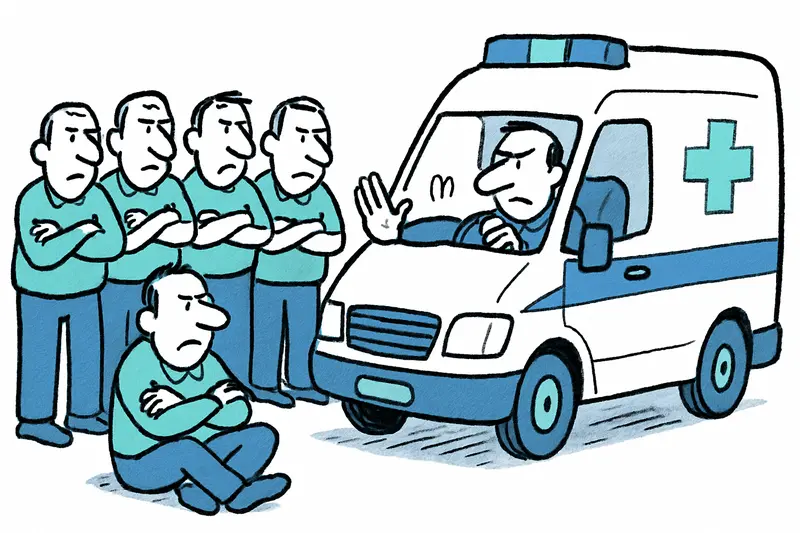
No agreement on new ambulances: drivers lay down the steering wheel
No agreement on new ambulances: drivers lay down the steering wheel
Seventy drivers refuse to operate the new, heavier ambulances. Who pays the price — patient safety or contractual obligations? A reality check from Mallorca.
No agreement on new ambulances: Who gets left behind?
Key question: Why were ambulances purchased that many drivers are not contractually allowed to drive — and who will bear the consequences?
Several new vehicles have been parked for days in the yard in front of Hospital Universitari Son Espases. They gleam in emergency yellow, look modern, but share a common problem: many of them weigh so much that a C1 driving licence is required. Among the 246 newly purchased ambulances, a portion of the regular drivers lack exactly these papers. Around 70 employees with truck licences have announced they will not drive the new vehicles. So far, the Balearic Health Authority has refused additional pay — positions are hardened. This situation was reported in Shiny ambulances sit in Palma's yard — but many cannot be driven.
This is not an abstract administrative dispute: in Palma you hear the rattling of delivery vans in the morning, the louder siren of an ambulance, the conversation of two drivers in front of a bar on the Paseo Marítimo. The patient on the third floor of a block of flats at Plaça Major waits for transport to a check-up; the question of whether a vehicle is available suddenly becomes part of her everyday life.
Analysis: the crisis has several levels. First, the fleet change revealed a discrepancy between the tender, the technology and operational reality. If procurement selects vehicles without taking the existing licence structure of the staff into account, a practical problem arises — not just a legal one, as outlined in New ambulances, empty seats: How a drivers license shortage is slowing Mallorca's emergency services. Second, it is about contract and labor law: drivers have agreed to certain vehicle classes in their contracts. They are not automatically obliged to obtain a higher licence class. Third, it concerns work incentives and recognition: refusing to take on additional tasks without compensation is a legitimate negotiating position — especially for work that increases responsibility, stress and legal risks.
What has been missing so far in the public debate is an honest inventory: Why were the vehicles ordered in this weight class at all? Was there a cost-benefit calculation that also considered training costs, licence acquisition times and possible additional pay? And what transition plans exist so that patients do not suffer from the labor conflict?
Concrete everyday scenes demonstrate the urgency: during an evening rush-hour call on the Vía de Cintura, heavier vehicles can take longer in narrow streets — this is not a theoretical problem but a matter of minutes. Drivers who commute on weekends through Platja de Palma or Alcúdia report additional stress factors: unfamiliar driving characteristics, different braking distances, difficulties maneuvering in hospital parking garages.
Concrete solutions that could take effect immediately:
1) Immediate measures: Prioritized allocation: only drivers with a C1 licence should temporarily operate the heavy vehicles. At the same time, lighter existing vehicles must remain in service until the situation is resolved. Deployment plans should be adjusted so that critical emergencies do not depend on the disputed vehicles; similar provisional arrangements were used in previous rollouts, for example Ambulances in Mallorca: Temporary measures in December — a question of driving licenses.
2) Financial transitional arrangements: Short-term allowances for shifts with C1-required vehicles or a time-limited bonus for obtaining the C1 licence. The Balearic Health Authority could cover part of the training costs — this is often cheaper than operational disruptions.
3) Training offensive: Organize fast courses and accelerated exams, offer flexible schedules for shift workers, concentrate exam dates regionally (Palma, Inca, Manacor) — funding via a joint fund from the contracting authority and the operator.
4) Technical adjustments: Check whether payload and equipment can be reduced to lower weight; in the long term, design equipment selection and tenders so that vehicle weight and staff structure match.
5) Legal and transparent review: Independent review of the procurement decision, disclosure of contract terms and impact assessment. This can help regain trust and avoid future misplanning.
What is needed now is political responsibility. It is not enough to dismiss every demand with a blanket no. A solution must reconcile three interests: patient safety, legal clarity for drivers and financial prudence for public authorities. On the island it applies: when Son Espases calls, someone should arrive safely — without arguments about whether the driver has the right licence.
Conclusion: The conflict could have been avoided. More important than assigning blame is speed now: pragmatic transitional solutions, quickly financed training and an open review of the procurement. Otherwise patients may postpone appointments, hospitals will have to improvise and the morale among crews will suffer long-term. The health authority, service providers and unions should work on an emergency plan today — not tomorrow.
Local observation to close: when in the early evening an ambulance with the new livery drives along Avinguda Jaume III, taxi drivers glance up briefly, waiters set their glasses down — on an island that must count on fast help, trust in the rescue chain is not a luxury but a life insurance.
Frequently asked questions
Why are some of Mallorca's new ambulances not being used?
Do ambulance drivers in Mallorca have to get a C1 licence for heavier vehicles?
Could the ambulance shortage affect patient transport in Mallorca?
What solution is being discussed for the new ambulances in Mallorca?
Where are the new ambulances parked in Mallorca?
Why does the ambulance dispute matter in Palma and not just in offices?
What kind of training could help ambulance drivers in Mallorca?
What should Mallorca do to avoid this kind of ambulance problem again?
Similar News
Injured captain, big plans: Germania Mallorca before the away match in Consell
The newly founded FC Germania Mallorca travels to Consell on Saturday. Captain Bastian Müller is out injured, but coach ...

Palma, Palma de Mallorca, Palma‑Mallorca: What is it really about?
The debate over the city's name is more than grammar: it concerns identity, law and branding policy. A sober reality che...

Warning to Bathers: Nipping Fish in Cala Major and Other Coves — a Reality Check
In Cala Major and several beaches around Mallorca, bathers report painful “nips”. Who are the animals, why are they gett...
Rental Car Theft in El Arenal: What This Incident Reveals About Our Gaps
A teenager steals a running rental car in El Arenal, flees on foot, climbs over walls and is caught by the Guardia Civil...

Red Rope in Palma's Library: What Helps Against Selfie Tourism — and What's Missing
Palma's city library cordoned off an area with a red rope to keep selfie tourism away from reading and working activitie...
More to explore
Discover more interesting content

Can Cap de Bou

Townhouse Lleo 72
