
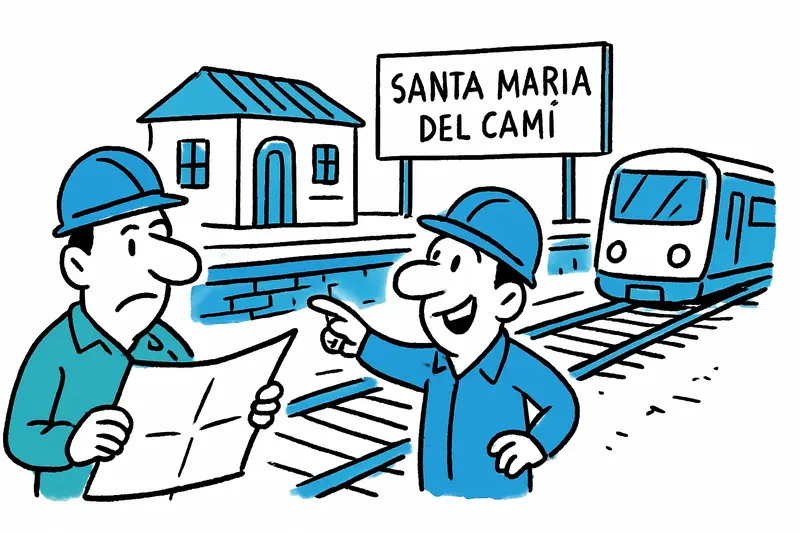
Santa Maria del Cami Station: Platforms to be renewed in 2026
Santa Maria del Cami Station: Platforms to be renewed in 2026
The Santa Maria del Camí station will receive new platforms. Around €674,000 is planned; construction begins in the second half of 2026 and will last six months.
Santa Maria del Camí Station: Platforms will be renewed in 2026
New surface, improved safety — train services remain possible during works
In the early morning, when the coffee from the bakery on the Plaça is still warm and the rubbish collection rattles down the narrow streets of Santa Maria del Camí, you repeatedly see commuters with backpacks and cyclists step onto the platform. Exactly this spot, where the daily life of the town meets the tracks, will receive a refresh next year: around €674,000 has been budgeted for the renewal of the platforms, according to Estación de Santa Maria del Camí: los andenes se renovarán en 2026.
Work is scheduled to start in the second half of 2026 and to last about six months. Good news for commuters: train services will not be completely suspended. The plan is to keep at least one platform in operation during the construction phase so that trains can continue to stop and the connection to the island's capital remains in place, as noted in coverage of related station works like La estación intermodal de Palma será renovada: nuevas escaleras mecánicas y más comodidad a partir de noviembre.
Why is this important for Santa Maria? The station is not just a pass-through — it is a meeting point, a transfer hub and occasionally the scene of short market conversations. In recent years wear and minor defects have become visible in places, not least because infrastructure has not always received sufficient investment. The upcoming works will now mean a visible improvement: new surfacing, safer edges, and likely better access for people with luggage and strollers.
The measure is part of a small repair programme: similar upgrades are also planned in Binissalem and Es Pont d'Inca; see also La Plaza España estrena nueva imagen. This is practical because the sections of track are connected and thus require less improvisation in planning during closures. For commuters between these places this means: perhaps construction noise in the coming months, but medium-term less bumpy boarding and alighting.
Around the station plaza residents will probably notice short journeys: tradespeople transporting materials, construction fences put up, and the smell of fresh asphalt instead of the light oily smell otherwise clinging to platforms. For the small shops and the café opposite, a construction site is doubly noticeable — noise in the morning, but later more passers-by who find the renewed station more attractive.
For the Balearic government the project is a manageable but concrete step: with €674,000 a lot can be improved locally without the long planning times of major projects. For Santa Maria del Camí this means: more comfort when boarding and alighting, a more modern first impression for visitors and more reliable conditions for everyday traffic.
What remains to be done before the excavator moves in? Final planning, tendering and coordination with the timetable are on the to‑do list. It is important that those responsible communicate information to commuters and residents early and clearly — so that no one is surprised in the morning by blocked paths. A clearly visible construction sign at the approach to the Estació and regular notices at the stops would already help a lot.
In the end the island community benefits: a safer, more reliable station makes commuting easier, small traders get more foot traffic, and the route between Santa Maria, Binissalem and Palma looks better kept. When next spring the first trains stop again at clean edges, you might even hear less squealing of brakes and more conversations about the new benches — ordinary local improvements that make everyday life easier.
Image: Balearic Government
Frequently asked questions
When will the Santa Maria del Camí station platforms be renewed?
Will trains still stop at Santa Maria del Camí during the platform works?
What will be improved at Santa Maria del Camí station?
How much is being invested in the Santa Maria del Camí station renewal?
Is the Santa Maria del Camí station renovation part of a wider Mallorca rail upgrade?
Why is Santa Maria del Camí station important for daily life in Mallorca?
What should commuters in Santa Maria del Camí expect during the platform works?
Will the Santa Maria del Camí station upgrade improve access for people with luggage or strollers?
Similar News

Nine-year-old rescued after cliff fall at Cala Murada — How safe are Mallorca's coastal paths?
A boy fell roughly five meters down the rocks near Cala Murada. The dusk rescue was elaborate; a helper also had to be r...

How safe are tourists in the luxury marinas? After arrests: a reality check
The Guardia Civil arrested two men in Calvià who are suspected of stealing luxury watches in Port d'Andratx and Puerto P...

Palma Chases Wealthy US Tourists — The Key Question: Who Should the City Actually Serve?
The city is investing more than €200,000 to attract high-paying visitors in several US cities. A good idea — but what is...

Enough swimming: Why Port de Pollenca is louder than the sea
More than 200 people formed a human chain in Port de Pollenca — not only as a protest but as a wake-up call. Guiding que...

Mysterious disappearance in Alcúdia: Where is 24-year-old Lisa B.?
Since August 3 there has been no trace of 24-year-old German Lisa B. The family has traveled to Mallorca and urgently re...
More to explore
Discover more interesting content

Boat Tour with BBQ along Es Trenc Beach

Private transfer from Mallorca Airport (PMI) to Pollensa
