
Reality Check After the Eclipse: What Mallorca Needs to Learn from the Night
The total solar eclipse was a spectacle — and at the same time a stress test for Mallorca's infrastructure, environmental protection and crisis management. How well did the island really react, and what is missing from the public debate?
Reality Check after the Eclipse: What Mallorca Needs to Learn from the Night
Key question
How well was Mallorca prepared for a surge that pushed the island to capacity limits in several places — and what do municipalities, authorities and visitors urgently need to do differently?
Evening summary
In the evening, promptly at 20:31, the sun disappeared for about one and a half minutes over the island and turned pale dusk into a short, impressive darkness. Tens of thousands gathered on beaches, harbours, viewpoints and in villages; at some spots the crowds were so intense that traffic closures had to be implemented earlier than planned. More than 2,000 emergency personnel were on standby, and rescue services recorded 36 incidents — mostly traffic disruptions. An estimated 60,000 people gathered in Platja de Palma.
Critical analysis
The event revealed several weaknesses. First: traffic planning. Closures were planned but felt reactive rather than proactive. The Ma-10, access roads to Sa Calobra, parking at Puig de Randa and at Cap de Ses Salines filled up hours before the scheduled closure times. Those who left early found hardly any legal parking; others left vehicles in bays or on hard shoulders, which limited the ability of emergency services to operate. Second: supply and logistics. Fuel ran out at one harbour, and protective eclipse glasses were quickly sold out at pharmacies and opticians. Third: nature conservation and public space. Cases of anchoring on seagrass meadows, cordoned-off beach sections, and tensions between boat crews and bathers show that during major events the boundaries between public space and private use blur faster than expected.
What is missing from the public discourse
The discussion focused a lot on spectacular images — less on structural questions: Are there binding capacity limits for popular viewpoints? How are sensitive natural areas like Posidonia meadows protected in advance? Why is there no central multilingual information service for visitors that informs in time about closures, parking capacities, shuttle offers and behavioural rules? And: How can people be prevented from only buying protective glasses on the day itself — instead of beforehand?
Everyday scenes from the island
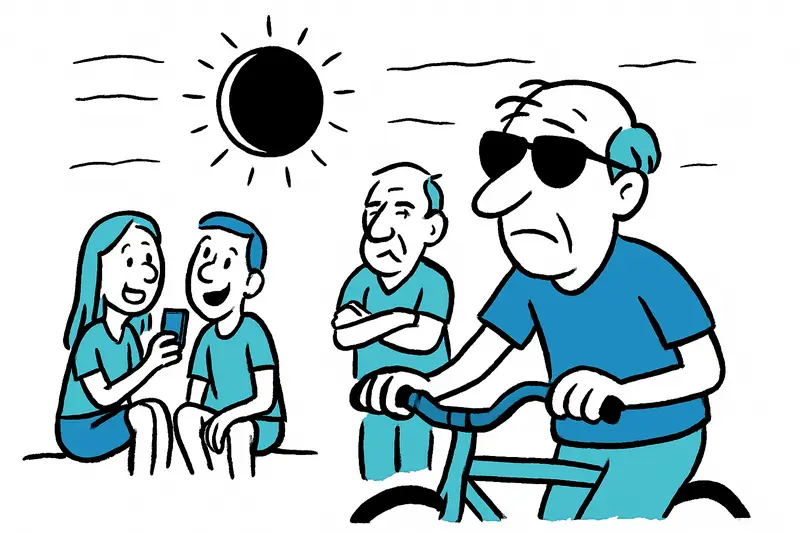
In the afternoon in Sóller it smelled of diesel and grilled fish, car horns formed a tinny backdrop, young families walked along pavements with beach chairs, and locals stood on the plaza shaking their heads. On the Ma-10 near Valldemossa campervans stood with doors open, campers sought shade under pine trees, and along the coast boats remained in loose formation as if they wanted to experience the eclipse in convoy. Small moments — like an old man calmly pushing his bicycle while wearing sunglasses, and a group of schoolgirls giggling as they took photos — show: the island breathed excitedly, but often without coordination.
Concrete solutions
1) Pre-booking for sensitive viewpoints: an online registration with limited places could spread visitor flows and reduce parking pressure. 2) Temporary shuttle corridors: from easily accessible park-and-ride lots (with clear timetables) to observation zones — operated by local bus companies — would reduce private traffic. 3) Stock management for critical goods: authorities should plan minimum stocks together with pharmacies, fuel stations and port operators that can be activated at short notice. 4) Stricter rules for anchoring: pre-designated protection zones for Posidonia and clearly communicated fines could raise awareness and compliance. 5) Multilingual information campaign: timely notices in several languages via social media, harbour offices and tourist information, complemented by loudspeaker services at hotspots. 6) Volunteer response teams on site: local volunteers and conservation groups could direct visitors and resolve disputes outside of police intervention.
Why these changes are realistic
Many of the measures cost little money and mainly require coordination: clear responsibilities between municipalities, the island government, harbour authorities and conservation agencies. Shuttle models and reservation systems have been successfully tested elsewhere. What is lacking here is the political will to turn the event into lasting improvement.
Concise conclusion
The eclipse was a natural event — the chaos beforehand was man-made. If Mallorca wants to get through the next major event dignified and without lasting damage, frowning is not enough. It needs coordinated planning, clear rules for nature and harbours, better advance information and pragmatic mobility solutions. Otherwise the same night will repeat: breathtaking images in the sky, and frustration on the ground.
Frequently asked questions
What lessons should Mallorca learn from the eclipse crowds for future events?
How can Mallorca ease traffic and parking when large crowds gather at viewpoints or beaches?
What steps protect Posidonia meadows and natural spaces during major events in Mallorca?
Why is multilingual information important for visitors during big events in Mallorca?
What supply challenges were observed during the eclipse crowd in Mallorca?
How could volunteers help during large events in Mallorca?
Are shuttle models a viable solution for Mallorca crowds?
What practical planning steps should visitors take before attending a major event in Mallorca?
Similar News

Sky show over Mallorca: How we will experience the total solar eclipse on August 12
A hot August evening, a special flight above the cloud cover and dozens of viewing spots across the island — the total s...
Solar Eclipse Stress Test for the Island: How Mallorca Reached Its Limits on Wednesday
The partially or fully expected solar eclipse threw the west coast into disarray: packed viewpoints, closed access roads...
Deià Rations Water: Who Pays the Price for Luxury?
Due to extreme drought, Deià will impose water shutdowns three times a week from August 14. The Hotel La Residencia and ...

Magaluf: Tourist slaps police officer — officer draws service weapon
An incident in Magaluf escalated: a 27-year-old Brit slapped a local police officer in the face and shouted insults — a ...
Eclipse on the Plate: Palma's Pastry Shop Releases 'Pastel de Eclipse'
A small pastry shop on Calle Pascual Ribot baked a limited cake for the sky spectacle: a biscuit base, caramel cream and...
More to explore
Discover more interesting content

Boat Tour with BBQ along Es Trenc Beach
Private transfer from Mallorca Airport (PMI) to Pollensa
