
Record Heat at 500 Meters Depth: Mallorca Faces an Invisible Danger
Measurements show: in 2025 the water around Mallorca warmed more deeply below the surface than at the top. What does this mean for coasts, fishers and tourism — and why is talking about the warm sea no longer enough?
Record Heat at 500 Meters Depth: Mallorca Faces an Invisible Danger
Key question: How do we respond when the sea under our feet is hotter than at the surface?
In summer, temperatures at some coastal spots reached up to 31 °C. That sounds bad enough, but a finding in this year’s measurement series is even more alarming: at around 500 meters depth a warming trend developed that even exceeded the surface. Scientists from the coastal observation system Socib speak of the strongest temperature anomalies since the start of satellite records, as detailed in When the Sea Cooks from Below: Why 500 Meters Depth Should Alarm Mallorca, and this is not an abstract natural experiment – it hits the ecosystem hard.
Critical analysis: Why depth matters. Surface waves, wind and exchange with the atmosphere dampen temperature fluctuations at the sea surface. In depth, however, water circulates more slowly and heat remains stored for longer. If layers around 500 meters warm noticeably more, it means: heat is being fed into ocean circulation, it does not simply "go away" and it alters living conditions in places we on land hardly perceive. That raises the risk for seagrass meadows, benthic communities and migrating fish species.
From the facts package: June 2025 was, according to the measurement series, the warmest month since 1982; average values were two to four degrees above normal, regionally up to five degrees in early July. For 2025 there were also 210 days counted with marine heatwaves; for the first time the region reached a category-3 heatwave. More than 90 percent of the excess heat from human emissions has already been absorbed by the oceans, as explained by NOAA’s overview of how oceans absorb excess heat — a global phenomenon with local consequences.
What is missing in public debate. The discussion here too often revolves around bathing water temperatures, the tourist season and its consequences. That is important, but incomplete. Hardly anyone talks about persistent changes in deep water layers, about the timescales over which this heat is stored, and about indirect effects — such as altered ocean currents, warmed water masses flowing into bays, or the absence of nutrient-rich upwelling phases that regulate food chains in the sea.
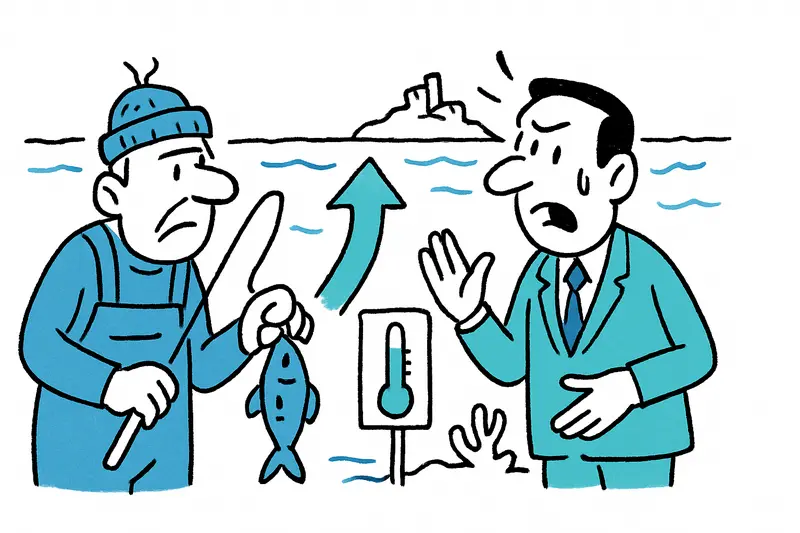
An everyday scene: On a gray morning along the Paseo Marítimo I hear the usual hum of delivery vans, the squeak of a bicycle brake cable and the distant calls of gulls. A fisherman from Port de Pollença hauls his net basket ashore and shakes his head: “There are fewer young fish this year.” He says it quietly, not dramatically. Observations like these accumulate: beachgoers notice fewer fish while snorkeling, dive schools report damaged seagrass beds in shallower bays.
Concrete solutions (not platitudes, but locally actionable):
1) Expand and publish monitoring: Socib must strengthen its measurement-network pool in cooperation with the Consell and the Ajuntament. More buoys, autonomous measuring vehicles and long-term funded analyses are needed so deep warming trends can be tracked in real time.
2) Expand protected areas strategically: Seagrass meadows (Posidonia) are key habitats, as discussed in How the Sea off Mallorca Is Heating Up Faster Than We Think — and What We Can Do About It. Where possible, rest zones should be designated and fishing zones adjusted to increase regeneration chances after hot summers.
3) Reduce nutrient inputs: Warmer water plus more nutrients promotes harmful algal blooms. Stricter rules for treatment plants, agriculture and direct discharges into coastal waters can help in the short and medium term.
4) Adapt fisheries management: Catch limits and closed seasons should be more flexible and take temperature data into account — young stocks benefit from calm years and protection during critical growth periods.
5) Early warning systems and local emergency plans: When sea temperatures reach critical thresholds, beach operators, ports and emergency services need clear action guidelines — from bathing bans and beach clean-ups to targeted inspections of seagrass areas.
What won’t work in the short term: isolated tourism campaigns, delayed funding applications or half-hearted projects. If heat remains at 500 meters depth, beach umbrellas do not help underwater vegetation. Persistent, science-based measures are needed here.
Funding and responsibility: Local administrations can tap EU funds and Spanish climate pots, but must set priorities. A transparent cost-benefit analysis should show that investments in coastal ecology also make economic sense in the long run — for fisheries, watersport providers and residents.
What we can do immediately: Accept and network more citizen observations. Divers, anglers and skippers are often the first to notice changes. A digital reporting portal, linked to official measurement data, would provide early signals and strengthen trust between science and the public.
Pointed conclusion: The visible heat on the beach is only half the truth. If the sea at 500 meters depth heats more strongly than at the surface, the island sits on the heat source of a system that is slowly but steadily changing our coastal biology. Anyone who talks only about sunshades and the season misunderstands the depth of the problem. It is time for clearer priorities, better data and practical measures — before what we have lost becomes irretrievable.
Frequently asked questions
Why is the sea around Mallorca getting warmer even far below the surface?
How hot did the sea get near Mallorca in summer 2025?
Is it still safe to swim in Mallorca when the sea is very warm?
What does a marine heatwave mean for Mallorca?
What should I pack for Mallorca in a very hot summer?
Why is Posidonia so important in Mallorca’s coastal waters?
What is happening with fish stocks around Port de Pollença?
How are scientists monitoring sea temperature around Mallorca?
Similar News

Who will clean up? Illegal rubbish heaps on the highway near Son Gual drive residents onto the streets
For months, construction debris and household waste have piled up along the highway between Palma and Manacor near Son G...

Amundi takes over Bikini Island & Mountain Port in Sóller – many questions remain open
The French asset manager Amundi has acquired the four-star Bikini Island & Mountain Port hotel in Sóller from an Austria...

Silvia was allowed to see the sea once more – a small farewell in Port de Soller
A team from the Balearic health service IB-Salut fulfilled a terminally ill woman's wish: one last trip to the water in ...

Magaluf: Imprisonment for Beach Club Employee after Theft of a Bag — What the Ruling Overlooks
A former dishwasher received a one-year prison sentence for stealing a Louis‑Vuitton bag. The appellate court upheld the...

Road collapse at Port de Valldemossa: Who will pay for the next wave of damage?
A section of the MA-1131 near Port de Valldemossa slipped after heavy rains from cold front "Adam". Residents are strand...
More to explore
Discover more interesting content

Can Cap de Bou

Townhouse Lleo 72
