
How the Sea off Mallorca Is Heating Up Faster Than We Think — and What We Can Do About It
The Mediterranean off Mallorca is warming significantly faster than other oceans. Why this is dangerous for Posidonia and our coasts — and which local steps are needed now.
How the Sea off Mallorca Is Heating Up Faster Than We Think — and What We Can Do About It
Key question: How quickly does warming threaten life beneath our water's surface — and why is talking alone not enough?
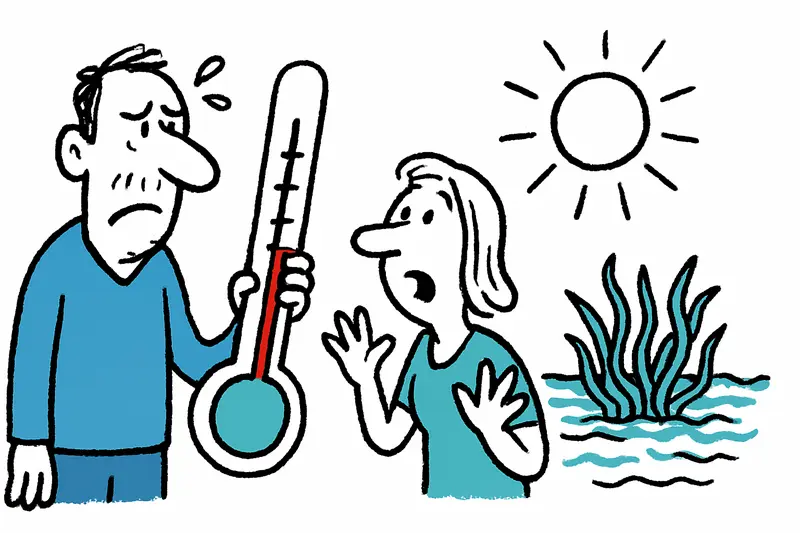
Early morning on the Passeig Marítim in Palma: fishers are stowing their nets, the smell of diesel blends with wet seaweed, joggers run their laps, and children reach into the still-cool water of the bay. Scenes like this are part of everyday island life — and yet they are the quiet forerunners of a problem that is growing louder: the water off our coasts is warming noticeably faster than many realize (Record Heat at 500 Meters Depth: Mallorca Faces an Invisible Danger). Experts say the Mediterranean is warming two to three times faster than other marine regions. For those of us on Mallorca this isn’t abstract — it changes the beach, the fisheries, the meadows of Posidonia and therefore how we use the coast.
Critical analysis: Heat is not a neutral phenomenon. Seagrass meadows like Posidonia are not just green carpets on the seabed — they store carbon, stabilise sand and provide habitat. But at water temperatures above around 28 °C mortality rises sharply. If these meadows die off on a large scale, not only is their function as a carbon sink weakened — the carbon already stored can be released again. That is a double loss: less storage and more emissions from the seabed.
Public debate often names individual pressures — fishing, shipping, pollution. It is true that many of these pressures can be managed locally. But there are two overarching, interlocking problems that are harder to regulate: the warming itself and the spread of invasive species that benefit from warmer water. Together they can upend entire ecosystems.
What is missing from the debate? Three points stand out: First, clarity about responsibilities. The Balearic Islands have only a tiny share of strictly protected inland waters (1.7 percent) and in the entire sea, including national waters, the figure is negligible at 0.07 percent. It is therefore legitimate to ask who should enforce which measures where — and how regional and national responsibilities are to be coordinated. Second, concrete timelines and priorities are often missing: Where do we start with protected areas, where with Posidonia restoration? Third, the voice of those who work on the sea every day is missing: fishers, boat rental operators, dive schools. Their local experience can help identify suitable protected zones that are both ecologically meaningful and socially acceptable.
Everyday scene: On a calm, windless afternoon in Portixol you can see small boats dragging their anchors across seagrass beds. In summer charter boats lie close together; on the jetty boatmen discuss new fees while older couples in the nearby café enjoy the view of the sea. This closeness to the water makes it clear: measures against warming and for the protection of Posidonia directly affect people’s lives, holiday experiences and local incomes.
Concrete approaches — pragmatic and locally feasible:
1. Expand protected areas sensibly: More strictly protected marine areas without fishing are not a luxury but an investment in resilience. Priority should be given to areas with intact Posidonia meadows and important spawning or nursery grounds.
2. Anchor bans and alternative buoy systems: In sensitive meadows anchoring and dragging must be prohibited. Instead, environmentally friendly buoy fields should be installed, financed through port fees or tourism levies.
3. Monitoring and transparency: Temperature and visibility data must be comprehensive, public and up to date (Sea temperatures off Mallorca drop temporarily — temporary reprieve or false alarm?). Such data help detect heat events early and trigger rapid protective measures. Citizen science monitoring programs with schools and dive clubs can be useful here.
4. Restoration and research: Posidonia transplants and pilot projects to strengthen resistant genotypes need support. At the same time, research must promote how invasive species can be contained without creating new risks.
5. Economic incentives: Fishers could be compensated for changing behaviour and respecting protected areas. Tourism businesses should receive rewards for sustainable practices — not just penalties.
6. Local climate action: Even if global warming cannot be solved on Mallorca alone, local measures count: faster conversion of municipal fleets to electric vehicles, promotion of renewable energy in ports, and less unnecessary concrete development along the coast.
Punchy conclusion: Warming of the Balearic Sea is not a distant statistic, it is the background noise of our daily lives. A healthy sea is our greatest ally against climate extremes — but it takes more than words. It needs clearly regulated protected areas, tangible local policies and the inclusion of the people who live with the sea every day. If we continue to watch Posidonia die, we will lose several foundations of island life. That is why it is time to read the loud boat engines and the smell of seaweed not only as island idyll but as a warning sign.
Frequently asked questions
Why is the sea around Mallorca warming so quickly?
Is it still safe to swim in the sea off Mallorca when temperatures rise?
What happens to Posidonia seagrass when the water off Mallorca gets too warm?
Why are anchor bans being discussed in Mallorca's most sensitive sea areas?
Which parts of Mallorca's coast need more protection from warming and boating pressure?
How can fishers and boat operators in Mallorca be part of sea protection?
What can Mallorca do locally about a warming sea if climate change is global?
How can people in Mallorca tell if the sea is under stress?
Similar News

When Paradise Becomes Unaffordable
Hotel rooms, paella and the weekly grocery shop: Mallorca is becoming more expensive for many. Who pays the bill — guest...

End at Ballermann: What Is Lost with the Dino Mini Golf at Playa de Palma
On October 25 the dinosaur mini-golf course at Playa de Palma will close after more than 30 years. Why the city is recla...

Expensive Address Calvià: What Does First Place Mean for Mallorca?
The National Institute of Statistics (INE) ranks Calvià as Spain’s most expensive municipality for property purchases. W...

Emergency over Spain: Ryanair Dublin–Tenerife flight diverted to Santiago after medical emergency
A Ryanair flight from Dublin to Tenerife was diverted to Santiago de Compostela due to a passenger's acute health proble...
Ten Years in a Tent: A Couple in Son Verí and the Gaps in the Housing Market
A British couple has lived for around ten years in a makeshift shelter near Son Verí. Their story is not an isolated cas...
More to explore
Discover more interesting content

Can Cap de Bou

Townhouse Lleo 72
