
Half Fish, Half Horse: How Palma Aquarium Returns Seahorses to the Sea
Half Fish, Half Horse: How Palma Aquarium Returns Seahorses to the Sea
In the hidden rearing area of the Palma Aquarium, specialists care for the island's fragile seahorses. An insight into rituals, techniques and a small day of joy by the sea.
Half Fish, Half Horse: How Palma Aquarium Returns Seahorses to the Sea
When you walk along the Paseo Marítim by Playa de Palma you hear engines, seagulls and occasionally the clatter of a bucket in a workshop. A few streets away, behind the brightly colored façade of the Palma Aquarium, the soundscape is different: gentle splashing, filters humming and the muted conversation of people who know how delicate some marine animals are. There, in rooms not open to the crowds, seahorses are nursed back to health.
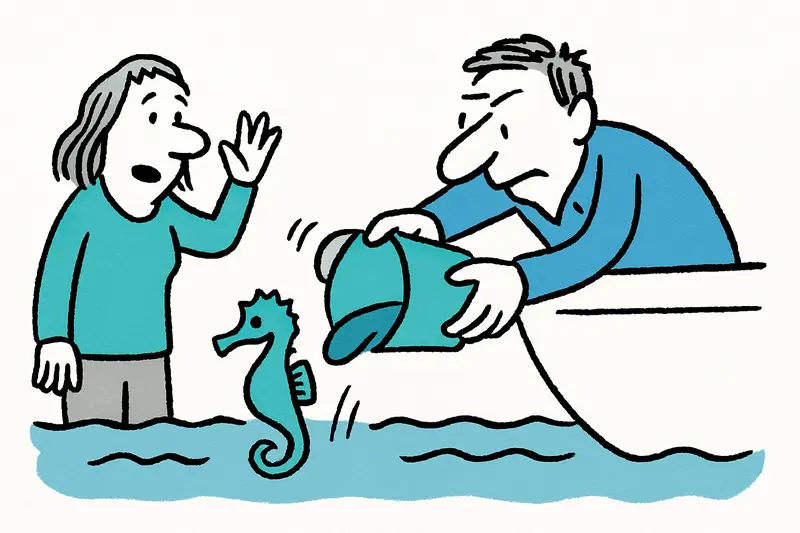
Seahorses are not a given in the Mediterranean. Around Mallorca two native species live, the long-snouted Hippocampus guttulatus and the short-snouted Hippocampus hippocampus. Fishermen occasionally bring in isolated animals; not out of malice, but because nets and traps sometimes catch creatures that would hardly survive without human help. Palma Aquarium takes in many of these found animals.
The care is precise, patient work. The basins are taller than ordinary aquarium tanks because the animals need vertical space for their courtship dance: mating rituals and ascending to the surface are part of the process so the transfer of fertilized eggs can occur. Unlike most fish, in seahorses the male carries the young; after fertilization he often releases hundreds of tiny juveniles a few weeks later, each about 1.6 centimeters long.
Rearing in the aquarium is shaped by small steps: appropriate currents, tiny food like Artemia and plankton-like feed, calm lighting and very clean tanks. Staff check water parameters, clean algae and watch behavior. When carers talk about it, it sounds less like laboratory work and more like concern for neighborhood children.
These measures show results when the animals are allowed back to the sea. Last October, for example, about 70 young seahorses were released off Mallorca in two actions off the coast, at locations near Calvià and near Colònia de Sant Jordi. This is not a mass program but a series of small, locally limited operations that are also symbolic: every released animal is one more chance for seagrass meadows and for local biodiversity.
Besides their curious appearance, seahorses serve as indicators: they react sensitively to changes in the ecosystem. Healthy populations often point to intact seagrass beds, which in turn provide important coastal protection, nutrient cycling and nursery habitat for other species. That is why the little sea horses — yes, the term sounds a bit silly — are useful for preserving Mallorca's coastal landscape.
The work is not only scientific. Whoever enters the aquarium's rooms senses the ritual: the scent of seawater, the clicking of measuring devices, occasionally the smell of freshly brewed coffee from a small kitchen when a night shift starts. People like Debora Morrison, who has cared for these animals for years, speak of pride on release days and frustration when controls are lacking. Since 2022 various protection efforts have been running in the March-Bank region, but whether wild populations measurably increase as a result remains unclear.
What remains is a simple, almost banal hope: whoever finds an animal should contact the right authorities — and incidents such as the Dead Shark at the Paseo: A Wake-up Call for Better Coastal Protection in Palma remind people why that matters — and anyone walking the coast can look out for seagrass meadows and avoid dropping anchors on them. Small steps add up. And on a mild morning, when the sun sits low over the sea and a boat hums quietly in the bay, it is a beautiful sight when young seahorses head back into the open blue — half fish, half horse, and at least a story that on Mallorca is not yet finished.
Why this is good for Mallorca
Every rescued seahorse is a sign of functioning coastal care: intact seagrass meadows protect beaches, support biodiversity and are part of the island's identity. The aquarium's work combines science, local knowledge and the simple joy of preserving something existentially small.
Frequently asked questions
Why are seahorses important for Mallorca's coastline?
What should I do if I find a seahorse in Mallorca?
Can seahorses survive in aquarium care before being released?
Why do seahorses need taller tanks in Mallorca aquarium care?
Where were seahorses released off Mallorca?
What do seagrass meadows have to do with seahorses in Mallorca?
Do male seahorses really carry the babies?
Can boats and anchors damage seahorse habitat in Mallorca?
Similar News

New trick at Palma Airport: suitcase stolen from the belt — a reality check
On September 28 a 36-year-old allegedly stole a suitcase from the baggage belt of a 51-year-old German passenger at Palm...
Urgent Clearing of Palma's Torrents: Flood Prevention or Symptom of Short-Sighted Planning?
The city of Palma is responding to storm forecasts and has cleared several torrents. We ask: Is the short-term clearing ...

Evaneos and Mexico: A Reality Check for Sustainable Travel
Travel advertising often reads like a promise: local, sustainable, unique. But how deep do these promises really go? A c...

From Megapark to the Altar: Party Singer Now Offers Weddings in Mallorca
A well-known party artist combines partying and marriage: instead of a traditional church there are ceremonies at the Me...

The Maricarmen Case: Why an Eviction Is Forcing Spain's Housing Debate
Images of an 87-year-old woman on a stretcher have sparked a debate in Spain that also runs deep in Mallorca. Who protec...
More to explore
Discover more interesting content

Can Cap de Bou

Townhouse Lleo 72
