
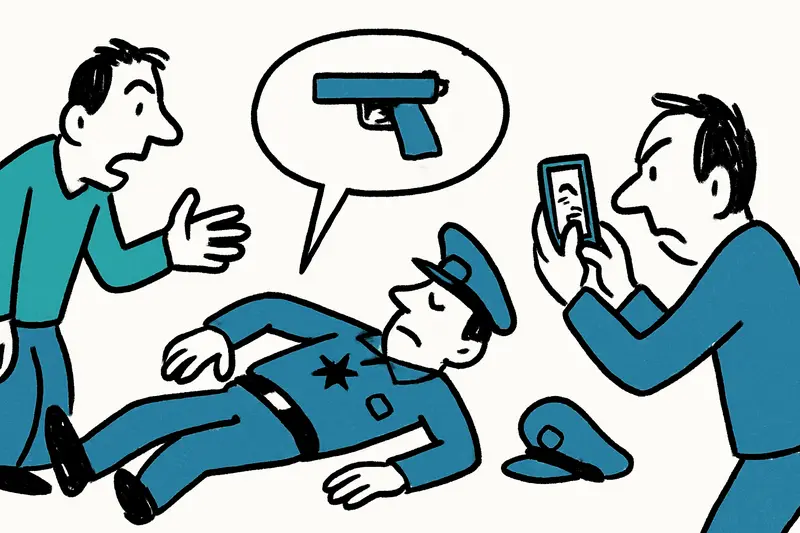
Gunfire in Corea: What Palma’s Debate Must Do Now
A police officer is shot in the neighborhood, shaking the community. But between outrage and hasty judgment, what is needed above all is reliable answers—and a closer look at the conditions that can lead to such escalations.
A Shot Is Not the End of the Story
When a police officer is shot in Palma’s Corea neighborhood, one simple, stark fact comes first: an officer was injured, and people were put in danger. The investigation must establish who was responsible and exactly how it happened. Especially in a case where a ballistics report plays a role, it would be wrong to piece together a definitive judgment from individual details.
So the key question is not just: Who had the gun? It is also: How did a confrontation in a public place escalate to this point, and what can be learned for the next response? These questions do not necessarily have the same answer. Criminal responsibility is one matter. Operational procedures, de-escalation, and the relationship between police and the neighborhood are others.
Between Suspicion and Judgment
In cases like this, the public narrative tends to draw a straight line: dispute, violence, gunshot, perpetrator. Reality is usually less tidy. Accounts conflict, videos show only fragments, and an expert report answers a specific technical question—not every question about what happened. A reliable finding can be important. It does not replace a review of all accounts or a court’s decision.
This is not a free pass for a suspect, nor is it a reason to lose sight of the injured officer. It is simply the minimum standard for a debate that must not become a second escalation in its own right. Anyone sharing a name, a family relationship, or a claim about the exact moment the shots were fired should ask whether the information is verified and whether sharing it explains anything at all.
The other side of the issue also deserves attention: an attack on a police officer is no reason to dismiss every question about police conduct as an attack on the police. If it is unclear how a service weapon came to be involved in a dangerous situation, that must be examined objectively. Not to prejudge responsibility, but because such reviews can help prevent future injuries.
What Is Missing from the Public Conversation
It is easy to talk about images of perpetrators. The less dramatic questions are harder: Where were the officers positioned? Was there a way to separate people in the crowd? What support was available at the scene? What was already known before the critical moment? And how can residents who witnessed the dispute at close range be heard without treating their unverified recollections as proof?
A single incident does not automatically explain conditions across an entire neighborhood. Corea is not synonymous with violence. Anyone putting the neighborhood’s name in a headline should avoid turning a specific event into a label for everyone who lives there. In Palma, people know how quickly stereotypes take hold: a few social media images, a few comments, and suddenly a street is being portrayed as a permanently troubled area.
But everyday life in a neighborhood is more than the minutes when sirens can be heard. There are people heading home, shops reopening the next morning, and neighbors wondering whether, at the next dispute, they should look away or call for help. This ordinary uncertainty is part of the story too. It is often barely mentioned in the heated debate.
What Can Be Improved in Practical Terms
First, people need clear, timely information about what has been established—and what is still being investigated. No details that could jeopardize proceedings, but clear distinctions between confirmed facts, witness accounts, and unanswered questions. Second, after a serious operation, an independent and transparent review should be possible. This not only protects those involved from premature suspicion; it also protects the police from rumors and speculation.
Third, the city must discuss how it can mediate early when conflicts in public spaces recur. Complaints about noise or a blocked street can begin as minor issues. If they are taken seriously and addressed, the risk of frustration building up over time can at least be reduced. This does not explain a shooting or excuse violence. Prevention and law enforcement are not mutually exclusive.
In the meantime, residents should avoid forwarding unverified videos or names, report observations to the relevant authorities, and call emergency services if there is immediate danger. It may not sound dramatic. That is exactly why it is often more useful than the next confident claim in a group chat.
Facts First, Certainty Later
The injury to a police officer is serious. The unanswered questions are serious too. Palma’s response should be neither reflexive partisanship nor blanket distrust, but a thorough investigation, clear communication, and practical work to address the conflicts that arise in everyday life. An expert report can shed light on part of the story. The full judgment about what happened does not belong in the comments section.
Frequently asked questions
What is known about the shooting of a police officer in Palma’s Corea neighborhood?
What can a ballistics report tell investigators about a shooting in Mallorca?
How should I check videos and claims about a violent incident in Palma?
What should I do if I witness a violent incident in Mallorca?
Why should police conduct be reviewed separately from criminal responsibility in Palma?
How can Palma reduce the risk of everyday public disputes escalating?
Does a shooting in Corea mean the whole Palma neighborhood is dangerous?
Why does Palma need clear updates while a serious incident is still being investigated?
Similar News
Son Ferrer: When a Home Becomes a Dispute for Two Years
An owner has been able to return to his finca in Son Ferrer after two years. The case shows how quickly property rights,...

New Venue at the Harbor: The Poppa Club Moves into the Former Varadero
The Marport Group has unveiled The Poppa Club in the former Varadero building. A terrace, lounge, and views of the bay a...
Eggs in Mallorca: What the Wrong Size Grade Really Means
Price isn’t the only thing that matters when buying eggs: carton size labels follow fixed rules. Here’s what shoppers ca...
Groceries in central Palma: Carrefour Express opens on Jaume III
There’s a new place for a quick shop on Jaume III: Carrefour Express offers groceries and everyday essentials, including...
Palma on the Jersey: Germania Mallorca Sells New Away Kit
White with dark blue accents and Palma Cathedral on the chest: FC Germania Mallorca is offering its new away kit for €49...
More to explore
Discover more interesting content

Can Cap de Bou

Townhouse Lleo 72
