
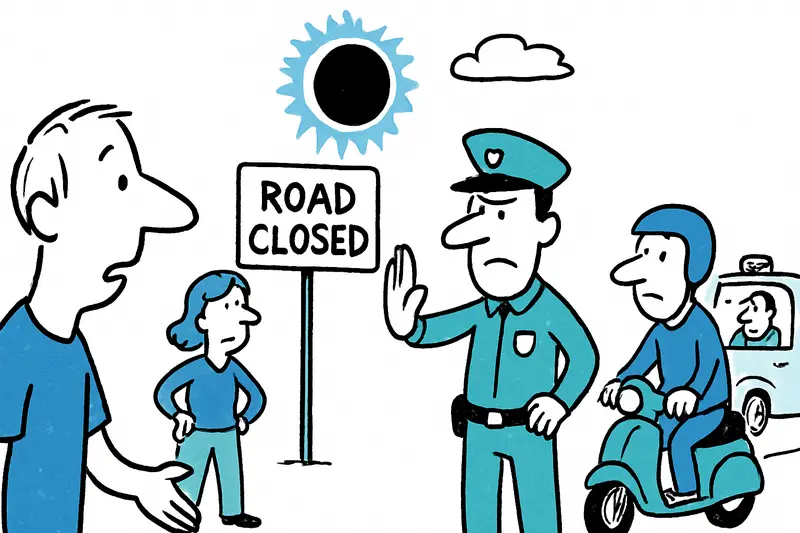
Solar eclipse on August 12: Roads closed — but for whom?
Solar eclipse on August 12: Roads closed — but for whom?
The regional government is expanding access restrictions for the total solar eclipse — they now also apply to motorcycles and mopeds. What that means in practice and which questions remain unanswered.
Solar eclipse on August 12: Roads closed — but for whom?
Key question: Do the widespread closures really protect the island — or do they create new problems that have so far been overlooked?
Authorities have tightened the traffic rules for the big day: on Mallorca many access roads to the Serra de Tramuntana and to popular viewpoints will be temporarily completely closed to car traffic. New is that exemptions for motorcycles and mopeds have been removed — so there will be no through traffic if you want to go by scooter to Cala Deià or along the Ma-10. The closures are generally due to take effect from 3 p.m. and remain in place into the evening; an earlier start is possible if traffic builds up sooner, as detailed in Total Solar Eclipse 2026: Opportunities, Risks and How Mallorca Should Prepare.
That sounds decisive, and protection against congestion and wildfires is a worthy goal. It becomes critical, however, when looking at implementation: there is a lack of transparency about how typical everyday situations will be handled. Who gets the tradesperson to the mountain farmhouse if a pass is not sufficient? What happens with hotel deliveries or rescue trips if queues form at the closure points? Many of these detailed questions are left out of the information packages.
A scene from everyday life: on a hot July morning in Sóller the cashiers at the market hall click away, a few scooters are already parked on the square in front of the church, taxi drivers wave to guests. If closures suddenly appear on August 12, this means for these neighborhoods: quieter, yes — but also potentially cut off, if it is not clarified in advance how supply chains and emergency services will be allowed through. This is particularly concerning given reports that Sóller fills up: Hotels almost fully booked for the 2026 solar eclipse.
The safety concept uses 26 official observation zones with room for several hundred thousand people. On paper this relieves the mountains because visitors are guided away. In reality there is a danger that too many people will be concentrated at too few points and the infrastructure there will be overloaded: parking shortages, lack of toilets, water supply, waste — all of these are logistical problems that have so far been hardly discussed publicly.
Particularly sensitive is the balance between traffic control and emergency access. Police posts at closure points are supposed to regulate passages for residents and emergencies, but when queues stretch along the MA-10 there is little room to manoeuvre. Also: how are foreign guests on buses supposed to be informed about changes? Which languages and which digital tools will be used? Without clear communication the number of lost visitors who park in side streets and thus block emergency routes will increase. Nightly tunnel closures have already highlighted the difficulty of detours and communicating alternatives in the area, see Nightly Closures in the Sóller Tunnel: Commuting, Detours and Smart Solutions.
What is missing from the public debate can be summed up as follows: clear rules for businesses and care workers, concrete alternative routes with scheduled frequencies, coordinated shuttle systems, a digital permit system with QR codes, adequate provisions at the observation zones (shade, water, toilets), and a roadmap in case a fire breaks out or a medical emergency occurs simultaneously. For additional practical observer advice see Total Lunar Eclipse: Evening Tips for Observers on Mallorca.
Concrete proposals that could be implemented quickly include: temporary park-and-ride sites with shuttle buses from Palma and Manacor; dedicated corridors for emergency vehicles; digital checks with short-term electronic permits; clearly visible, multilingual signage along the MA-10, Ma-11 and access roads to Sóller; additional volunteer helpers from municipalities for information stands; and fixed points for drinking water and mobile toilets at the official observation spots.
On the subject of shipping: there is so far no ban on boat trips, but monitoring by rescue and coastguard services. That approach is fundamentally correct, but it needs to be clearer how anchoring bans, distance zones and emergency communication at sea will be regulated — especially because boats can add pressure to the coast if beach access on land is closed.
Those who are on Mallorca on August 12 should prepare for two things: calm in places that are cordoned off — and crowds at the official zones. Practically, this means: plan ahead, set off earlier, use public and organised transport offers, and do not rely solely on spontaneous scooter trips.
Conclusion: the intention to direct crowds and reduce fire and congestion risks is understandable. To ensure the measures do not become the source of new problems, more details, better communication and pragmatic alternatives for residents and businesses are needed. If the authorities close these gaps, the island can get through the unusual celestial event safely. Let us hope the next meeting decides not only on new closure signs but also on concrete shuttles and water dispensers.
Frequently asked questions
What should I expect from Mallorca’s road closures during the August 12 solar eclipse?
Are there plans to ease travel during the eclipse, such as park-and-ride or shuttle services?
How could the closures affect access to Sóller and Cala Deià on the eclipse day?
What about emergency access during the closures?
What will the official eclipse viewing spots be like in terms of logistics?
What should I do to prepare for the eclipse day in Mallorca?
Will boat trips or coastal access be affected during the eclipse?
Why are Mallorca’s eclipse road closures controversial?
Similar News
Rental Car Theft in El Arenal: What This Incident Reveals About Our Gaps
A teenager steals a running rental car in El Arenal, flees on foot, climbs over walls and is caught by the Guardia Civil...
Red Rope in Palma's Library: What Helps Against Selfie Tourism — and What's Missing
Palma's city library cordoned off an area with a red rope to keep selfie tourism away from reading and working activitie...
Fort San Carlos: Museum, Harbor Dispute — and a Conflict That Demands Answers
The military museum at Fort San Carlos sits right on Palma's harbor, with unexpectedly quiet rooms filled with cannons a...
Old Town Under Pressure: When a Doorway Becomes a Sleeping and Shower Place
For months a woman has been living with a parasol, a clothes rack and personal belongings next to the social welfare off...

When Shopping Weighs Heavier: Mallorca Demands a Tax Pause on Food and Fuel
Rising prices are putting pressure on households and agriculture. The Balearic Islands are calling for temporary tax rel...
More to explore
Discover more interesting content

Can Cap de Bou

Townhouse Lleo 72
