
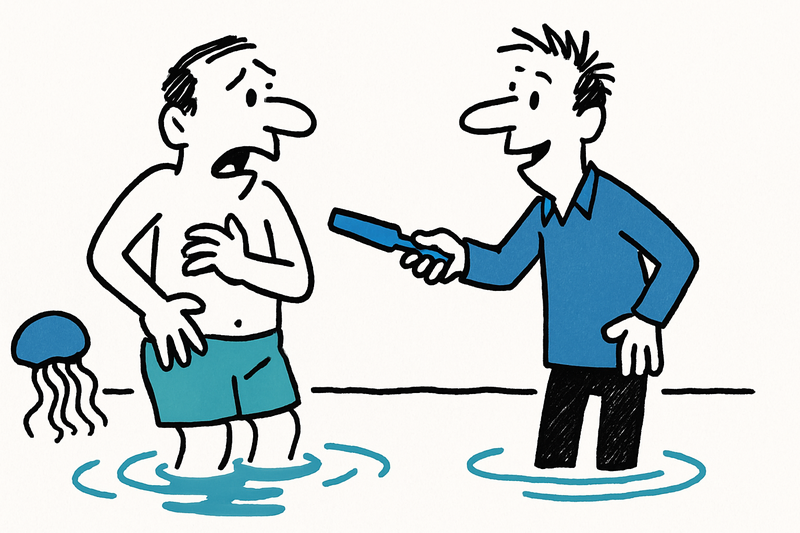
New in Port Adriano: Stingblade Helps Against Jellyfish Stings – Practical and Sustainable
A new shop in Port Adriano sells a small tool that effectively and gently removes jellyfish stings — made from recycled fishing nets. Good news for bathers, families and environmental lovers in Mallorca.
A small tool, a big difference
When the first boats dock in Port Adriano in the morning and seagulls shriek over the marina, it's not only sun-seekers who stroll past the cafés anymore – recently you can also come across a small shop with an unusual offering: Stingblade. The British company has opened its first store in Urbanización El Toro and brings a seemingly simple but very useful tool that treats jellyfish stings faster and more gently than many home remedies.
How does the device work?
The principle is surprisingly simple: a small, specialized scraping instrument removes the tiny barbs of the jellyfish from the skin before they can release their venom again. Anyone who has ever tried vinegar, water or even — believe it or not — urine after a sting knows how helpless one can feel. The Stingblade tool addresses the problem at its root. There are two variants: the Personal Sport model, robust and compact, intended for quick use in the water after coming out of the waves, and the Super Blade Professional, a bit larger and ideal for thorough treatment on land or aboard boats.
Human, practical, sustainable
The idea comes from Mark Dyer, a sea-lover with Mallorcan roots. He didn't want a high-tech gadget but something that immediately helps locals and tourists. Liam, who runs the shop in Port Adriano, sums it up: “For children, a sting can not only hurt, it often leaves fear. When parents can act quickly, it's more than first aid — it's reassurance.” You can see that when you watch small families who pop in after a morning swim and leave with a device and a smile.
What is also appealing: the tools are made from recycled fishing nets. In an island community where the sea is visible every day — from the sparkling bay to the fisherman's jetty — that's a nice detail. Production combines health protection with a sustainable approach. A device made from the remnants of the sea itself to protect people in the sea has a symbolic quality; local environmental work, such as efforts by a freediver who collects plastic in Mallorca, reflects the same concern for the coastline.
Practical consequences for Mallorca
For the island this has several benefits: on the one hand, an easy-to-use tool reduces trips to the nearest health center or emergency call when only a quick treatment is needed. On the other hand, the availability of such devices, especially in bays popular with families or at popular surf spots, could reduce the fear of swimming. Imagine: a lifeguard with a small kit in their pocket, a dive school that includes kits in their first aid backpacks, or a fisherman who after breakfast quickly docks to help — these are small but effective measures that make life by the water more relaxed.
Looking ahead: stations, collaborations, education
Dyer and his team are thinking bigger. Mobile stations at popular beaches, collaborations with rescue services and information campaigns for schools are on the agenda. “The more people know how to respond correctly, the less fear and the fewer complications there will be,” says Dyer. That sounds like a pragmatic plan: not every problem needs a big budget; often the right item in the right place and a bit of know-how is enough.
Of course Stingblade will not be a cure-all for every jellyfish species, and in severe reactions a doctor's visit remains mandatory. But as part of a responsible beach experience it is a practical component. The combination of quick help, ease of use and sustainable production makes the product, in our view, a gain for Mallorca.
Important in brief
The first shop is located in Port Adriano, Urbanización El Toro. If you are not on site: information and orders are available via the manufacturer's website. Beachgoers should remain attentive, follow local advice and contact rescue services if in doubt. A small knife in the beach bag can be handy — but even nicer is when it is made from old netting and helps children quickly after a brush with a jellyfish.
Frequently asked questions
What should I do if I get stung by a jellyfish in Mallorca?
Are jellyfish stings common on Mallorca beaches?
Can you still swim in Mallorca if there are jellyfish around?
What is Stingblade and how does it help after a jellyfish sting?
Where can I buy Stingblade in Mallorca?
Why is the Stingblade tool considered sustainable?
Is Port Adriano a good place to look for beach safety gear in Mallorca?
When should I see a doctor after a jellyfish sting in Mallorca?
Similar News

When the Tap Only Runs Sometimes: Why Municipalities in the Balearic Islands Are Now Rationing Water
Deià, Valldemossa, Esporles, Sóller and several places on Menorca are scaling back water supply. Who is responsible, why...
Battle for the Ramp: Why Cala Gamba Needs More Than Enforcement
The Guardia Civil intervened in Cala Gamba — residents breathed a sigh of relief, but unease remains. Key question: Are ...
He dances at the Duty-Free: How an airport employee brings a smile to Palma
A Duty-Free employee at Palma Airport created a viral TikTok with dancing breaks. Why the scene is more than just an int...
Stolen Motorcycle in Palma: Fatal Crash in Coll d'en Rabassa Shortly After Theft
A motorcycle parked on Plaza Miquel Dolç in Son Gotleu was reportedly stolen in the early hours. Hours later two men cra...
When More Guests Mean Less: Mallorca's Restaurants at the Limit
Despite record visitor numbers, the revenues of many restaurants are shrinking. Why more visitors don't automatically me...
More to explore
Discover more interesting content

Boat Tour with BBQ along Es Trenc Beach

Private transfer from Mallorca Airport (PMI) to Pollensa
