
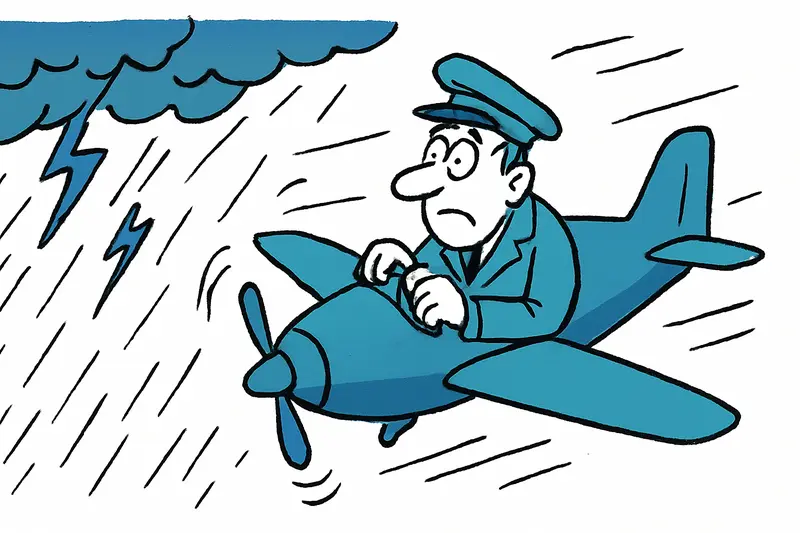
Storm over the Islands, Tilted on Approach: What a Flight Video Really Shows
A propeller plane flying from Palma to Ibiza landed safely in gusty weather. The footage looks dramatic, but it does not answer every question about conditions at the airport.
A video, a rocking plane—and many unanswered questions
How much can a short phone video tell us about a flight in stormy weather? Not very much. Footage of an approach to Ibiza shows a propeller plane visibly swaying in the wind and appearing tilted at times. It is unsettling to watch. But it is not proof that the crew lost control or that the situation was immediately dangerous.
According to the information available, the flight was operated by regional airline UEP Fly from Palma to Ibiza on Thursday, November 12. The plane touched down on the neighboring island at 10:09 a.m.—one minute ahead of schedule. The landing was reportedly safe. Storm Charles had brought strong gusts to the Balearic Islands, with regional peaks of up to 100 kilometers per hour. That figure, however, does not automatically describe the wind strength at the runway at the time of the approach.
What the footage shows—and what it doesn’t
On a screen, a plane correcting for the wind can quickly look more dramatic than the maneuver may feel from inside. Wind can push aircraft sideways on approach, and the crew has to respond. Movements are often clearly visible in footage of a propeller plane. But a single viewpoint reveals neither the actual wind readings at the airport nor the decisions made in the cockpit, the aircraft’s distance from the ground, or its safety margins.
A visible tilt is not, by itself, a diagnosis either. It may be part of a correction—or it may look more pronounced because of the camera angle. Without the full recording, reliable weather data for the airport, and expert analysis, no one should judge the crew’s performance based on a few seconds of footage. The fact that the plane landed safely is important. It does not mean the approach was comfortable, but it does put the clip in a more measured context.
A video headline can take shape in seconds: plane tilts, storm, thrills. The flight itself, by contrast, involves many measurements and ongoing decisions that outsiders cannot see. That is where the line lies between a striking image and a reliable explanation.
The missing context: Where was the wind blowing, and how strongly?
When gusts of up to 100 kilometers per hour are reported, it may sound like a precise measurement for this particular flight. In fact, a regional peak alone does not tell us what conditions were like at Ibiza Airport. Gusts can vary greatly from place to place; their direction and duration matter too. To put the approach in context, it would help to have readings from the airport at the time, the wind direction, and information about any delays or decisions to divert.
That information is missing from what is currently known. There is also no indication of injuries or an interruption to flight operations. That should not be mistaken for a license to speculate. Anyone sharing a dramatic clip should include the few confirmed facts—above all, that the plane landed safely and that the reported peak gust may not have been measured at the airport.
Otherwise, public discussion gets stuck on the frightening moment. For passengers, it would be more useful to know how airlines decide whether to delay, divert, or cancel flights in strong winds, and where to find reliable status updates. These questions cannot be answered by a video. They are still part of the story of a stormy day when people are traveling between the islands.
On Mallorca, a storm is no abstract weather term
In November in Palma, people often notice the wind first through things they rarely pay attention to otherwise: a sun umbrella folding shut, leaves rushing along the pavement, someone gripping a shopping bag on Passeig Mallorca. On the coast, the weather sounds different; in a harbor, a line clatters against a mast. For people waiting for a flight to Ibiza, the weather quickly becomes a personal question: Will it take off, and when will I arrive?
For many people, short flights between the islands are more than a convenient shortcut. Appointments, work, and onward connections depend on them. Still, a delay in difficult conditions is not a failure that can be judged from the terminal. When the weather and operations change, travelers need clear information rather than empty reassurances—and an understandable explanation of what happens next.
What would help now
Three things would help provide a factual assessment: time-specific weather data from Ibiza Airport, clear confirmation of the flight route and actual landing time, and a brief explanation from the airline of whether the approach was within normal operating parameters. These are verifiable facts, not a dramatic add-on. During significant weather events, airlines and airports could also make guidance on delays, rebooking, and status checks easy to find.
It is also worth pausing before sharing footage. Not to dismiss the impression it makes, but to avoid claiming more than the clip can show. “A visibly turbulent approach, safe landing” is less sensational than an alleged near-crash—and closer to the known facts.
The approach was apparently turbulent, and the plane landed safely. Both can be true at the same time. The video captures a striking moment, but it is not a complete safety analysis. Anyone seeking to draw broader conclusions needs measurements and reliable information—not just a tilted horizon and a few seconds of wind.
Frequently asked questions
Can flights from Mallorca to Ibiza land safely in strong winds?
Does a plane swaying or tilting on approach mean it is in danger?
Does a report of 100 km/h gusts mean the wind was that strong at Ibiza Airport?
Can a phone video show whether a pilot handled a landing correctly?
What can happen to flights between Mallorca and Ibiza during a storm?
How can I check whether my flight from Palma is delayed by bad weather?
Why can a propeller plane look especially unsteady in strong winds?
Did the Palma-to-Ibiza flight during Storm Charles land safely?
Similar News
Port d’Andratx and the Next Storm Surge: What the Harborfront Is Missing
A storm on the coast is not an emergency that can be dealt with by moving a few chairs. Port d’Andratx needs clear proce...
Resident Discount at the Airport: A Boarding Pass Won’t Solve Every Problem
The resident discount is important—but at check-in, it must be clear what a boarding pass confirms and what travelers ca...
Luxury Hotels in Mallorca: What Actually Stays on the Island?
New luxury offerings promise higher revenues and international guests. But the key question is whether local workers, co...
Mallorca’s Digital Traffic Signs: Useful Only When the Information Is Right
Electronic signs at key access points are meant to help drivers find their way. But they can ease congestion only if the...
Tax Suspicion in Mallorca: What the Case Reveals About Trust and Responsibility
An investigation into German business owners in Mallorca raises questions that go beyond the specific allegations: about...
More to explore
Discover more interesting content

Can Cap de Bou

Townhouse Lleo 72
