
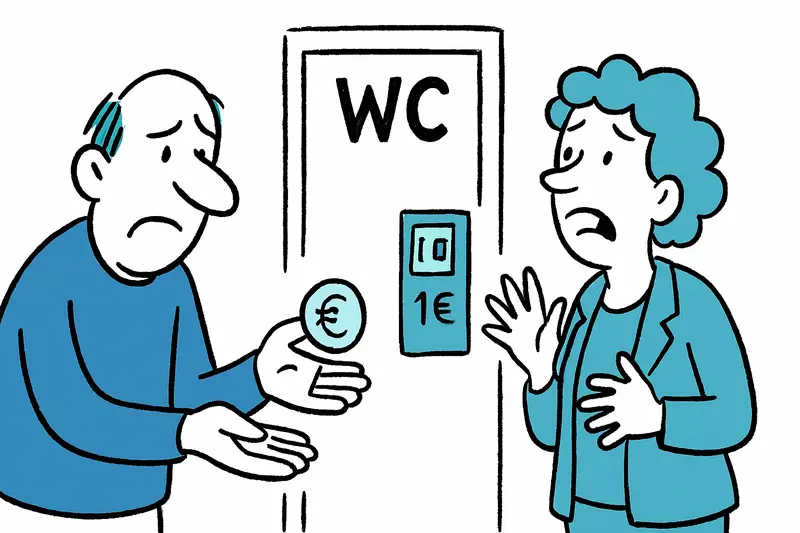
When a toilet visit at Mercat de l'Olivar suddenly costs €1 — who pays the price?
When a toilet visit at Mercat de l'Olivar suddenly costs €1 — who pays the price?
Since mid-May, using the WC at Mercat de l’Olivar costs €1 (card only). Shoppers receive a QR code at the market office. A practice that affects residents, older visitors and spontaneous market-goers. A reality check with proposed solutions.
When a toilet visit at Mercat de l’Olivar suddenly costs €1 — who pays the price?
Quick reality check on a small fee with big impact
On 13 May 2026 a new rule came into effect at Palma’s large market hall Mercat de l’Olivar: anyone who wants to use the toilets must pay €1 — contactless, by card. People who previously bought something or ate in the market can enter for free, but only with a QR code issued at the market office via a receipt. That is the bare fact; the consequences remain in the shadows.
Key question: Is this fee a necessary measure against vandalism and rising costs — or does it mainly affect those who already come to the weekly market on a tight budget, as wider analyses of local prices show When a Shopping Cart Makes a €1,500 Difference: Price Chaos in Palma's Supermarkets?
Mercat de l’Olivar is not only a tourist spot; in the mornings you can hear espresso machines on the corner of Carrer de la Unió, vendors calling out prices, and the air is a mix of fresh fish, fried camaiot and oranges. This everyday scene is being affected by the new rule. A pensioner who quickly buys bread and cheese, a parent with a child on the way to work, a construction worker with dirty hands — for many, public toilets are more than comfort, they are part of daily infrastructure.
From the market management’s point of view the fee may be an instrument: less misuse, revenue for cleaning and maintenance, maybe also a shift to cashless payments; such local charges sit alongside other proposed increases like EMT Plans Single-Ticket Increase: Who Will Pay the Bill in Palma?. But these justifications are not explicitly documented in the available facts. What is missing here is transparency about costs and the purpose of the payment. How high are the actual cleaning costs? Do the revenues flow back into the market or are they passed on to third parties? And why is free use tied to a QR code issued at the market office, which costs time and cannot be obtained directly at the stalls?
Another problem: payment method. Card-only payment excludes people who prefer cash or do not use a card — older residents, occasional visitors, people with limited access to banking services. In Pere Garau, where similar turnstiles now cost €0.50, residents have already grumbled, as detailed in Turnstiles at the Toilets: Palma's Market Halls Introduce Toilet Fees — Who Pays the Price?. Those without small change face a closed door — a new, small annoyance that quickly adds up.
What is missing from the public debate is the perspective of users and small market stalls. Vendors often give little change and must focus on sales; walking from a stall to the market office just to get a QR code is impractical. And: there is no clear rule for emergencies, for people with disabilities or for parents with small children. Are disability cards recognised? Does a medic on duty get access without paying? These details have not been answered so far.
A concrete everyday-scene thought: it is 11 a.m., it is raining briefly over Plaça de l’Olivar, the benches are full. A young father with a wet coat and a fussy toddler asks at a coffee stall for a cup of water and a receipt — the stall cannot issue a QR code, the walk to the office takes time, the child becomes restless. In the end he pays €1 at the cashier or gives up and leaves. Small frictions that change the market as a living place.
Practical and fair solutions:
1) QR issuance at the stalls: A simple stamp or QR function directly at stall checkouts, linked to purchases. This saves trips and creates acceptance.
2) Cash option and tiered pricing: Machines or turnstiles should accept coins as well. A reduced fee for residents or free passes for socially disadvantaged people are possible.
3) Transparency report: Public breakdown of how the revenues are used — cleaning, staff, repairs. That builds understanding.
4) Clear exceptions: Free access for people with disabilities, for emergencies, for children under a certain age. This must be clearly displayed at the entrance.
5) A small pilot with feedback: Test for three months, survey visitors, check the figures and adapt the measure. Markets live on the pulse of people — administration should listen.
In conclusion, a sober — slightly pointed — remark: a one-euro coin is not a moral compass, but a fee changes behaviour and space. If a market where the city’s life pulses makes hygiene a paid service, it is not a purely technical problem. It is about access, dignity and everyday usability. The operators should justify their decision openly and cushion the hardships with small, practical steps. Otherwise the lively Mercat de l’Olivar risks becoming a place you think twice before entering — and that would be a loss for Palma.
Frequently asked questions
Why do you have to pay for the toilets at Mercat de l'Olivar in Palma?
Can you use the toilets at Mercat de l'Olivar for free if you buy something?
Do you need a card to pay for the toilets at Mercat de l'Olivar?
Is Mercat de l'Olivar still worth visiting after the toilet fee?
What should you know before going to Mercat de l'Olivar with children?
Are there exceptions for disabled visitors at Mercat de l'Olivar toilets?
Has a similar toilet payment system been introduced elsewhere in Palma?
What would make the Mercat de l'Olivar toilet system fairer?
Similar News
Magaluf: Watchtower Alarm – Lifeguards Pull Unconscious Beachgoer from the Water
After a drama in the late afternoon, two lifeguards at Magaluf beach rescued an unconscious 44-year-old man. He was stab...
Turquoise in the City: How dangerous is the color play of the Sa Riera?
The Sa Riera in Palma suddenly turned turquoise — a pretty motif, but behind the effect lies a discharge of saline waste...

Jeckliner at Sunnesching: Cologne spirit sets sail from Palma
In September 2027 the Mein Schiff 2 briefly becomes a floating carnival stage: four days with Cologne bands, comedy and ...
Finally Home: Mike and Leyla Heiter Buy Villa with Sea View in Mallorca
The reality TV couple Mike and Leyla Heiter have bought a house in Mallorca with a roof terrace and sea view. An Instagr...
Arrest after series in Palma: Who protects apartments from repeat offenders?
The National Police arrested a man in Palma who investigators say may have broken into several apartments. In one incide...
More to explore
Discover more interesting content

Can Cap de Bou

Townhouse Lleo 72
