
Acute Parking Shortage in Son Castelló: When Companies Block Public Parking Spaces
Acute Parking Shortage in Son Castelló: When Companies Block Public Parking Spaces
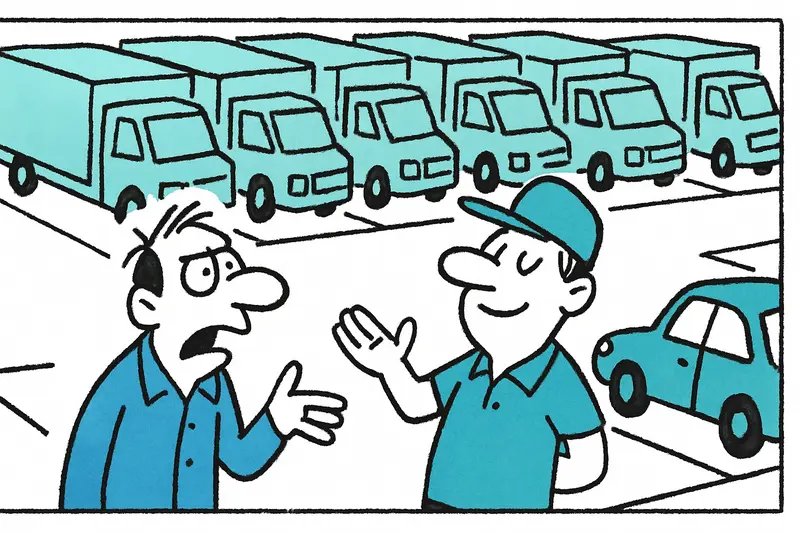
In the Son Castelló industrial zone 14 companies report: One car dealership occupies up to 70 percent of the public parking spaces. Employees circle, arrive late or risk fines.
Acute Parking Shortage in Son Castelló: When Companies Block Public Parking Spaces
Key question: Can a single company claim almost the entire municipal parking lot for itself – and if so, who intervenes?
When you drive through the Polígono Son Castelló in the morning, the first things you hear are the rumble of trucks, the clatter of pallets and the beeping of reversing vans. In between, employees do laps with a hand on the horn and furrowed brows: they often only find a free parking space after twenty or thirty minutes. This everyday scene is not imagined: 14 local companies have observed that more than 56 parking spaces in the nearby public lot are constantly occupied by vehicles belonging to a car dealership – at peak times apparently up to 70 percent. Local reporting has also covered related disruptions in the area, for example Vehicle inspection in Son Castelló closed for three months – who bears the gap?.
The result is familiar and annoying: employees arrive late, have to leave earlier to even have a chance of finding a spot, or park riskily in driveways and zones that lead to fines. The local police have already sanctioned wrongly parked cars, especially where access ways are blocked or two parking spaces are used at once. But that does not solve the structural problem.
Critical analysis: This is a conflict on several levels. First: public space versus private use. When a commercial operation effectively uses several dozen public parking spaces permanently, it reduces the freedom of movement for other businesses and their employees. Second: enforcement and controls. Individual warnings for incorrectly parked vehicles make sense in the short term but do not lead to a general reorganization of space usage. Third: planning responsibility. Industrial zones were originally planned with an expected traffic and parking demand; a temporary bottleneck can result from changes in company sizes, vehicle fleets or a lack of private parking areas.
What has been missing so far in the public debate is the perspective of land use and the question of long-term rules. There is much talk about fines, less about preventive solutions such as mandatory employee parking for large commercial tenants, regulated loading zones for car dealers, or the introduction of simple parking-management systems, and similar signage or display failures have caused confusion elsewhere, notably False readings in Port de Sóller: When the parking sign paralyzes harbor life. The social dimension also often remains invisible: for many workers, the availability of parking determines whether they are punctual and whether their job is even viable from an organizational point of view.
Concrete proposals from everyday practice: 1) A short-term inventory by the municipality: count how many spaces are permanently used by commercial fleets. 2) Clearer signage and time limits on public areas, complemented by targeted enforcement – not just fines on individual cars, but consistent towing rules for long-term parking in sensitive areas. 3) For larger companies: conditions for business expansions that require proof of employee parking or that make municipal parking permits paid and limited. 4) Promotion of car-pooling and shuttle buses for shift changes in Son Castelló; this reduces parking pressure and is often cheaper than more asphalt. 5) Encourage private solutions: negotiations between neighboring companies and the car dealership about specifically reserved areas or time-coordinated parking.
A quick emergency tip: mobile markings or temporary bollards at critical access points prevent sales units from spreading across the area. In the medium to long term, however, rules are needed that reconcile private fleet use with public interests.
Conclusion: Son Castelló is not an isolated case on Mallorca; other municipalities are also wrestling with parking strategies and capacity, as discussed in Sóller wants to tame the parking chaos: Three parking lots and 300 resident spaces — is that enough? When public parking spaces become storage areas for company vehicles, the economic mobility of whole business locations suffers – and in the end the people who go to work there every morning suffer. The balance between commercial needs and public rights can be achieved: with clear rules, better management and a little local consideration. Son Castelló needs pragmatic decisions now instead of individual parking tickets.
Frequently asked questions
Why is parking so difficult in Son Castelló, Mallorca?
Can companies in Mallorca use public parking spaces for their vehicles every day?
What can workers in Son Castelló do if they cannot find parking?
Are you likely to get fined for bad parking in Son Castelló?
What solutions could help with the parking problem in Son Castelló, Mallorca?
Why does parking in Mallorca business areas matter for workers?
Is Son Castelló the only place in Mallorca with parking trouble?
What can the municipality do to stop company vehicles from taking over public parking in Son Castelló?
Similar News

Are the Balearic Islands the Southern Border of Europe? A Reality Check on Immigration
The Balearic Islands are again calling for EU aid after a sharp rise in arrivals by sea. Conflicting priorities between ...

"Expensive chaos" and many open questions: What clients can do when a lawyer suddenly stops responding
Several clients complain that a well-known German lawyer in Mallorca has been unreachable for months. Key question: What...

TV tip: 'The Last Problem' — Mallorca as the setting of a classic crime
A classic whodunit on Mallorca: A new miniseries set in spring 1959 brings storm, an isolated hotel and a dense web of s...

Nipping Sea Creatures: Why Bathers in Cala Major and Elsewhere Should Be Cautious
In Cala Major, bathers have reported being nipped by small fish. What is behind it, how can problems be avoided — and wh...
Forced eviction in Santa Catalina: When a 65-year-old slept in her car and showered on the beach — a question of responsibility
The story of Pilar López from Santa Catalina represents a problem affecting many Mallorcans: How can an island with a bo...
More to explore
Discover more interesting content

Can Cap de Bou

Townhouse Lleo 72
