
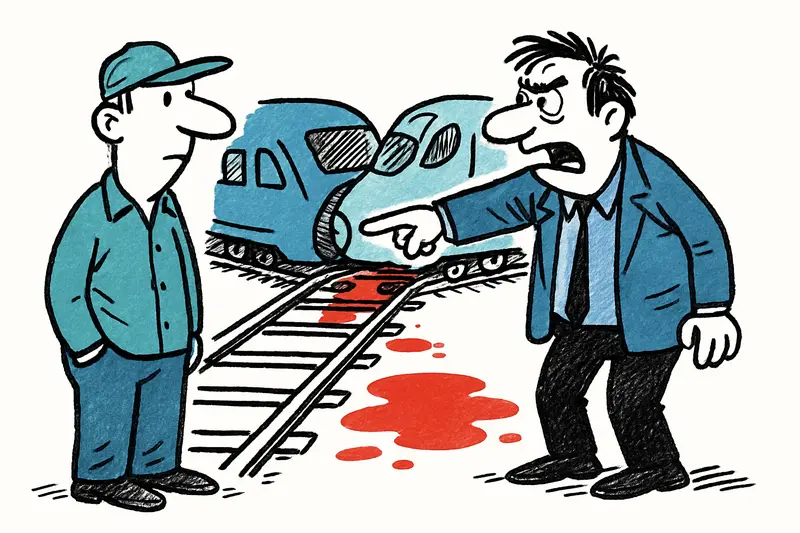
"Adamuz": Who bears responsibility for the blood on the tracks?
"Adamuz": Who bears responsibility for the blood on the tracks?
The train crash at Adamuz has plunged Spain into mourning. Three days of national mourning, dozens dead and injured — and many unanswered questions. A reality check: what do we know, what's missing from the public debate, and which measures should be taken now?
"Adamuz": Who bears responsibility for the blood on the tracks?
Key question: How could it happen that two high-speed trains collided on a newly renewed, straight section at over 200 km/h — and who wants or can be held accountable?
On Monday Spain was in an unusually quiet mourning. In many cafés in Palma, for example on the Passeig Mallorca, people turned on the news, spoke quietly with each other, and some walked on with their heads bowed. The government responded: three days of national mourning were declared, the prime minister travelled to the site of the accident and promised a "thorough clarification." Facts that are already emerging: the collision occurred near Adamuz (province of Córdoba) on Sunday evening; involved were an Iryo high-speed train and a Renfe-Alvia, both with hundreds of passengers and both apparently travelling at more than 200 km/h. At least 39 people died and over 150 were injured. Hundreds of emergency personnel, including the Military Emergency Unit, worked through the night.
These are the hard facts. But they do not answer the central question: Why could one train end up on the adjacent track and collide head-on with another, even though the line is said to have been recently renewed and modern safety systems are reportedly installed?
Critical analysis: technology, responsibilities, privatization
At first glance several levels intersect here: infrastructure (Adif), state operator (Renfe) and private providers (Iryo). The fact that the Iryo train was "nearly new" and had reportedly been inspected only days before makes a purely technical total failure of the vehicle less plausible — but not impossible. Likewise, the age of the line and allegedly modern safety technology mean that simple explanations like "broken rails" do not readily hold up.
This raises questions about system integration: Do signalling and protection systems work seamlessly across operator boundaries? Did traffic control centres, automatic protective devices and personnel cooperate correctly? Who monitors the interfaces between private and state operators? And how traceable are inspection reports and maintenance logs when several operators use the same infrastructure?
What's missing from the public debate
Current reporting understandably focuses on casualty numbers, identification and immediate aid. But two aspects receive too little attention: first, the technical foreseeability of such accidents — are there weaknesses in the interoperability concept, in older control software or in staff routines? Second, the question of governance: what role does the recent opening of long-distance services to private operators play in risk distribution? Similar concerns were raised after another nighttime collision in Alcúdia, as reported in Fatal accident in Alcúdia: Who is responsible — and what needs to change?. Discussions about "privatization" often degenerate into buzzwords; the issue is concretely about interfaces, responsibilities and binding inspection processes.
Everyday scene in Mallorca
On Plaça Cort in Palma neighbours gathered on Monday, listened to the radio and shook their heads. A metro cashier told me she had cried after her shift — not only out of sympathy, but because every train accident on the island awakens memories: of past collisions, of lost commuters, of overstretched rescue services, and of incidents such as Accidente mortal en Alcúdia: ¿Quién asume la responsabilidad y qué debe cambiar?. The conversations sounded like a plea: more clarity, less political noise.
Concrete proposed measures
Now it is not just words that are needed, but measures that show quick effect and can later be followed by systematic changes. Proposals that should be discussed immediately on the island and elsewhere:
1) Immediate, transparent data analysis: Event recorders (black boxes), signal logs and track logbooks must be made available to investigators without delay. Publishing inspection reports in anonymised form would build trust.
2) Temporary protective measures: Until clarification, speed limits should apply on affected sections and additional technical protection layers should be activated to prevent track changes at high speeds.
3) Interface audit between operators: Independent checks of the interoperability of train protection systems, including stress tests under realistic fault scenarios.
4) Strengthening investigative resources: The Commission for Railway Accidents (CIAF) needs personnel and technical reinforcement so it can work truly "independently and quickly" — including interim results made available to relatives.
5) Emergency support for relatives: Standardised contact points with medical, psychological and legal support — logistically prepared in regional centres (such as Córdoba, Seville, Madrid) and coordinated uniformly.
A particularly painful point
Identification of victims by DNA is cruelly necessary but also shows how poorly some structures are prepared for mass fatalities. Forensic experts worked around the clock; such images are hard to forget. Relatives need continuous, binding information channels — and not only in the first hours.
The criminal investigation in Montoro and the CIAF investigation are the right steps. But legal proceedings are slow; technical changes need budget, time and political will. Both must run in parallel now, not one after the other.
Concise conclusion
Adamuz is more than a tragedy: it is a stress test for a system made up of different parts — state infrastructure, private operators, technical safeguards and human actors. It is not enough to call for unity in mourning. Reasonable answers require rapid transparency, independent reviews of operational processes and clear, short-term protective measures. On Mallorca, at the coffee table or in shift briefings, people keep asking: Who will take responsibility — and how do we prevent this from happening again?
Frequently asked questions
What is known about the Adamuz train accident in Spain?
Why are train accidents like Adamuz still possible on modern railway lines?
Who is responsible when a train crash involves both public and private operators in Spain?
What do investigators check after a serious train collision in Spain?
How did people in Mallorca react to the Adamuz train tragedy?
Are there lessons for Mallorca from the Adamuz rail accident?
What should relatives expect after a major rail disaster like Adamuz?
Should train passengers in Mallorca worry about rail safety after the Adamuz crash?
Similar News
More water than last year: Mallorca's reservoirs breathe easier
September rain refilled the Tramuntana's reserves: overall fill around 35 percent, Cúber at 40.42 percent, Gorg Blau at ...
Three Luxury Hotels in Banyalbufar: Lots of Money, Many Questions
A Danish investor plans three exclusive accommodations in Banyalbufar — including the historic Son Valentí. The announce...
2.1 tonnes of cocaine on sailing yacht off Spain's coast – a reality check for the coastguard
A 14-metre yacht was seized with 2.1 tonnes of cocaine. Who monitors the ports, how does the international hunt succeed ...
Heat Bonus in Mallorca: 100 Euros Extra for Outdoor Staff at MarSenses
MarSenses pays employees who worked outdoors in August an extra €100 as recognition. Lighter uniforms, reduced hours for...
Renovating in Mallorca: What You Really Can Do Without Neighbour Consent
Many think they can do whatever they want in their apartment. That's partly true — but only as long as structural elemen...
More to explore
Discover more interesting content

Can Cap de Bou

Townhouse Lleo 72
