
Hidden Air-Raid Shelter beneath Palma Schoolyard to Become Part of Lessons
Hidden Air-Raid Shelter beneath Palma Schoolyard to Become Part of Lessons
During expansion work at IES Ses Estacions near Plaça d'Espanya, workers came across a well-preserved air-raid shelter from the Spanish Civil War. The city secured the access, and the tunnel will be used to make history lessons more tangible.
Hidden Air-Raid Shelter beneath Palma Schoolyard to Become Part of Lessons
Discovery during construction at IES Ses Estacions: Tunnel complex to give students a tangible sense of history
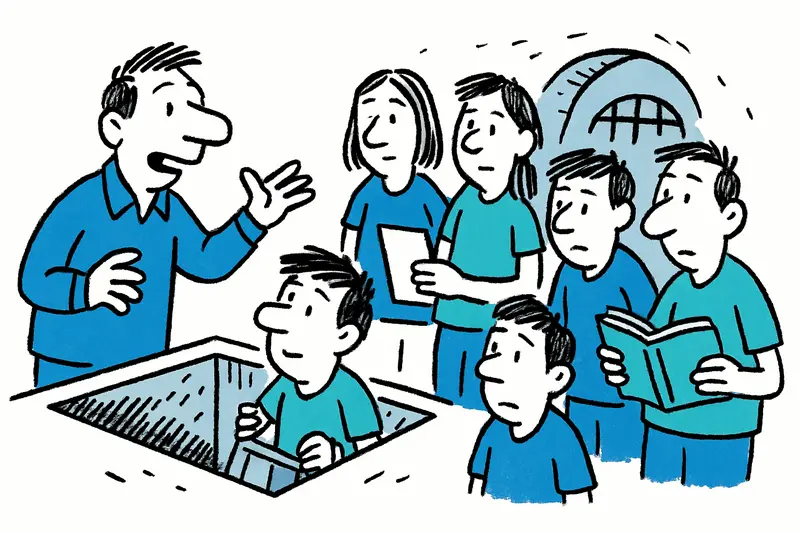
On a frosty morning earlier this year — the display on the Paseo then showed just under 8 °C — during earthworks at IES Ses Estacions near Plaça d'Espanya a machine's wheel got stuck in a depression. What began as a small problem for the site manager quickly developed into a discovery with the power to evoke the past: workers found an entrance to an underground shelter from the time of the Spanish Civil War.
Juan José García, who is overseeing the expansion work, describes how the discovery came about: while exposing the foundation the team came across an opening that had apparently been built over or buried before. Instead of covering it up, the workers stopped — a decision that will now benefit many students.
The facility lies in places up to 14 meters below ground level and is in remarkably good condition. Niches are visible in the stone walls, probably for lanterns or candles. Remnants of old electrical wiring hang from the ceiling. A flight of stairs leads to a deeper section that is separated from the upper corridor by a rusty grille. Historians on site interpret this as an indication that the shelter was connected to military areas in the vicinity, a concern mirrored by Madrid plans a semi-underground munitions bunker near Palma Airport.
A concrete pillar installed during the school's construction in the 1990s breached a tunnel wall; nevertheless the underground area remained unnoticed for decades. In the current works planners had to rearrange the foundations so that the historical structure would be preserved. The institute's extension, which began in February and provides additional rooms for vocational education, has a budget of around 2.8 million euros and, according to the city, is to be completed in March.
The school administration spent about 15,000 euros on the initial securing and access protection of the bunker. On Tuesday the Balearic education minister was also on site to get an impression. The plan is to integrate the underground tunnel system as a demonstrative object in history lessons: instead of long lectures, pupils will descend into the space themselves and gain a direct impression of 1930s protective structures, a hands-on approach reflected in reporting on When the Schoolyard Becomes More Colorful: Schools in the Balearic Islands Between a Culture of Welcome and Everyday Stress.
In Palma such relics are not an exotic rarity; the city has layers of history beneath its paving stones. Still, it is surprising how well preserved this bunker appears: the cold in its walls feels different from the cool December air above the plaza, and it does not smell of chestnut stands or Christmas lights but of damp stone and old times.
For residents of the adjacent Carrer de Ses Estacions the project means not only a construction delay but also an unexpected gain: a piece of local history that remains visible. Teachers see it as an opportunity to make historical processes more concrete for young people. Parents occasionally question the costs but want the visits to be safe and well prepared.
What remains is the reminder of how closely everyday life and history lie together: an excavator wheel that got stuck in December at the square is enough to reopen a forgotten door. For the students of IES Ses Estacions this could mean fewer dry facts and more a personal passage into the past — right in the centre of Palma.
Outlook: In the coming months, guided-visit concepts and safety precautions will be developed. Anyone strolling across Plaça d'Espanya hears the constant rush of the city; underfoot there will soon be a place where history is not only taught but experienced.
Frequently asked questions
Why is there an air-raid shelter under a schoolyard in Palma?
How well preserved are the underground shelters found in Palma?
Will the Palma air-raid shelter be open to students?
What should you know about air-raid shelters in Palma's city centre?
Why did construction at IES Ses Estacions in Palma stop after the discovery?
Can visitors see the air-raid shelter near Plaça d'Espanya in Palma?
What was found inside the hidden shelter under the Palma school?
How much did it cost to secure the shelter found in Palma?
Similar News
Injured captain, big plans: Germania Mallorca before the away match in Consell
The newly founded FC Germania Mallorca travels to Consell on Saturday. Captain Bastian Müller is out injured, but coach ...
Palma, Palma de Mallorca, Palma‑Mallorca: What is it really about?
The debate over the city's name is more than grammar: it concerns identity, law and branding policy. A sober reality che...

Warning to Bathers: Nipping Fish in Cala Major and Other Coves — a Reality Check
In Cala Major and several beaches around Mallorca, bathers report painful “nips”. Who are the animals, why are they gett...

Rental Car Theft in El Arenal: What This Incident Reveals About Our Gaps
A teenager steals a running rental car in El Arenal, flees on foot, climbs over walls and is caught by the Guardia Civil...

Red Rope in Palma's Library: What Helps Against Selfie Tourism — and What's Missing
Palma's city library cordoned off an area with a red rope to keep selfie tourism away from reading and working activitie...
More to explore
Discover more interesting content

Can Cap de Bou

Townhouse Lleo 72
